


Signing the representation agreement is the moment the process shifts. Before that point, you were managing everything alone — fielding adjuster calls, tracking medical appointments, trying to figure out what your rights are. After that point, you’re not alone anymore.
What happens after you hire a personal injury lawyer in Nevada is a sequence of distinct stages, each with a clear purpose. Knowing what those stages look like — and what your role is at each one — removes the uncertainty that makes the waiting harder than it needs to be.
Here’s the full picture, from the first day of representation through the moment money reaches your hands.

Day One: The Insurance Company Hears From Your Attorney
All Communication Transfers Immediately
The first thing that changes after you hire a personal injury lawyer is who the insurance company talks to. A representation letter goes out to all relevant insurers — the at-fault driver’s carrier, your own insurance company if applicable, and any other parties with potential coverage exposure.
From that point forward, adjusters are legally required to communicate through your attorney. Direct calls to you should stop. If an adjuster contacts you directly after representation has been established, you tell them your attorney handles all communications and end the call. You don’t answer questions, provide updates, or discuss the case.
This single change removes the most significant source of early claim damage. Adjusters are trained negotiators running a process designed to minimize payouts. Every unscripted conversation with an unrepresented claimant is an opportunity to gather information that works against them. That opportunity disappears the moment your attorney is in the picture. Our post on why you shouldn’t talk to the insurance company without a lawyer covers exactly what those early conversations are designed to accomplish.
Evidence Preservation Begins Right Away
Time-sensitive evidence gets addressed immediately. Preservation letters go to businesses, government agencies, and other parties who may have surveillance footage relevant to your accident. Medical records are formally requested. The police report is obtained if you don’t already have it.
Skid marks fade. Footage gets overwritten. Witnesses become harder to reach. The sooner preservation starts, the stronger the evidentiary foundation of your claim. Waiting weeks or months to retain representation often means losing documentation that can’t be recovered.
The Investigation Phase: Building Your Case
Your Attorney Constructs the Full Picture
With communication handled and preservation underway, the formal investigation begins. This involves collecting all available evidence: medical records, billing statements, the complete police report, photographs, witness statements, traffic and surveillance data, and in more complex cases, expert analysis or accident reconstruction.
The investigation also examines insurance coverage in depth. Nevada’s minimum auto insurance requirements are relatively low. Many drivers carry only the minimums — or nothing at all. Your attorney identifies every potential source of recovery: the at-fault driver’s policy, your own uninsured and underinsured motorist coverage, commercial policies if a business was involved, and any other applicable coverage.
Understanding the full insurance picture early determines the realistic ceiling of what your case can recover — and shapes the strategy for getting there.
What You’re Doing During Investigation
Your job during this phase is to focus on your medical treatment and stay in communication with your legal team. Attend every appointment. Follow your treatment plan. Keep records of how your symptoms are progressing and how your injury is affecting daily life.
Document the non-economic impact of your injury in real time — pain levels, sleep disruption, activities you can’t do, emotional toll. That running record supports the pain and suffering component of your claim, which is legitimate and recoverable under Nevada law but requires documentation to substantiate.
If anything changes — new symptoms, new providers, missed work, changes in your condition — tell your attorney. Your legal team can only account for what they know about.
Medical Treatment and Maximum Medical Improvement
Keep Treating — Your Health and Your Claim Depend on It
Hiring a lawyer doesn’t pause your medical care. Treatment continues throughout the entire legal process. Your attorney needs your medical picture to be as complete and well-documented as possible before moving into serious negotiations.
The milestone your attorney is working toward is called maximum medical improvement — the point at which your condition has stabilized and your medical team has done everything currently possible. Reaching MMI doesn’t mean you’re fully healed. It means your injuries have progressed as far as they’re going to for now, and the total cost of your care can be accurately assessed.
Settling before MMI means settling before your future medical costs are known. That’s one of the primary reasons insurance companies push hard for early resolution — and one of the primary reasons your attorney advises patience during this phase. Our post on why insurance companies make quick settlement offers explains the financial logic behind that pressure in detail.
How Medical Bills Get Handled
Medical bills accumulate during treatment. Providers may place liens on your case — meaning they agree to defer payment until your claim resolves, with the understanding that their bills get paid from the settlement proceeds. Your attorney tracks these liens, negotiates their amounts where possible, and manages the disbursement process at the end.
You are not expected to pay medical bills out of pocket while your case is pending if lien arrangements are in place. Your attorney coordinates with providers to establish those arrangements as part of managing the overall claim.
The Demand Package: Making the First Move
Your Attorney Calculates the Full Value of Your Claim
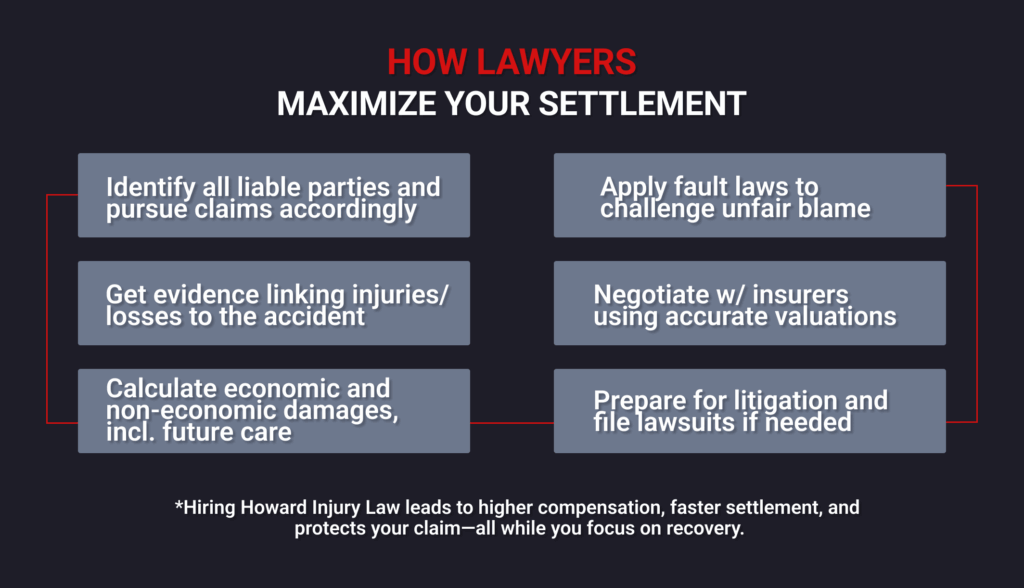
Once you’ve reached MMI and your medical records are complete, your attorney compiles a demand package. This is a comprehensive document presenting the full value of your claim — every medical bill, future treatment projection, lost wages, reduced earning capacity, property damage, and a carefully calculated figure for pain and suffering and other non-economic damages.
The demand is sent to the insurance company with a requested settlement amount that reflects what your case is actually worth. That number is not a starting point for a race to the middle. It’s a documented, evidence-supported position — and a signal that your attorney knows exactly what the claim involves.
Negotiations: What to Expect
The insurer reviews the demand and responds — typically with a counteroffer below the requested amount. Your attorney evaluates their position against the evidence and responds accordingly. This exchange continues until both sides reach an acceptable number or talks break down.
The negotiation dynamic looks different when an attorney on your side is genuinely prepared to litigate. Insurance companies track which attorneys settle everything without fighting and which ones take cases to trial. Glen Howard’s background on the insurance defense side means he understands exactly how adjusters evaluate risk — and that knowledge affects what they put on the table.
Most personal injury cases in Nevada resolve during this negotiation phase. A trial is never guaranteed, but the credible threat of one often produces a fair result without ever needing a courtroom.
If Negotiations Fail: Litigation
Filing a Lawsuit Doesn’t Mean Going to Trial
If the insurance company’s best offer doesn’t reflect the actual value of your claim, your attorney files a lawsuit. Filing doesn’t mean the case is heading to trial — the majority of cases that enter litigation still settle before a jury hears them. What filing accomplishes is escalating the process and making clear that your attorney is prepared to go the distance.
Once filed, the case enters discovery — the formal evidence exchange phase. Both sides request documents, conduct depositions, and surface information that informs the strength of each position. Depositions are recorded interviews under oath. Your attorney prepares you thoroughly before any deposition takes place.
After discovery, many cases settle during mediation — a structured negotiation with a neutral third party. Cases that don’t settle in mediation proceed toward trial. The full litigation process can take anywhere from several months to over a year depending on court scheduling, case complexity, and the opposing party’s willingness to negotiate.
Settlement: What Happens When a Number Is Agreed On
You Make the Final Decision
When negotiations produce an acceptable offer, your attorney presents it to you with a clear explanation of what it covers. The decision to accept belongs to you — not your attorney. Glen Howard presents the offer, explains what it accounts for and what signing means, and gives you his honest recommendation. You decide.
Once you agree, a release of liability is signed and the claim is formally closed. The insurer issues payment — typically within a few weeks of the signed release.
How Disbursement Works
Settlement funds don’t arrive in your account the day the check clears. The payment goes to your attorney’s trust account first. From there, several items are handled before your portion is distributed.
Medical liens are paid from the settlement proceeds. Your attorney negotiates lien amounts where possible — providers often accept less than the full billed amount in lien resolution. Attorney fees per the contingency agreement are deducted. Case expenses are accounted for. The remainder is disbursed to you.
Your attorney provides a detailed disbursement statement showing exactly what was received, what was deducted, and what you’re getting. Nothing happens without your review and understanding of the numbers.
How Long Does All of This Take?
The Honest Answer Depends on Your Case
Straightforward claims with clear liability, cooperative insurers, and complete medical documentation can resolve within a few months of reaching MMI. Complex cases involving serious injuries, disputed fault, multiple parties, or litigation take longer — often a year or more from the date of the accident.
Nevada’s statute of limitations gives most personal injury victims two years from the accident date to file a lawsuit. Your attorney monitors that deadline regardless of where negotiations stand and ensures your legal options stay intact throughout the process.
The timeline isn’t entirely within anyone’s control. What is within your attorney’s control is how aggressively the claim is pushed, how quickly documentation is compiled, and how effectively pressure is applied when the insurer stalls. Understanding what each stage involves makes the overall timeline feel manageable rather than uncertain.

Frequently Asked Questions
Can I still see my doctor after hiring a lawyer?
Yes — and you should. Medical treatment continues throughout the entire legal process. Your attorney needs your treatment to be complete and well-documented before finalizing negotiations. Stopping treatment prematurely or creating gaps in your care gives the insurance company ammunition to argue your injuries resolved or weren’t serious.
Will my lawyer talk to me regularly, or will I hear nothing for months?
That depends entirely on the firm. At Howard Injury Law, Glen Howard stays directly involved in your case and keeps you informed at each stage. You’re not passed off to case managers you’ve never met. If something significant happens — an offer arrives, a deadline approaches, a new development emerges — you hear about it directly.
What if the insurance company contacts me directly after I’ve hired a lawyer?
Tell them your attorney handles all communications and end the call. Do not answer questions, provide updates, or engage beyond that statement. Contact your attorney immediately and let them know the insurer reached out directly. That contact is improper once representation is established.
How do I know if a settlement offer is fair?
Your attorney evaluates every offer against the documented value of your claim — medical costs, future treatment, lost wages, earning capacity, and non-economic damages. Glen Howard presents offers with a clear explanation of what they include, what they exclude, and whether the number reflects the full picture of your damages. For more context on what drives case value, our post on how to know if your injury case is worth pursuing walks through the four key factors attorneys use to assess a claim.
From Signing to Settlement — You’re Not Doing This Alone Anymore
The moment you retain representation, the dynamic of your claim changes. Evidence gets preserved. Communication gets managed. Deadlines get tracked. The insurance company negotiates with someone who knows their process from the inside — not with someone navigating it for the first time under stress.
Your role is simpler than you might expect. Focus on treatment. Keep your attorney informed. Make decisions when they’re presented to you.
Everything else is handled.
If you haven’t retained representation yet — or you’re still deciding whether to — start with a free case review at Howard Injury Law. Glen Howard is available 24/7, reviews every case personally, and gives you a straight answer about what pursuing your claim would actually involve.
Our post on what happens when you pursue a claim provides a parallel view of the process from the claims perspective — useful context for understanding how the legal and insurance timelines interact. And if you’re still on the fence about whether representation makes sense for your situation, our post on do I really need a lawyer or can I handle this myself gives you the honest breakdown.