

You were riding in an Uber on the Strip, another car blew the light, and now three insurance companies are each telling you the crash isn’t their problem. If you’re trying to figure out who pays after a rideshare accident in Las Vegas, start with this: that stonewall is a strategy, not the final answer. Which policy actually owes you money is a knowable thing — it comes down to two questions, and once you can answer them, the finger-pointing loses most of its power.
Read here for the full mechanics of how a Las Vegas rideshare and taxi accident claim gets built, and we’ll help you understand your own situation well enough to stop feeling powerless.
Fault and coverage are two different questions — insurers blur them on purpose
Most people ask “whose fault was it?” and assume the answer tells them who pays. In a rideshare crash, that’s not how it works, and the gap between the two is where adjusters go to work.
Nevada is an at-fault state, so the party who caused the crash is responsible for the damage. That’s the fault question. But which insurance policy actually covers that damage is a separate question — and in an Uber, Lyft, or taxi crash, the answer can swing by hundreds of thousands of dollars depending on one detail that has nothing to do with who was careless. Keep the two questions apart, and the adjusters’ script gets a lot easier to read.
The detail that decides which policy applies: the driver’s app status
Here’s the pivot the whole case turns on. A rideshare driver moves through different insurance phases depending on what their app was doing at the exact moment of impact:
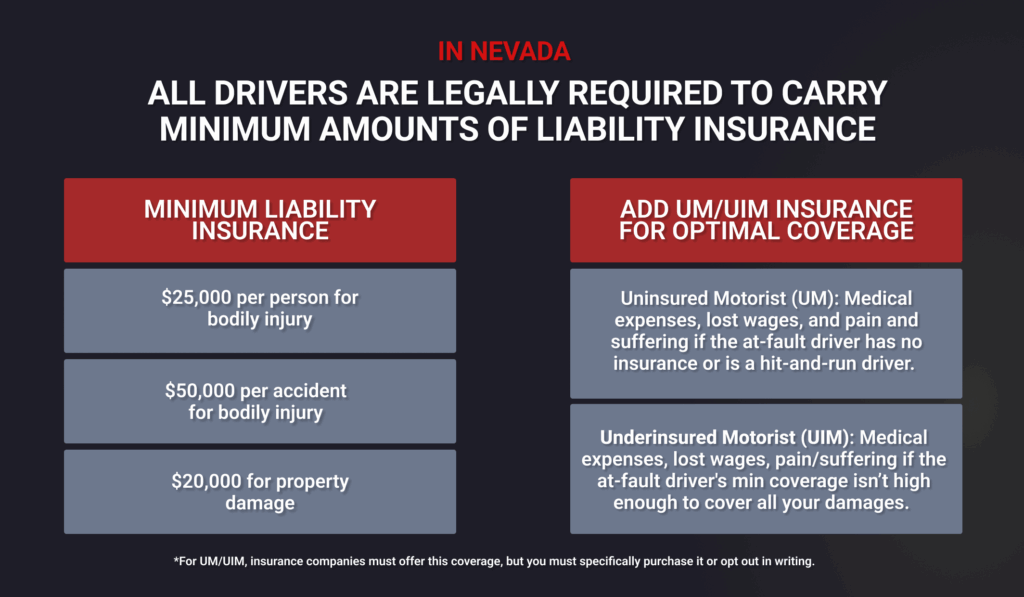
- App off. The driver was off the clock. Only their personal auto policy applies — Nevada’s minimums are just 25/50/20 under NRS 485.185, and Uber or Lyft owes nothing.
- App on, waiting for a request. A limited amount of company contingent coverage kicks in — thinner than most people expect.
- Ride accepted or passenger aboard. This is the high-coverage phase. Uber and Lyft carry commercial liability of up to $1 million per incident during an active trip.
That’s the short version. The full tier-by-tier breakdown — and the reason the driver’s own insurer almost always denies during the app-on phases — is mapped out on our page explaining how Uber and Lyft coverage works by app status. The takeaway for you: the app status the insurer asserts is not the final word. Trip logs, GPS timestamps, and session records can confirm or contradict it, and that data decides which policy is on the hook.
So who actually pays after a rideshare crash? Walk your situation, not a list
Instead of memorizing every party who could be liable, find the branch that matches your crash.
The rideshare driver caused it
If your Uber or Lyft driver was speeding, fatigued, or working the app instead of watching the road, they’re personally at fault. But their personal auto policy almost always excludes commercial driving — so recovery usually runs through the company coverage tied to their app status, not their own insurer. A distracted rideshare driver is one of the most common versions of this, and the driver-monitoring data inside Uber’s and Lyft’s own apps can prove it.
Another driver hit you
If a third-party motorist caused the crash while you were riding, your claim runs against that driver’s liability insurance first. And if they’re uninsured or don’t carry enough, you’re not stuck — see the backstop below.
Something on the car or the road failed
If a mechanical failure or a defective auto part — bad brakes, a blown tire — caused the wreck, the manufacturer or a maintenance provider can share fault. If a broken signal or a dangerous road contributed, a government entity may be partly responsible. Government claims are possible but hard: Nevada shields many public design decisions from liability, caps what you can recover, and imposes a separate, strict notice deadline that’s easy to miss. If a public vehicle or road hazard is in your case, talk to a Nevada attorney fast.
A robotaxi was involved
Las Vegas is a testing ground for driverless vehicles, and a crash with a Zoox or other self-driving vehicle follows a different liability framework — pointing toward the manufacturer, the fleet operator, and the systems controlling the car rather than a human driver. That area of the law is still being written, which is exactly why these claims need a lawyer who tracks it.
“Can I sue Uber or Lyft directly?”
This is where a lot of outdated advice online will steer you wrong. Nevada’s Assembly Bill 523, effective October 1, 2025, reshaped how rideshare liability works.
Two things you need to know. First, the required active-trip coverage was set at $1 million per incident — if you’re reading older articles that cite $1.5 million, they’re out of date. Second, the platform is now generally not vicariously liable for a driver’s conduct when that $1 million policy is in place. Uber and Lyft treat their drivers as independent contractors, and the law now backs that up.
That sounds discouraging, but read it carefully — it doesn’t mean no one pays. The $1 million active-trip policy still applies. The company can still be pursued for its own negligence, such as keeping a driver with a known dangerous history on the road, where the facts support it. And the $1 million is not a ceiling on your total recovery — the at-fault driver’s insurance, uninsured/underinsured coverage, and a manufacturer’s liability can all stack on top. “You can’t sue Uber, so no one will pay” is a half-truth designed to make you give up.
The backstop when the at-fault party can’t pay
Here’s the piece that answers “three insurers are pointing at each other and no one will pay me.” Nevada doesn’t require Uber or Lyft to carry uninsured/underinsured motorist coverage — but the major platforms generally do provide UM/UIM protection for passengers during a trip. Your own auto policy’s UM/UIM can also step in. When the driver who caused your crash has no insurance or not enough, that coverage is often what actually pays your bills. A rideshare accident lawyer’s job is to find every one of these layers, not just the first one that denies you.
What NOT to tell the insurance company after a rideshare crash
While you’re sorting out who pays, the insurers are already working to pay less. A few moves protect your claim:
- Don’t give a recorded statement. Report the crash, but get legal advice before you describe it to any adjuster. Anything you say gets used to shrink the claim.
- Don’t say “I’m fine.” Rideshare injuries often surface days later. A cheerful “I feel okay” at the scene becomes the insurer’s proof that you weren’t hurt.
- Don’t accept their version of the app status. If an adjuster tells you the driver’s app was in a lower-coverage phase, treat that as a claim to be verified against the trip data — not a fact.
- Don’t take the first offer. A fast, low settlement is designed to close your file before you know the full extent of your injuries. Sign the release and you give up the right to pursue more, permanently.
Every case is different, and general information isn’t a substitute for advice about your specific crash. But those four habits rarely hurt and often save a claim.
Frequently Asked Questions
What is considered a third party in a rideshare accident?
A third party is anyone other than you and the rideshare driver whose fault contributed to your crash — and who may owe you money. In a Las Vegas Uber or Lyft case, that can include another motorist who hit your vehicle, the manufacturer of a defective part, a maintenance company, or a government agency responsible for a broken signal or hazardous road. Identifying every third party early matters, because each one carries separate insurance and a separate legal argument. Miss one, and you may leave the coverage that actually pays your bills on the table. A rideshare accident attorney maps all of them before negotiating.
Can you sue Uber for an accident in Nevada?
Sometimes — but the answer changed in 2025. Under AB 523, if Uber’s required $1 million policy is in place, the company is generally not vicariously liable for its driver’s conduct, so you usually can’t hold Uber responsible simply because its driver caused the crash. You can still recover through that $1 million policy during an active trip, and you can pursue Uber directly for its own negligence where the facts support it. The bottom line: “you can’t sue Uber” doesn’t mean you can’t recover. It means the path to recovery runs through the right policies, which is worth confirming with a Nevada attorney.
What is the typical settlement for an Uber accident?
There’s no honest “average,” and anyone quoting a specific typical Uber settlement figure is guessing. Value depends on the severity of your injuries, which coverage tier applies at the moment of impact, your medical costs and future care, lost income, and how fault is divided. A minor soft-tissue claim and a spinal injury during an active $1 million-coverage trip are not in the same universe. Be cautious with any lawyer or website that promises a number before reviewing your case — a real estimate requires the facts. The more useful question is which policies apply to you and what your specific claim is worth.
What if the Uber driver’s app was off when we crashed?
If the app was genuinely off, the driver was off the clock, and only their personal auto policy applies — Uber and Lyft owe nothing in that phase. But here’s the catch: the insurer’s version of app status isn’t always accurate, and it isn’t the final word. Ride log records, GPS timestamps, and session data can confirm or contradict what the company claims. Before you accept that the app was off and walk away, have a rideshare accident attorney in Las Vegas pull the data. That one record can be the difference between a personal-policy minimum and real coverage.

Three insurers are arguing about your claim. We’ll end that.
Here’s what the adjusters won’t tell you: Glen Howard spent years as an insurance defense attorney before he started representing injured people. He built the finger-pointing playbook these carriers are running on you — which is exactly why he knows how to take it apart. Howard Injury Law pulls the trip data, pins the app status to the right period, and makes the correct insurer pay — on contingency, no fee unless we win.
If three companies are denying your Las Vegas rideshare claim, that standoff is our problem to solve, not yours. Get a free case review — it costs nothing to find out which policies owe you money and whether you have a case. Call (702) 331-5722 or start online, and don’t wait: Nevada gives you two years from the crash to file under NRS 11.190, and the ride-log evidence that proves your case can be purged within days. For more, see answers to common rideshare and taxi accident questions or our full Las Vegas motor vehicle accident hub.