

A garbage truck is the last vehicle most people expect to land them in an ER — until one reverses into your car on a quiet residential street or swings wide back onto its route and clips you. If that just happened to you in Las Vegas, two questions are probably running on a loop: who is actually responsible, and can you even sue if it was a “city” truck? Here’s what most people don’t know: in the Las Vegas valley, that garbage truck almost certainly belongs to a private company, not the city — and that usually makes your claim easier to pursue, not harder.
Below, we break down who you can sue after a garbage truck accident, how to tell a government truck from a private hauler, and the Nevada filing deadlines that actually apply. It’s the kind of case a Las Vegas truck accident lawyer sorts out quickly, but understanding the basics helps you protect yourself from day one.
First, who owns that garbage truck? (In Las Vegas, probably not the city)
This is the single most important question in your case, and the answer surprises people. Unlike New York or Chicago, where the city runs sanitation directly, garbage collection across the Las Vegas valley is handled by a private company under a franchise contract. Republic Services holds those exclusive franchise agreements with the City of Las Vegas, Clark County, North Las Vegas, Henderson, Laughlin, and Summerlin — some of them going back decades.
What that means for you is simple: if a residential garbage truck hit you anywhere from Spring Valley to Henderson, you are most likely dealing with a private corporation and its commercial insurance — not a government agency. The lone common exception is Boulder City, which still runs its own municipal fleet. A city or county could also be on the hook if the vehicle was a government-owned truck that isn’t the franchise hauler, like a public-works or street-maintenance vehicle.
You can usually tell which is which right at the scene:
- Company branding and logo. A Republic Services truck carries its own markings. A genuine city or county truck carries government markings.
- The USDOT number on the cab, which ties the truck to a registered carrier.
- Your municipality’s public-works or franchise page, which lists whether collection is contracted out or done in-house.
If you’re not sure, that’s fine — sorting out the correct defendant is exactly what your attorney does. But a single photo of the truck’s markings can settle the entire question later.
Why garbage truck crashes are their own kind of dangerous
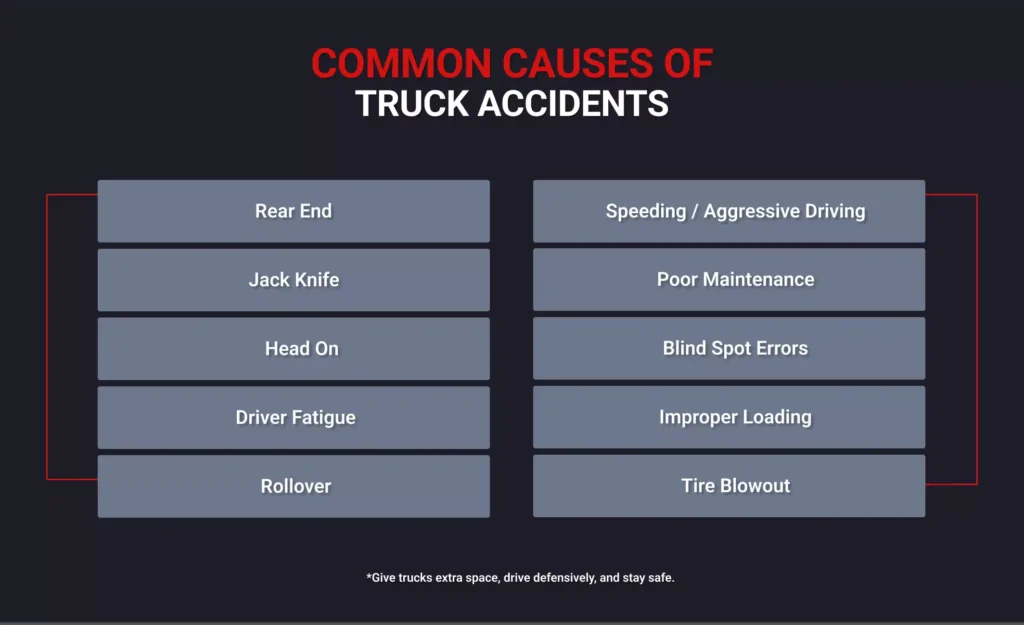
Refuse collection consistently ranks among the most dangerous jobs in the country, and the same hazards that injure workers injure the drivers and pedestrians sharing the road. A loaded garbage truck can weigh well over 30 tons, with enormous blind zones to the front, sides, and especially the rear.
Add the way these trucks operate — hundreds of stops a day, constant reversing on narrow residential streets, often in the low light of early-morning routes — and you get a vehicle that is uniquely hard to predict. National safety data attributes roughly a quarter of garbage truck injury crashes to backing accidents alone. The result is often serious: crushing injuries, spinal damage, or a traumatic brain injury from a low-speed impact you never saw coming. Some of the worst symptoms don’t even show up until days later, which is why medical follow-up matters even if you felt “okay” at the scene.
Who can you sue after a garbage truck accident?
More than one party is usually responsible in these cases, and identifying every one of them is where the value of your claim is won or lost. Potentially liable parties include:
- The driver, whose negligence — backing without checking, distraction, fatigue, or ignoring a warning device — is legally passed up to their employer.
- The hauling company (private or municipal), for that driver’s conduct and independently for poor hiring, inadequate training, skipped maintenance, or unsafe route and production pressure.
- The truck or equipment manufacturer, if a defect — a failed brake, a broken backup camera or alarm, a malfunctioning compactor — contributed to the crash.
- A government entity, but only if the truck was truly municipal, not a private franchise hauler.
Which of these applies decides not just who you sue, but how — because a private claim and a government claim run on very different rules.
Suing a private hauler (like Republic Services)
When a private company operates the route, the full framework of commercial truck negligence applies. The company answers for its driver’s negligence, and it carries substantial commercial insurance built to cover exactly this kind of loss. Just as importantly, a private-hauler claim is not subject to the damage cap that limits claims against the government — and in cases of egregious conduct, punitive damages may even be on the table.
The catch is that these companies defend claims aggressively and move fast to protect themselves. That’s where having a lawyer who has seen the other side matters. Howard Injury Law’s founder, Glen Howard, spent years as an insurance-defense attorney before switching to representing the injured, so he knows how commercial carriers value these claims, where they cut corners, and how to push back.
Suing the city or county (a true government truck)
If a genuine government vehicle caused the crash — a Boulder City sanitation truck or a city or county fleet vehicle — the claim shifts into Nevada’s Tort Claims Act. A few things change:
- You must file a written notice of claim with the governing body (the city or county) within two years of the accident under NRS 41.036.
- Total damages are capped at $200,000 per claimant under NRS 41.035, and punitive damages are barred against a government entity.
- Certain claims tied to road design or signal timing can run into government immunity, which is another reason to get a lawyer involved early.
One myth worth killing: you may have heard that suing the government requires a 90-day or 180-day notice. That’s not Nevada. Some states hide those short fuses, but Nevada gives you the full two-year window — and filing the notice isn’t even a strict prerequisite to your lawsuit. (If a federal vehicle like a postal truck is somehow involved, that’s a separate track under the Federal Tort Claims Act.)
How long do you have to file in Nevada?
For a standard injury claim against a private hauler, Nevada gives you two years from the date of the crash to file, under NRS 11.190(4)(e). Miss that deadline and the right to recover is generally gone, no matter how strong the case was. If a government entity is the defendant, you’re still looking at that same two-year window for your notice of claim.
Two years can feel like plenty of time, but the evidence that wins these cases disappears far faster. Route logs, the truck’s onboard data, and backup-camera or dash footage can be overwritten within days, and a truck can be repaired or put back in service before anyone thinks to preserve it. If weeks have already passed since your crash, that doesn’t mean you’re out of options — it means the clock on the evidence is what to worry about first. Every case is different, so the smartest move is to have an attorney confirm the exact deadlines that apply to yours.
What to do after a garbage truck accident in Las Vegas
A few steps protect your claim from the start:
- Photograph the truck’s markings and USDOT number. This is the fastest way to prove whether you’re dealing with a private hauler or the city — the fact your whole claim turns on.
- Get medical care, even if you feel fine. Serious garbage-truck injuries often surface a day or two later, and a gap in treatment gives the insurer an argument.
- Don’t give the hauler’s adjuster a recorded statement. Their rapid-response team may call within hours; you’re not required to give a recorded account, and what you say can be used to shrink your claim.
- Preserve everything. Photos, witness names, the police report number, and any communication from an insurer.
You can learn more about how these commercial trucks actually operate and where their blind zones are, which helps you understand how the crash likely happened.
Frequently Asked Questions
Can you sue if a garbage truck hits your car in Nevada?
Yes. If a garbage truck driver’s negligence caused your crash, you can pursue a claim against the driver and, in almost every case, their employer — the hauling company. You may also have a claim against a truck or parts manufacturer if a defect played a role. Nevada uses a modified comparative negligence rule, so you can recover as long as you were not more than 50% at fault, with your award reduced by your share. You generally have two years from the date of the accident to file. The bigger question is usually who the correct defendant is, which is why identifying whether the truck was private or government-owned matters so much.
Is the garbage truck in my Las Vegas neighborhood the city or a private company?
In almost all of the Las Vegas valley, it’s private. Republic Services holds the exclusive franchise for residential and commercial collection in the City of Las Vegas, Clark County, North Las Vegas, Henderson, Laughlin, and Summerlin. Las Vegas does not run sanitation directly the way some cities do. The main exception is Boulder City, which operates its own municipal fleet, and a city or county could still be involved if the vehicle was a government-owned truck rather than the franchise hauler. You can usually tell from the truck’s branding, its USDOT number, or your municipality’s public-works page — and a photo of the markings settles it.
How long do I have to file a garbage truck accident claim in Nevada?
Two years from the date of the crash for most personal injury claims, under NRS 11.190(4)(e). If a genuine government entity is the defendant, you still have two years to file your written notice of claim under NRS 41.036 — Nevada does not impose the short 90- or 180-day deadline some states do. That said, don’t treat two years as breathing room. The onboard data, route logs, and camera footage that prove fault can be overwritten within days, so the practical deadline for protecting evidence is much sooner. Every case carries its own facts, so confirm your specific deadlines with an attorney.
Is there a cap on what I can recover?
It depends entirely on who you’re suing. A claim against a private hauler like Republic Services is not subject to a statutory damage cap, and its commercial insurance is built to cover serious injuries; punitive damages may even be available in cases of extreme misconduct. A claim against a government entity is capped at $200,000 per claimant under NRS 41.035, and punitive damages are not allowed. This is the clearest reason why the private-versus-government question isn’t a technicality — it can change what your case is worth by a wide margin.

Talk to a Las Vegas truck accident lawyer who knows how the other side thinks
If a garbage truck hurt you, the two things standing between you and a fair recovery are naming the right defendant and moving before the evidence disappears. You don’t have to figure out the city-versus-private question on your own — that’s our job, and we start on it immediately.
Howard Injury Law has represented injured Nevadans for more than 20 years. Glen Howard personally handles every bodily injury case, and because he spent years defending insurance companies before switching sides, he knows exactly how their adjusters value and fight these claims. He’s a member of the Nevada Bar in state and federal courts, the Clark County Bar Association, and the Nevada Justice Association, and the firm has recovered millions against some of the largest insurers in the country.
The consultation is free, and you pay nothing unless we win. Request your free case review or contact our team at (702) 331-5722, and we’ll tell you honestly whether you have a claim worth pursuing — and who’s actually on the hook.