

A crash with a Prime van or a FedEx truck isn’t a normal fender-bender, and the first thing most people get wrong is who they’re actually up against. You were hit by a truck wearing a trillion-dollar company’s logo — but the driver may not work for that company at all, and that gap is exactly what their insurers use to pay you less. A Las Vegas delivery truck accident lawyer can cut through the corporate shell game and find every party who’s really on the hook.
Las Vegas runs on last-mile delivery. Amazon warehouses on the outskirts of the valley push vans into Spring Valley, Summerlin, and Henderson neighborhoods all day, while FedEx and other carriers thread the Strip’s loading zones, I-15, and the 215 Beltway under brutal time pressure. More trucks and tighter quotas mean more crashes — and more confusion about who pays when one of them hits you.
Here’s what you need to know to protect yourself, and why these cases are winnable even against a corporate giant.
Why a delivery truck crash isn’t a normal car accident
In an everyday car wreck, you deal with one driver and one insurance policy. A delivery crash usually has layers: the driver, the small company that actually employs them, the corporation whose brand is on the door, and several insurance policies stacked behind all of them.
That’s good news and bad news. The bad news is that the corporate side will move fast to point at the “little guy” contractor and wall itself off. The good news is that when you know where to look, there’s often far more insurance coverage available than in a typical crash — and multiple parties who can be held responsible.
This is where experience matters. Attorney Glen Howard built his career on the insurance-defense side before he started fighting for injured people. He knows the playbook these carriers run, because he used to run it — and that’s the difference between a claim that gets brushed aside and one that gets taken seriously.
What to do right after a delivery truck hits you in Las Vegas
The steps below matter in every crash, but a few of them are specific to delivery cases — because the evidence that proves who really employs the driver disappears within days.
- Call 911 and get a police report. An official Las Vegas Metropolitan Police Department report creates a neutral record of the scene. Stick to facts; don’t guess at fault or apologize.
- Photograph the branding — all of it. Get the company logo, the license plate, and any USDOT number on the van or truck. Snap the delivery uniform, the packages, and the vehicle from several angles. That branding can be the thread that ties a giant corporation to your crash.
- Get the driver’s employer, not just their name. Ask who they actually work for — the delivery company (often a separate business), plus the driver’s own name, phone, and insurance. “Amazon” or “FedEx” on the door doesn’t tell you who signs their paycheck.
- See a doctor immediately, even if you feel okay. Adrenaline hides neck, back, and head injuries, and some don’t surface for days. Prompt treatment protects your health and your claim.
- Don’t give the delivery company’s insurer a recorded statement. You are not required to, and it almost always helps them, not you. Talk to a lawyer first — here’s why a recorded statement can hurt your claim.
Who is actually liable when an Amazon or FedEx driver causes a crash?
This is the heart of a delivery case. The answer isn’t “Amazon” or “FedEx” by default — it depends on how the driver was working at the moment of the crash.
Amazon’s three types of drivers
Amazon uses three different delivery models, and each one changes who you file against:
- Delivery Service Partners (DSPs). Most Amazon deliveries come from DSPs — independent companies that lease Amazon-branded vans and employ the drivers. The DSP is usually a named party, and Amazon requires these companies to carry substantial commercial insurance.
- Amazon Flex. These are gig drivers using their own personal vehicles, dispatched through an app. Coverage here can layer a personal auto policy with Amazon’s own contingent commercial coverage, depending on whether the driver was actively delivering at the time.
- Direct Amazon vehicles. Less common, but when a crash involves an Amazon-owned truck and a direct employee, the corporation’s own responsibility is more direct.
FedEx Ground’s contractor model
FedEx Ground works much the same way. It uses contracted route operators — small businesses that hire the drivers and run the trucks — rather than deploying every driver as a direct FedEx employee. So a “FedEx” crash may really involve a local contractor’s company and its insurance.
When the corporation itself can be held responsible
Here’s what the corporate legal teams don’t advertise: the contractor label isn’t bulletproof. Under Nevada negligence law, courts look at control, not job titles. If a company dictates the routes, sets punishing delivery quotas, and monitors drivers through in-van technology, that control can pull the corporation into the case — through theories like respondeat superior or negligent hiring. The branded vans and uniforms matter too, because a reasonable person believes they’re dealing with Amazon or FedEx, not an anonymous LLC.
Sorting out which of these applies to your crash is fact-specific, and every case is different. That’s the work a delivery truck accident attorney does before the insurers get their story straight.
Do federal trucking rules even apply to a delivery van?
A lot of online advice assumes federal trucking regulations govern every delivery vehicle. That’s not quite right, and getting it wrong can cost you.
Federal Motor Carrier Safety Regulations — the rules covering driver hours, logs, and inspections — generally apply to vehicles rated at 10,001 pounds or more. Large step vans and box trucks often cross that line, which means federal safety rules, and the evidence they create, can come into play. Many smaller Sprinter-style and cargo vans fall below it.
But here’s the part that matters: it doesn’t let the company off the hook. Whether or not federal rules apply, Nevada negligence law and employer-liability rules still govern the crash. A smaller van doesn’t shrink your claim — it just changes which rules the investigation leans on. If you want to see how commercial-vehicle safety rules and company lookups fit into a case, our overview of commercial truck safety and FMCSA oversight walks through it.
The insurance picture: why there’s usually more coverage than you think
The fear most people carry after a delivery crash is that the “contractor” is broke and there’s nothing to recover. Usually, the opposite is true.
Nevada’s minimum personal auto coverage is low — just 25/50/20. Commercial delivery operations carry far more. Delivery companies contracting with major carriers are typically required to hold commercial auto policies of $1 million or more per incident, and the corporations often maintain additional coverage above that. There can also be your own uninsured/underinsured motorist coverage as a backstop if the at-fault coverage falls short.
The catch is that these policies don’t pay out just because you ask. Commercial insurers assign adjusters and investigators quickly, and their job is to limit what the policy pays. Careful documentation — and pinning down which policy applies to which party — is how that coverage actually reaches you.
How Nevada law protects you after a delivery truck crash
Nevada is a fault-based state. The party whose negligence caused the crash is financially responsible for the harm. If a delivery driver ran a light at a busy intersection or rear-ended you on I-15, that fault points at them and the companies behind them.
Two things to keep in mind, kept general because your situation is unique:
- Your own share of fault can matter. Nevada uses a comparative-fault system, so an insurer may try to assign you part of the blame to shrink what they pay. If you were fully in the right, that shouldn’t reduce your recovery at all — which is one reason not to hand them a recorded statement that muddies the picture.
- You have a limited window to file. Personal injury claims in Nevada generally must be filed within two years of the crash. Property-damage-only claims run on a different clock. Waiting also lets crucial evidence — van data, delivery records, branding — vanish.
Because delivery cases turn on evidence that expires fast, the smartest move is to talk to a Las Vegas truck accident lawyer early, while the record can still be locked down. Delivery-vehicle crashes share a lot with other commercial cases — if you want to see how a claim against a commercial vehicle differs from a standard car crash, that breakdown is a useful companion read.

Frequently Asked Questions
What happens if you get hit by an Amazon truck?
First, the driver may not be an Amazon employee — most drive for a Delivery Service Partner, an independent company that contracts with Amazon. That means your claim can involve the driver, the DSP, and sometimes Amazon itself, plus their insurance policies. The upside is that these operations carry substantial commercial coverage, so there’s usually real money available. The key is preserving evidence fast: the van’s branding and USDOT number, the driver’s actual employer, and the police report. From there, an attorney investigates which parties can be held responsible and which policies apply, then handles the corporate insurers so you can focus on recovering.
How much can you get if a FedEx truck hits you?
There’s no honest flat “average” — anyone who quotes you one is guessing. What you can recover depends on the severity of your injuries, how clearly liability falls on the delivery side, your medical costs and lost income, and the coverage available. FedEx-related crashes often involve contracted route operators with sizable commercial policies, which can mean more coverage than a typical car crash. Compensation may include medical bills, future treatment, lost wages, and pain and suffering. The way to find your claim’s real range is to have an attorney review the facts — not to trust a number pulled from a marketing page.
Can I sue Amazon for hitting my parked car?
If the only damage is to an unoccupied vehicle, that’s a property-damage claim, which runs on a longer deadline than an injury claim and is often resolved directly through the responsible party’s insurance. You’d still want the driver’s employer, the incident report, and photos of the branding. If you were in the vehicle or injured when the delivery van hit you, it becomes a personal injury claim — a different, usually more significant matter, and the situation where a delivery truck accident lawyer adds the most value. When you’re unsure which one you have, a free case review sorts it out quickly.
Are Amazon delivery drivers actually Amazon employees?
Often, no. The majority drive for Delivery Service Partners — separate businesses that employ the drivers and lease Amazon-branded vans. Amazon Flex drivers are gig workers using their own cars. This structure is deliberately designed to place initial liability on the smaller company rather than the corporation. But the label isn’t the last word. Nevada courts look at how much control the corporation exercised — routes, quotas, in-van monitoring, uniforms — and that control can bring Amazon into a claim regardless of the paperwork. Untangling this is a core part of building a delivery-crash case.
Should I talk to the delivery company’s insurance adjuster?
You’re not legally required to give a recorded statement, and doing so almost always benefits the insurer. Early calls are designed to get you to minimize your injuries or say something that sounds like partial fault. Even a small shift in blame can reduce what they owe. Give basic facts to the police, then let a lawyer handle the insurance conversations. Once you’re represented, those calls go to your attorney — not to you at a vulnerable moment.

Find out who’s really liable — before the corporate insurer decides for you
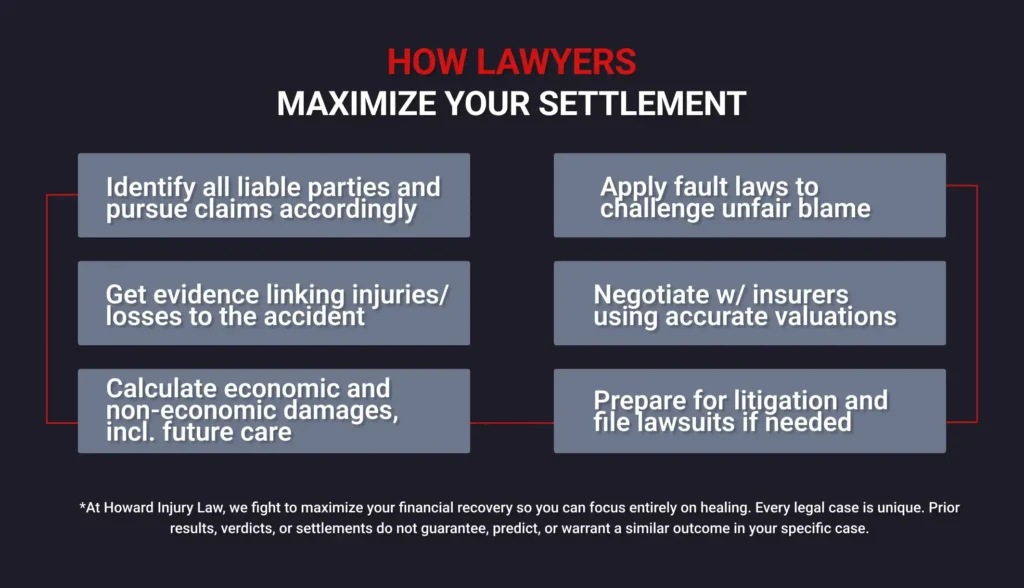
The delivery company’s insurer is already working to limit what your crash costs them. You deserve someone doing the same for you. Because attorney Glen Howard spent years on the insurance-defense side, he knows exactly how these carriers build a file to pay you less — and how to take it apart.
Howard Injury Law handles delivery and commercial truck claims on a contingency basis: no fee unless we win. A free case review will tell you who can be held responsible, which policies apply, and what your claim is actually worth — no pressure, no cost to find out.
👉 Start your free case review and let our Las Vegas truck accident attorneys pursue every liable party while you focus on healing. You can also learn how these cases fit into our broader motor vehicle accident claims work across the valley.