


A wreck with an 80,000-pound commercial truck isn’t just a bigger version of a car crash. It’s a different kind of collision, and it almost always falls into one of a handful of predictable types — each with its own cause, its own injury pattern, and its own fight over who pays.
Knowing which type of crash you were in tells you a lot about what you’re facing. This guide breaks down the most common types of truck accidents in Las Vegas, the data on how often each happens and how severe they get, and why the type of crash shapes your entire claim.
What counts as a “truck accident” in Nevada
Not every crash with a truck is a “truck accident” in the legal sense. What matters is whether a commercial or large truck was involved — generally a vehicle over 10,000 pounds, like a semi, tractor-trailer, box truck, dump truck, or delivery van.
That distinction changes everything. A large truck is bound by federal safety rules (the FMCSA regulations) covering driving hours, maintenance, inspections, and cargo loading. And instead of one at-fault driver, a single truck crash can involve several responsible parties: the driver, the trucking company, the cargo loader, a maintenance contractor, even a parts manufacturer.
That layered liability is exactly why these cases need a Las Vegas truck accident lawyer who handles them differently than a standard car wreck.
The most common type of truck accident — and the data behind it
If you’re asking “what is the most common type of truck accident?” — the answer is the one built into physics: rear-end and front-impact collisions.
Federal crash data is consistent on this. The front of the truck is the most common point of impact in serious truck crashes — well over 40% of them — with rear impacts the next largest share. In plain terms, that covers two everyday scenarios: a truck plowing into slowed or stopped traffic, and a car getting rear-ended by a rig that couldn’t stop in time.
The reason is stopping distance. A fully loaded tractor-trailer needs 20% to 40% more distance to stop than a passenger car, and even more on wet pavement or with worn brakes. When a driver tailgates, speeds, or gets cut off in Vegas stop-and-go traffic, that gap disappears fast. These crashes are common, and because of the weight difference, they’re rarely minor. When a big rig is the one that rear-ended you, more parties usually means more available coverage — that’s the practical upside of a rear-end crash with a commercial vehicle.
Jackknife accidents
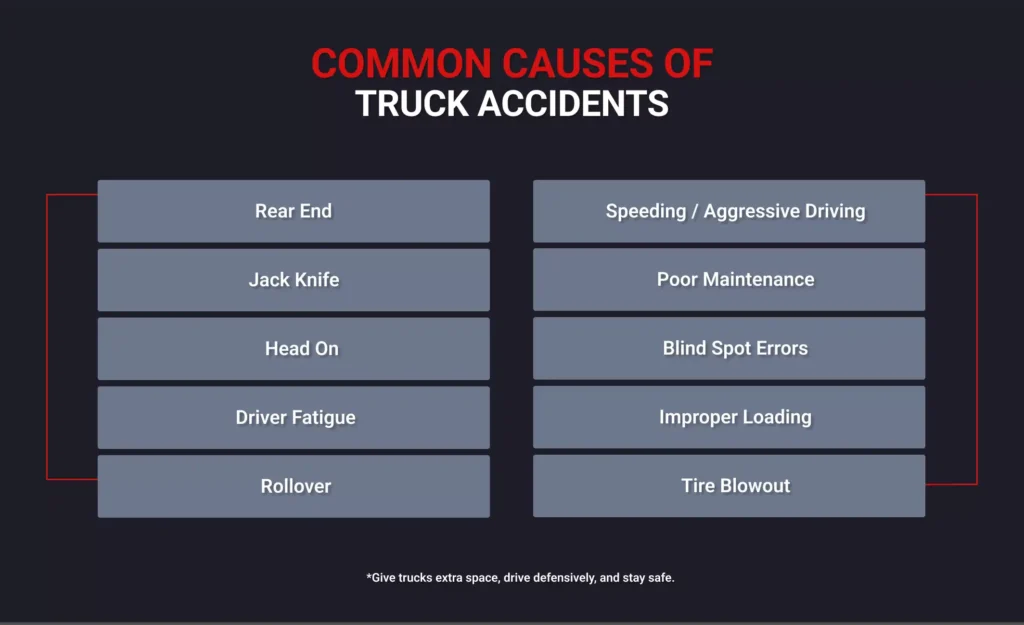
A jackknife happens when the trailer swings out to the side while the cab keeps moving forward, folding the rig into a sharp angle — like a pocketknife closing. Once the trailer breaks traction, the driver has almost no control, and the trailer can sweep across multiple lanes.
Jackknifes are usually triggered by hard braking, slick roads, downhill grades, or braking through a curve too fast. On I-15’s grades and the tight merges heading into the valley, a truck that brakes hard behind sudden congestion is a classic setup. Because the trailer covers so much roadway when it swings, a single jackknife can strike several vehicles at once, which is part of what makes fault and damages so tangled in these cases.
Rollover accidents
Trucks roll for one core reason: a high center of gravity. A loaded trailer sits tall and heavy, so a maneuver a car would handle easily — a freeway on-ramp, a sharp curve, a quick swerve — can tip a rig onto its side.
Speed on ramps and interchanges is the usual culprit, along with unbalanced or shifting cargo that throws the load off-center. The elevated ramps around the Spaghetti Bowl interchange, where I-15 and US-95 meet, are exactly the kind of geometry that punishes a truck taken too fast. Rollovers are violent: occupants can be ejected, and a rolling trailer can come down on the smaller vehicles around it. These are the crashes that stack up into serious freeway pileups on I-15 and the Spaghetti Bowl.
Underride accidents — the deadliest type
An underride crash is the one that keeps truck-safety engineers up at night. It happens when a smaller vehicle slides underneath the truck’s trailer — from behind or from the side — instead of bouncing off it.
Why they’re so lethal comes down to height and weight. Large trucks weigh 20 to 30 times as much as a passenger car and ride much higher off the ground. When a car underrides a trailer, the truck’s frame shears into the passenger compartment at windshield height, often past the point where seatbelts and airbags can protect anyone. Rear and side underride guards are supposed to stop this, but they fail — and when they do, the injuries are catastrophic or fatal.
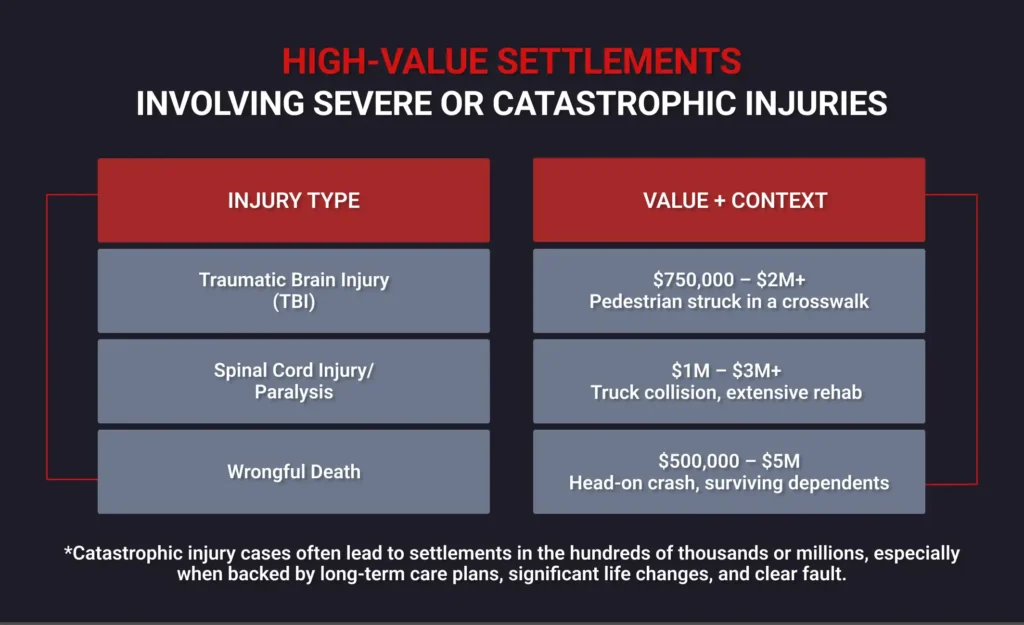
If you or a loved one survived an underride crash, you’re likely dealing with the most serious end of the injury spectrum: traumatic brain injuries, spinal cord damage, and permanent disability. Every crash is different, and only a full review of your specific facts can tell you what your case involves — but these are never the wrecks to handle alone against a trucking company’s insurer.
Head-on truck collisions
Head-on crashes are the least common type on this list, but they sit right beside underride as the deadliest. When a truck and a vehicle hit front-to-front, the closing speed combines both vehicles’ velocity — and the truck’s mass does the rest.
Most head-on truck crashes trace back to a driver leaving their lane: fatigue after too many hours behind the wheel, impairment, distraction, or a wrong-way entry. Federal rules let truckers drive up to 11 hours at a stretch, and fatigue remains one of the best-documented crash risks in the industry. On the darker, less-lit highway stretches around the valley — parts of US-95 heading out of town — a drifting rig has little margin before it crosses the centerline.
Where these crashes happen most in Las Vegas
Truck crashes here aren’t spread evenly across the city. They concentrate on the corridors built to move freight.
- I-15 is the main artery between Southern California and Salt Lake City, carrying heavy commercial traffic through the heart of the valley.
- US-95 and the 215 Beltway move trucks north and east toward Reno and Arizona.
- The Spaghetti Bowl funnels 300,000-plus vehicles a day through tight, high-speed merges where cars and trucks weave across the same lanes.
Work zones raise the risk further. With I-15 seemingly always under construction, Las Vegas has permanent work zones — and nationally, large trucks are involved in roughly a third of fatal work-zone crashes despite being a small share of traffic. Clark County already carries about seven of every ten traffic deaths in Nevada, and heavy commercial vehicles are a real part of that number. Our motor vehicle accident hub breaks down the valley’s crash hotspots in more detail.
Why the type of truck crash matters for your claim
Here’s the part most people don’t realize: the type of crash points to different evidence and different defendants.
A jackknife or rollover raises questions about braking, load balance, and cargo securement — which can pull in the loader or the maintenance contractor. An underride puts the trailer’s guard and the truck’s inspection history in play. A head-on turns attention to the driver’s hours-of-service logs and fatigue. Each type has its own paper trail, and much of it — the black box (ECM) data, the driving logs, the maintenance records — sits in the trucking company’s control and can be overwritten within days.
The other side knows this. A carrier’s insurer often has investigators building a defense within hours of the crash, tailored to exactly the type of collision that happened. Attorney Glen Howard spent years as an insurance-defense lawyer before he started representing injured people — so he knows how these companies read a crash and how they build the denial. That’s the difference between reacting to their playbook and getting ahead of it. You can see how the firm handles commercial truck cases in Las Vegas across every crash type on this list.
Understanding a truck’s blind spots also helps explain a lot of these wrecks — our page on commercial truck awareness covers the no-zones where sideswipes and merge crashes start.
Frequently Asked Questions
What is the most common type of truck accident?
Rear-end and front-impact collisions are the most common type. Federal crash data shows the front of the truck is the leading point of impact in serious truck crashes, with rear impacts next. It comes down to stopping distance — a loaded semi needs far more room to stop than a car, so when traffic slows suddenly or a driver follows too closely, these crashes happen easily. In Las Vegas stop-and-go traffic on corridors like I-15, that stopping gap disappears fast. Because of the weight difference, even a “routine” rear-end with a big rig can cause serious injuries.
What is a jackknife accident?
A jackknife is when a truck’s trailer swings out to the side while the cab keeps moving forward, folding the rig into a sharp V — like a pocketknife closing. It usually happens after hard braking, on wet or downhill roads, or when a driver brakes through a curve too fast and the trailer loses traction. Once it starts, the driver has little control, and the swinging trailer can sweep across several lanes and strike multiple vehicles. That’s what makes jackknife crashes so dangerous on busy freeways like I-15, and why fault in them often reaches beyond just the driver.
Are underride accidents really the deadliest?
Underride crashes are among the most lethal truck accidents, alongside head-on collisions. In an underride, a smaller vehicle slides beneath the truck’s trailer instead of striking its bumper, so the trailer shears into the passenger compartment at head height — past where airbags and seatbelts can help. Because large trucks weigh 20 to 30 times as much as a car and ride much higher, underride guards are the only barrier, and they can fail. Survivors often face catastrophic injuries like traumatic brain and spinal cord damage. Every case is different, so a case-specific review is the only way to know what you’re dealing with.
Where do most truck accidents happen in Las Vegas?
Most truck crashes concentrate on the freight corridors: I-15 (the main route between California and Salt Lake City), US-95, the 215 Beltway, and the Spaghetti Bowl interchange, where hundreds of thousands of vehicles a day merge at high speed. Work zones add risk — with I-15 frequently under construction, large trucks show up in a disproportionate share of serious work-zone crashes. Clark County carries roughly seven of every ten traffic deaths in Nevada, and heavy commercial vehicles are a meaningful part of that. These corridors combine high speed, tight merges, and constant freight traffic.
Do I need a lawyer for a truck accident in Las Vegas?
If you were seriously hurt, almost certainly yes. Truck cases involve federal regulations, multiple possible defendants, and evidence — black box data, driving logs, maintenance records — that the trucking company controls and can lose within days. Their insurer often starts building a defense within hours. A Las Vegas truck accident attorney moves quickly to preserve that evidence and identify every party who shares fault. The best way to know where you stand is a free consultation: no cost, no obligation, and no fee unless the firm wins your case.

Talk to a Las Vegas truck accident attorney — free
Not sure which type of crash you were in, or what it means for your case? That’s exactly what a free consultation answers. You’ll get a straight read on the crash type, who may be liable, and what evidence needs to be locked down before it disappears.
Howard Injury Law reviews truck crashes across Las Vegas and Nevada at no cost. Attorney Glen Howard knows how trucking insurers investigate these cases because he used to be on that side of the table — and there’s no fee unless we win. Request your free case review and get answers before the other side gets ahead of you.