

If a semi hit you at the Spaghetti Bowl, what happened wasn’t bad luck. Truck crashes cluster at this interchange for reasons poured into the concrete decades ago — and when an 80,000-pound truck is involved, the person who ends up in the hospital is almost never the trucker.
Spaghetti Bowl truck accidents happen where Interstate 15 tangles with US-95 and Martin Luther King Boulevard just north of downtown Las Vegas, on the busiest stretch of highway in Nevada. Understanding why the crashes happen here — and what makes a truck case different from a fender-bender — is the first step toward knowing whether you have a claim worth pursuing.
What Is the Spaghetti Bowl in Las Vegas?
The Spaghetti Bowl is the massive freeway interchange where I-15, US-95 (co-signed as Interstate 11 since 2024), and MLK Boulevard all cross north of downtown Las Vegas. Locals named it for the tangle of overlapping ramps and flyovers that, from above, looks like a bowl of pasta.
Here’s the problem in one sentence: it was built for a city that no longer exists. The original interchange went up in the mid-1960s and was designed to carry roughly 60,000 vehicles a day. Today it moves more than 300,000 vehicles daily — about one-tenth of Nevada’s entire population passing through a single junction, with an estimated 25,000 lane changes every hour. That mismatch between a 60-year-old design and modern traffic is the root of nearly every crash here.
Why the Spaghetti Bowl Is a Truck-Crash Hotspot
Volume alone doesn’t explain it. Freight does.
I-15 is Nevada’s busiest freight corridor, the main artery hauling goods between Southern California and Salt Lake City. Thousands of heavy commercial trucks — tractor-trailers, 18-wheelers, big rigs, and box trucks — funnel through the Spaghetti Bowl every day, sharing 1960s-era ramps with tourists racing to the Strip and commuters merging toward I-15 South. Many of those truckers are long-haul drivers passing through, unfamiliar with the interchange’s short merges and sudden lane drops.
That mix is a recipe for severe crashes. When a fully loaded truck and a passenger car try to occupy the same few hundred feet of weaving connector at freeway speed, physics decides the outcome — and physics does not favor the smaller vehicle.
The Numbers Behind I-15 Truck Crashes
State transportation officials weren’t quiet about how dangerous this stretch had become. When Nevada launched Project Neon — the $1 billion I-15 widening completed in 2019, the largest public works project in the state’s history — NDOT justified the price tag with a blunt statistic: on average, three crashes a day were happening in the Spaghetti Bowl.
Even after Project Neon reduced some of the merge-and-weave conflict, the underlying pressures haven’t gone away. Traffic through the corridor is projected to keep climbing, and the freight load hasn’t slowed.
The federal data explains why truck crashes here are so much worse than car crashes:
- In most large-truck crashes nationwide, the people killed are in the other vehicle — not the truck. Federal crash data has shown this pattern year after year.
- A loaded tractor-trailer can weigh 20 to 30 times as much as a passenger car, so the force transferred in a collision is enormous.
- At freeway speeds, a fully loaded truck needs a far longer distance to stop than the car in front of it — which is exactly the wrong trait for an interchange full of sudden slowdowns.
Why a Truck Crash Hits Harder Than a Car Crash
Weight and stopping distance are the whole story. A rear-end tap between two sedans is a bad afternoon. The same tap from a semi at the same speed can mean spinal injuries, a traumatic brain injury, or worse. If you want the statewide picture, our overview of how many truck accidents happen in Nevada each year puts the local numbers in context.
Where Truck Crashes Cluster Inside the Interchange
Not every foot of the Spaghetti Bowl is equally dangerous. Truck crashes tend to stack up in the same trouble spots:
- The I-15 / US-95 connector weaves, where trucks and cars cross several lanes in a short span to reach the right flyover.
- The MLK Boulevard on- and off-ramps, where slower merging traffic meets freeway-speed freight.
- The northbound and southbound flyover merges, where sharp connector curves force heavy trucks to brake hard.
- The I-15 approach from the Sahara and Charleston corridors, which runs heavy and stop-and-go, especially during weekend surges of California traffic.
These are the same corridors that produce the valley’s multi-car chain reactions. For how those pileups unfold and who’s at fault, see our breakdown of freeway pileups on I-15 and the Spaghetti Bowl. And for a wider look at the valley’s danger zones, our guide to crash hotspots across Las Vegas maps the intersections and highways where collisions concentrate.
What’s Actually Causing These Truck Crashes
The contributing factors at the Spaghetti Bowl fall into two buckets: the road, and the truck.
The road: an outdated 1960s layout, short merge zones, closely spaced ramps, and sharp connector curves that were never meant for today’s volume. Add tourist drivers making last-second lane changes toward the Strip, and the weaving alone triggers crashes.
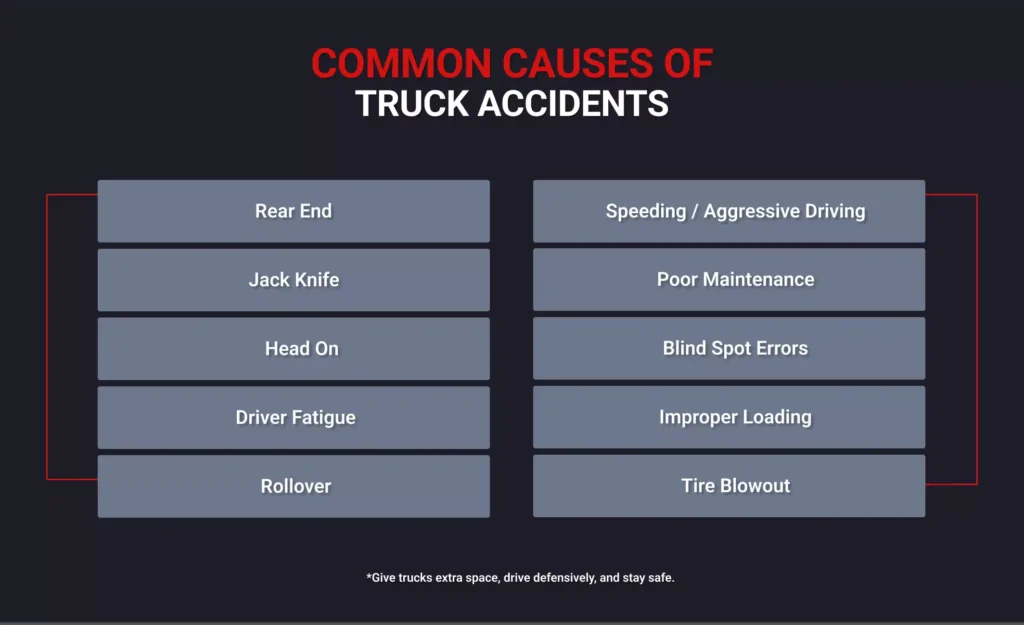
The truck: large blind spots — the “no-zones” where a trucker literally cannot see a car beside or behind them — plus long-haul driver fatigue, speed differences between freight and passenger vehicles, and improperly loaded or overweight trailers that make a rig harder to control. Many of these drivers are also from out of state, which raises its own questions. We cover those in what happens if the truck driver was from out of state.
Why a Spaghetti Bowl Truck Crash Isn’t Handled Like a Car Crash
This is where injured people lose ground without realizing it. A truck claim is not a bigger car claim — it’s a different animal.
There can be several at-fault parties, not just one driver. Depending on the crash, the trucking company, a freight broker, a cargo-loading contractor, or a maintenance shop can all share liability alongside the driver. More defendants can mean more available insurance coverage — but only if someone identifies and pursues them.
Critical evidence disappears fast. Commercial trucks carry a “black box” (an electronic control module) that records speed, braking, and hours of operation, and drivers keep federally required logs. That data can make or break a case — but companies aren’t required to preserve it forever, and some don’t. Our explainer on what a truck black box is and how it helps your case walks through why acting quickly matters.
Nevada also gives you a limited window: the deadline to file most personal injury claims is generally two years from the crash. Every case is different, so treat these as general rules — the specifics of your claim deserve a direct conversation with an attorney. If you want the full picture of how these cases are built, our Las Vegas truck accident lawyers handle the federal-regulation and multi-defendant side that general car-crash firms often miss.
Frequently Asked Questions
Why is the Spaghetti Bowl so dangerous for trucks?
The interchange was designed in the 1960s for about 60,000 vehicles a day and now handles over 300,000, with roughly 25,000 lane changes every hour. It sits on I-15, Nevada’s busiest freight corridor, so thousands of heavy trucks weave through short merges and sharp connector ramps alongside tourists and commuters. When a fully loaded truck and a passenger car compete for the same space at freeway speed, the outdated design leaves almost no room for error. That combination of high freight volume and cramped, decades-old geometry is what turns ordinary merging into serious truck crashes.
Where do most truck accidents happen on I-15 in Las Vegas?
Truck crashes tend to concentrate in the weaving zones: the I-15/US-95 connector merges, the MLK Boulevard ramps, the flyover curves where heavy trucks brake hard, and the stop-and-go I-15 approach from Sahara and Charleston. Weekend surges of California traffic make those stretches worse. The Spaghetti Bowl itself is the single most crash-prone point because it forces drivers to cross several lanes in a short distance. Nevada’s own transportation officials cited an average of three crashes a day here when justifying the $1 billion Project Neon rebuild.
Who is liable for a truck accident at the Spaghetti Bowl?
It depends on what caused the crash, and often more than one party is responsible. Beyond the driver, liability can extend to the trucking company, a freight broker, a cargo-loading contractor, or a maintenance provider. Federal safety rules, driver hours-of-service logs, and the truck’s electronic data all factor into who’s at fault. Because that evidence can be lost quickly and multiple insurance policies may apply, these cases are far more complex than a typical car crash. An attorney who handles truck cases specifically can identify every responsible party — every situation is different, so it’s worth a direct review.
Is I-15 the most dangerous highway in Nevada for trucks?
I-15 consistently ranks among the highest-crash corridors in Clark County, and its role as Nevada’s primary freight route makes it especially risky for truck-involved crashes. The Spaghetti Bowl interchange concentrates that danger, and the I-15 stretch running south through the Tropicana and airport interchanges carries heavy, stop-and-go traffic that stacks up chain-reaction wrecks. While no single road can be called “the most dangerous” for every driver, the mix of freight volume, dated design, and tourist traffic makes this corridor one of the state’s most serious hotspots for commercial-truck collisions.

Hurt in a Truck Crash at the Spaghetti Bowl?
Right now you may be dealing with a spread-out crash scene, mounting medical bills, and a trucking company whose insurer is already building its side of the story. You don’t have to match them alone.
Attorney Glen Howard spent years as an insurance defense attorney — the lawyer on the other side, defending carriers and their insurers. He knows exactly how they minimize truck claims, which evidence they hope you’ll never find, and how fast they move to protect that black-box data. Now he uses that playbook for injured Nevadans instead of against them.
Howard Injury Law works on contingency — no fee unless we win — so a consultation costs you nothing but the time to ask, “Do I have a case?” If a truck hit you on I-15 or inside the Spaghetti Bowl, the sooner someone starts preserving the driver’s logs and vehicle data, the stronger your claim.
Call (702) 331-5722 or request your free case review today, and let a Las Vegas truck accident attorney tell you what your options really are.