


You were hurt in a crash with a commercial truck in Las Vegas, and now you’ve learned the driver — or the company that owns the rig — is based in California, Utah, or somewhere else entirely. That single fact changes almost nothing about your rights, and this post explains why.
An out-of-state truck accident feels like the other side just slipped out of reach. It didn’t. Because the crash happened in Nevada, Nevada law controls your claim, and Nevada courts have the power to hold that out-of-state driver and their trucking company accountable right here. What actually changes is the paperwork behind the scenes — federal regulations, multi-state insurance, and evidence that can leave the state fast. A Las Vegas truck accident lawyer who works these cases handles that part so you don’t have to.
The short answer: the crash was in Nevada, so Nevada rules apply
The law of the state where a crash happens governs the claim. Your accident happened in Nevada, so Nevada’s fault rules, deadlines, and injury rules apply — not the rules of the driver’s home state.
That’s true even if the driver lives in Los Angeles, the trailer is registered in Utah, and the trucking company’s headquarters sits two states away. Where the driver is from doesn’t decide your case. Where you were hit does.
Nevada also gives you a firm window to act. Under state law, you generally have two years from the date of a crash to file a personal injury lawsuit. That clock starts running the day of the accident, no matter how many state lines the truck later crosses.
How many Las Vegas trucks are actually from out of state
Here’s the part most injured drivers don’t realize: on Las Vegas freeways, the out-of-state truck isn’t the exception. It’s the norm.
Interstate 15 is the busiest freight corridor in the state, the main artery moving goods between Southern California and Salt Lake City. Roughly 17,900 trucks a day pour through the I-15 and U.S. 95 interchange — the “Spaghetti Bowl” — and a huge share of them are long-haul carriers domiciled in another state, just passing through the valley. NDOT estimates 60,000 to 80,000 vehicles a day travel I-15 between Las Vegas and the California line alone.
The risk that comes with that volume isn’t small:
- A fully loaded semi can legally weigh up to 80,000 pounds — many times the weight of the car beside it. In a collision, physics decides who gets hurt.
- Large-truck crashes are roughly five times more likely to be fatal than the average crash.
- 56 people were killed in large-truck crashes in Nevada in 2023 alone.
So if an out-of-state trucker hit you on I-15 near the 215 Beltway, on U.S. 95, or on a surface street feeding the Strip, your case sits in the middle of one of the country’s heaviest freight routes. That’s exactly the pattern these cases follow, and it’s why they demand a different playbook than a routine fender-bender.
Can you sue an out-of-state trucking company here?
Yes. And the mechanism that makes it possible surprises most people.
Every trucking company that operates across state lines has to designate a process agent in every state — a person legally authorized to accept lawsuit paperwork on the company’s behalf. It’s a federal requirement for interstate carriers. In plain terms: an out-of-state trucking company has already agreed, as a condition of doing business, to be served with legal papers in Nevada.
On top of that, a company that regularly sends trucks through Nevada has enough connection to the state that Nevada courts can exercise authority over it. You generally file where the crash occurred, which for you is right here in Clark County — where local juries hear these cases. In some situations a company can also be sued where it’s headquartered, and a lawyer will weigh which venue serves you best.
The takeaway for you: state lines are a logistics problem for the lawyers, not a wall between you and compensation.
Does the insurance still cover an out-of-state truck accident?
It does. Auto liability coverage follows the vehicle across all 50 states, so the out-of-state driver’s insurer is on the hook for a crash that happens in Nevada. Their adjuster may be slower and less familiar with Nevada procedure, but the coverage still applies.
For commercial trucks, the numbers actually work in your favor. A regular Nevada driver only has to carry the state minimum of 25/50/20 — $25,000 per person for injuries. An interstate trucking company is held to a federal floor of $750,000 in liability coverage, and most carry $1 million to $5 million. That’s one reason serious truck cases resolve for far more than car cases with similar injuries: the coverage is there to reach.
Federal rules also add a safety net called an MCS-90 endorsement, which is designed to make sure the public can recover up to the federal minimum even if the carrier and its insurer are fighting over the policy. And if the at-fault party somehow lacks enough coverage, your own uninsured/underinsured motorist coverage may fill the gap. These layers get complicated quickly — which is where having someone who knows how carriers stack and dispute coverage earns its keep.
What if part of the crash was your fault?
You can still recover. Nevada uses a modified comparative fault rule: as long as you were less than 51% responsible, you can pursue compensation, reduced by your share of the blame. Being partly at fault doesn’t erase your claim — it just adjusts the math.
Fault in truck cases is rarely as simple as the insurer wants you to believe, and the carrier has every reason to shift blame onto you to shrink the payout. Every case turns on its own facts, so it’s worth having an attorney look at yours before you accept anyone’s version of what happened.
The evidence that disappears fast
This is the real reason an out-of-state truck accident rewards moving quickly.
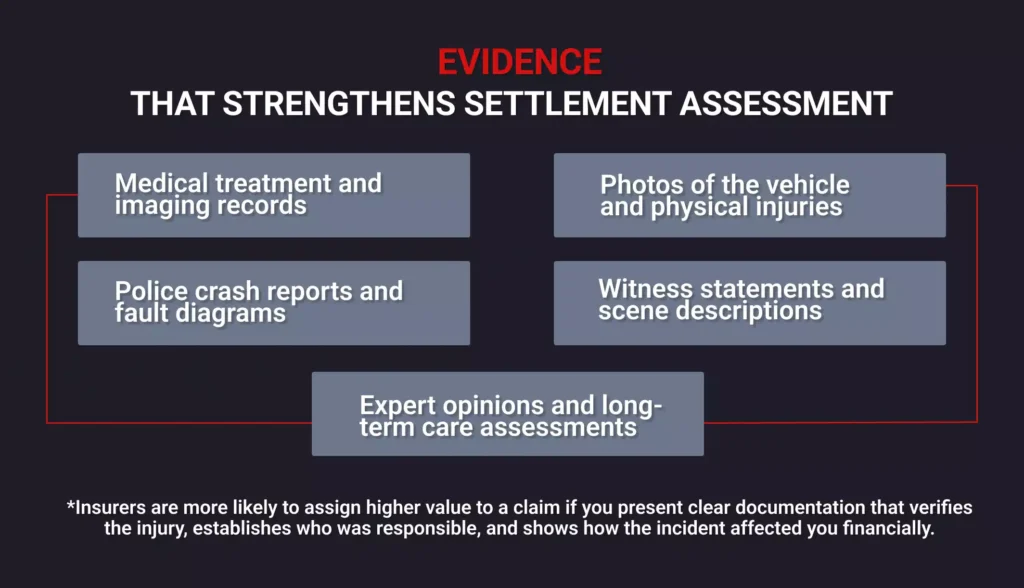
Modern commercial trucks are rolling data recorders. The truck’s black box and electronic logging device capture speed, braking, and the driver’s hours behind the wheel. Add dispatch records, GPS history, maintenance logs, and dashcam footage, and you often have a minute-by-minute account of what went wrong. That evidence is also the trucking company’s, and once the rig heads back across state lines, that data can be overwritten, lost, or quietly held back.
A lawyer can send a legal hold letter that forces the company to preserve those records before they vanish — but only if it goes out early. Pair that with Nevada’s two-year filing deadline, and the message is simple: the out-of-state angle isn’t a reason to wait. It’s a reason to start.
Pulling and reading that federal data is the heart of a strong trucking case, and it’s exactly the kind of proof that turns “the driver said he had the green” into a documented account of what the truck actually did.
How the right Las Vegas truck accident lawyer levels the field
Trucking companies keep legal and insurance teams on standby for crashes exactly like yours. The moment one of their rigs is involved, those teams start building the company’s defense — often before you’ve left the hospital.
Howard Injury Law was founded by attorney Glen Howard, who spent years on the insurance defense side before switching to represent injured people. He knows how carriers value a claim, where they look to cut it, and how out-of-state adjusters try to run out the clock on a Nevada crash. That perspective — knowing how the other side thinks — is a real advantage when the defendant is a trucking company two states away.
You also don’t pay anything up front. Personal injury cases at the firm are handled on a contingency basis: no fee unless we win. That means you can get a serious out-of-state truck case evaluated without adding a bill to everything else you’re dealing with.
If an out-of-state trucker hurt you in Las Vegas, the strongest move is to get the truck’s data preserved and the deadline calendared before the company’s team gets a head start. Request a free, no-obligation consultation and get a straight answer to the question underneath all of this: do I have a case? You can also call (702) 331-5722 — the line is open 24/7.

Frequently Asked Questions
Does insurance cover accidents out of state?
Yes. Standard auto liability insurance follows the vehicle across all 50 states, so an out-of-state driver’s policy still applies to a crash that happens in Nevada. The claim is generally handled under the laws of the state where the accident occurred — Nevada — not the driver’s home state. For commercial trucks, coverage is usually far higher than a personal policy because federal law requires interstate carriers to carry at least $750,000 in liability coverage. The main friction is practical, not legal: an out-of-state adjuster may be slower or less familiar with Nevada rules, which is one reason many injured drivers bring in a Las Vegas attorney to keep the claim moving.
What is the deadliest state to drive in?
By fatality rate, Mississippi consistently ranks as the deadliest state to drive in, with the highest deaths per 100 million miles traveled; Massachusetts sits at the safe end. Nationally, more than 39,000 people died in motor vehicle crashes in a single recent year. Nevada isn’t the worst, but its mix of high-speed interstates, heavy tourist traffic, and constant freight movement makes certain corridors genuinely dangerous — I-15 through Las Vegas is regularly cited among the most hazardous interstate stretches in the country. For anyone sharing those lanes with 80,000-pound trucks, the risk is real regardless of where the state ranks overall.
Does insurance still pay if you’re at fault?
Often, yes — it depends on the coverage and your share of blame. Nevada follows a modified comparative fault rule, so if you were less than 51% responsible, you can still recover compensation from the other party, reduced by your percentage of fault. Your own collision or medical-payments coverage may also apply to your losses regardless of fault, if you carry it. What you want to avoid is accepting blame at the scene or to an adjuster before the facts are sorted out, because fault in a truck crash is frequently more shared — and more disputed — than it first appears. An attorney can review the evidence before any fault determination sticks.
Can I sue a trucking company from another state?
Yes. Interstate trucking companies are federally required to designate an agent to accept legal papers in every state, and a company that routinely runs trucks through Nevada can be brought into Nevada courts. You’ll typically file where the crash happened — here in Clark County — although in some cases a company can also be sued where it’s based. Practically, state lines don’t shield an out-of-state carrier from a Nevada lawsuit; they just add coordination that your lawyer manages.

Which state’s laws apply — Nevada or the driver’s home state?
Nevada’s. The general rule is that the law of the state where the crash occurred governs the claim, including its fault rules, injury rules, and filing deadlines. So even if the truck driver lives elsewhere and the company is headquartered in another state, your Nevada crash is decided under Nevada law. That’s usually good news for injured people here, given Nevada’s fault-based system and Clark County’s jury pool — but every case is different, and it’s worth confirming how those rules apply to your specific facts with an attorney.