Some Las Vegas intersections produce wrecks so often that locals quietly plan their routes around them. If you were just hurt at one of the crash hotspots in Las Vegas, you already know the feeling — the corner everyone calls dangerous finally caught you, and now you’re trying to figure out what happens next.
The scale is real. Nevada recorded 381 traffic deaths in 2025, and roughly 237 of them happened in Clark County, according to preliminary data from Zero Fatalities Nevada and the state Department of Public Safety. The valley averages dozens of reported crashes every single day. This page maps where those crashes concentrate — the intersections, corridors, and interchanges that show up again and again — and, just as important, what a documented dangerous location can mean for your case. If you need the bigger statistical picture, our breakdown of Las Vegas car crash statistics covers the citywide numbers. If you were injured and want to know your options, a Las Vegas motor vehicle accident lawyer can review what happened at no cost.
The Most Dangerous Intersections in Las Vegas
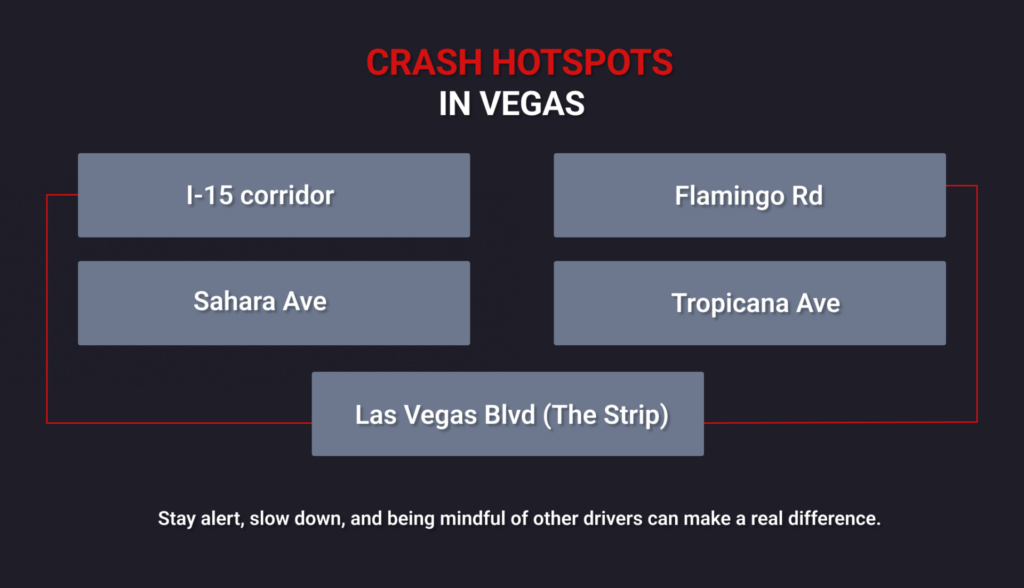
Intersections are where most valley crashes happen — multiple lanes, cross-traffic, left turns, and drivers rushing a yellow all collide in the same small space. The Las Vegas Metropolitan Police Department points to three causes behind most of these collisions: failure to yield the right of way, failure to maintain a lane, and speeding. When LVMPD released its top collision locations at the end of 2025, Maryland Parkway and Flamingo Road was among the intersections it named.
A handful of crossings turn up repeatedly across public crash data and local reporting:
- Sahara Avenue & Decatur Boulevard — heavy commercial traffic, constant turning movements, and congestion that stacks up fast.
- Tropicana Avenue at Decatur, Rainbow, and near Las Vegas Boulevard — one of the busiest east-west corridors in the city.
- Flamingo Road through the resort corridor and out toward Pecos and Eastern.
- Charleston Boulevard at Rainbow and at Lamb — a mix of commuter and local traffic with frequent rear-end and cross-traffic crashes.
The shared thread is right-of-way. When a driver runs a red, rolls a stop, or forces a left turn, the resulting crash is rarely a mystery — but the at-fault driver almost always tells the adjuster the light was theirs. How fault gets proven at these crossings follows its own rules, which we cover in detail in our guide to intersection car accidents in Las Vegas.
Strip and Tourist-Corridor Hotspots
The resort corridor concentrates almost every crash risk into a few square miles: dense foot traffic, rideshare and valet stops, tour buses, and millions of visitors driving rental cars on roads they’ve never seen. Around Las Vegas Boulevard, the danger clusters at resort driveways and the cross-streets feeding the Strip — the crossings near Koval Lane, Sands Avenue, Harmon Avenue, and the Tropicana-and-Las Vegas-Boulevard corner ringed by major casinos.
Two crash types dominate here. Sudden stops for pedestrians and rideshare pickups trigger rear-end and chain-reaction collisions, and drivers cutting across lanes to reach a driveway or an exit cause sideswipes. If your crash involved a rideshare vehicle picking up or dropping off, the coverage questions get complicated — our page on rideshare and taxi accidents explains how those claims work. Pedestrians hurt in this zone face their own set of rules, covered under Las Vegas pedestrian accidents.
High-Risk Freeway Corridors and Interchanges
Not every serious crash happens at a light. The valley’s freeways carry enormous daily volume and produce the most severe wrecks, simply because of speed.
I-15 is the spine of the region, connecting Las Vegas to Southern California and Utah, and it has landed on national lists of the deadliest interstates in the country. Through the resort corridor it mixes local commuters with tourists braking for unfamiliar exits — a recipe for sudden slowdowns and multi-vehicle pileups. The I-15/US-95 interchange, known locally as the Spaghetti Bowl, is one of the busiest and most confusing junctions in Nevada, where high-speed merging and short lane transitions leave little room to react. US-95 and the 215 Beltway carry the same pattern out to the northwest and the valley’s edges.
A crash at freeway speed is categorically different from a fender-bender on a surface street. The injuries are worse, more vehicles are usually involved, and liability can turn on lane position, merging, and seconds of reaction time — which is exactly why these cases need early investigation.
Where Pedestrian Crashes Concentrate in Las Vegas
Las Vegas consistently ranks among the most dangerous U.S. cities for people on foot. Statewide, 111 pedestrians were killed in 2025 — a heartbreaking share of the year’s total. The danger concentrates where foot traffic and vehicle traffic overlap: the Strip and Las Vegas Boulevard, downtown, East Charleston Boulevard, Boulder Highway, and the stretches of Lake Mead Boulevard with long gaps between crosswalks.
Poor nighttime visibility, drivers turning across marked crosswalks, and pedestrians crossing mid-block all feed the problem. Because these crashes so often cause catastrophic injuries, the response afterward matters more than in a typical fender-bender. If you or a family member was struck, our Las Vegas pedestrian accidents page walks through how these claims are built.
Late-Night and Impaired-Driving Hotspots
Las Vegas is one of the few places where alcohol is served around the clock, and that shows up in the crash data by time and place, not just cause. Impaired-driving wrecks spike late at night and in the early morning hours along the entertainment corridors near the Strip and downtown, and on the arterials feeding them. Add drivers who haven’t slept, and the same corridors that are crowded at noon become genuinely dangerous at 3 a.m.
Being hit by an impaired driver changes how a claim is handled — a criminal case may run alongside your civil one, and it can affect the value of your damages. You’ll find more on that in our guide to drunk driving accidents.
What a “Known Dangerous” Location Means for Your Claim
Here’s what many injured people get wrong: they assume a crash at a notorious intersection is just bad luck — the kind of thing bound to happen there eventually. That assumption quietly helps the insurance company.
A dangerous location does not erase fault. In nearly every one of these crashes, someone still failed to yield, ran a light, sped, or drove impaired — and that conduct is what the law looks at. A location’s documented crash history, its signal timing, its sightlines, and the traffic pattern at the moment of impact can all become evidence that supports your version of events rather than the other driver’s.
Insurers know this, so they run the opposite play. At a chaotic, multi-lane intersection, the adjuster’s goal is to muddy the picture — to argue everyone shares a little blame and shave down what they owe you. Nevada follows a comparative-fault rule, which means you can still recover as long as you’re not found more responsible than the other driver, though your share reduces the award. That rule is exactly where insurers try to pin extra blame on you.
Glen Howard spent years as an insurance defense attorney before he started representing injured people, so he built the other side’s “everyone’s a little at fault” argument for a living. That background is why a motor vehicle accident attorney who knows these corridors can be the difference in a hotspot crash — and why sorting out who is liable in a Nevada motor vehicle accident early protects your claim.
What to Do If You’re Hurt at a Las Vegas Crash Hotspot
The location works in your favor if you document it. In the moments after a crash at a busy intersection or corridor:
- Note the exact intersection or mile marker and which direction each vehicle was traveling.
- Photograph the scene widely — signals, lane markings, skid marks, and the resting positions of the vehicles.
- Get contact information from witnesses. Busy intersections almost always have them, and a neutral witness can settle a right-of-way dispute.
- Seek medical care right away, even if you feel okay. Adrenaline hides injuries, and gaps in treatment are the first thing an insurer attacks.
- Decline to give a recorded statement to the other driver’s insurer before you’ve talked to a lawyer.
For the full step-by-step, see what to do after a motor vehicle accident in Las Vegas.
Frequently Asked Questions
What are the most crash-prone intersections in Las Vegas?
Several crossings appear repeatedly in public crash data and local police reporting. Sahara Avenue and Decatur Boulevard, the Tropicana Avenue corridor, Flamingo Road through the resort area, Charleston Boulevard at Rainbow and at Lamb, and Maryland Parkway at Flamingo are all frequently cited. Most share the same causes: failure to yield, red-light running, and speeding through multi-lane crossings. Rankings shift year to year, so no single list is definitive — but if your crash happened at one of these, the location’s history and traffic pattern can help establish fault. Our guide to intersection car accidents in Las Vegas explains how liability is proven at these crossings.
What is the deadliest highway in Nevada?
It depends on how you measure it. Within the Las Vegas valley, I-15 is the deadliest by crash volume and total fatalities — it carries heavy tourist and freight traffic and has repeatedly appeared on national “deadliest interstate” rankings, with the I-15/US-95 Spaghetti Bowl interchange a particular trouble spot. Statewide, rural highways like US-95 and US-93 rank among the deadliest by fatal-crash severity, because high speeds, long desert stretches, and slower emergency response turn crashes into fatalities more often. In short: I-15 for sheer numbers near the city, the rural corridors for how deadly each crash tends to be.
How many accidents happen per day in Las Vegas?
Las Vegas averages roughly 56 reported crashes per day, which adds up to more than 20,000 a year across the valley — a figure that reflects everything from minor fender-benders to fatal collisions. The city’s 24/7 traffic, constant tourism, and dense arterials keep that number high year-round. For the full breakdown of citywide crash trends and how they’ve changed, see our Las Vegas car crash statistics page.
What part of Las Vegas should drivers be most cautious in?
The resort corridor and the major east-west arterials demand the most attention. The Strip and the cross-streets feeding it combine dense pedestrian traffic, rideshare stops, and unfamiliar drivers, while corridors like Tropicana, Flamingo, Sahara, and Charleston carry heavy volume and frequent intersection crashes. On the freeways, the I-15/US-95 Spaghetti Bowl interchange is the spot where merging and lane changes cause the most trouble. None of these areas are “off-limits” — they’re just where extra caution pays off, especially at night and during peak hours.
Does it matter that my crash happened at a known dangerous intersection?
Yes, and usually in your favor. A documented dangerous location doesn’t make the crash your fault — fault still rests on the driver who failed to yield, ran the light, or sped. The intersection’s crash history, signal timing, and traffic pattern can actually support your account of what happened. Insurers often use a chaotic intersection to argue you share blame and reduce your payout, so having a lawyer who knows these specific roads and how the other side argues them matters. Every crash is different, so it’s worth having yours reviewed before you accept any version of events from an adjuster.
Talk to a Las Vegas Motor Vehicle Accident Lawyer
If you were hurt at one of these hotspots, the crash probably looked chaotic — and the insurance company is counting on that. They’ll use the busy intersection, the multiple vehicles, and the conflicting stories to argue you were partly to blame and pay you less.
Howard Injury Law knows these roads and knows how the other side builds that argument, because Glen Howard spent years making it from the insurance defense side. We investigate the location, lock down the evidence before it disappears, and handle the adjuster so you don’t have to. There’s no fee unless we win your case, and the first conversation is free.
Tell us where your crash happened and what you’re dealing with. Request a free case review or call Howard Injury Law at (702) 331-5722 — we’ll tell you honestly whether you have a case and what it may be worth.