

After a crash, one question decides everything about your recovery: who is liable in a motor vehicle accident in Nevada, and who actually has to pay for it? Nevada is an at-fault state, so the driver who caused the crash — or their insurance company — is responsible for the damage. But fault isn’t always obvious, it isn’t always one person, and the driver behind the wheel isn’t always the only party on the hook.
Understanding how liability works protects your claim from the moment the crash happens. It also helps you spot when the insurance company’s version of events doesn’t match Nevada law — which happens far more often than most injured people realize.
Howard Injury Law handles motor vehicle accident cases throughout Las Vegas and Nevada. Glen Howard spent years on the insurance defense side before he represented injured people, so he knows exactly how liability gets evaluated, disputed, and quietly minimized. Available 24/7. No fees unless we win.
Nevada Is an At-Fault State — What That Means for You
Some states use a no-fault system, where each driver’s own insurance covers their injuries regardless of who caused the crash. Nevada is not one of them. Here, the driver who caused the accident is financially responsible for the resulting injuries, property damage, and other losses.
In practice, you generally cannot file with your own insurer and be made whole. You have to establish that the other driver was negligent — that they did something a reasonable driver wouldn’t, or failed to do something they should have. Once negligence is established, their insurance becomes the primary source of recovery.
That structure has a hard consequence: the adjuster on the other side is not there to help you. Their job is to find reasons to reduce your claim and settle for as little as possible. Knowing that before you say a word to them is one of the most important things you can do to protect yourself.
When You’re Partly at Fault: Modified Comparative Negligence
Nevada doesn’t require the other driver to be 100 percent at fault for you to recover. The state follows a modified comparative negligence rule, which lets you recover even if you share some of the blame — with two conditions.
First, your recovery drops by your percentage of fault. If your damages are $100,000 and you’re found 20 percent at fault, you recover $80,000. Second, and more critically, you recover nothing if your share of fault is greater than the combined fault of everyone you’re seeking recovery from. In a typical one-on-one crash, that’s the 50 percent line — cross it and the right to compensation disappears entirely.
Insurers know this rule cold, and they use it. Assigning you even a modest share of fault reduces what they owe. Pushing you past the halfway line erases their bill completely. So they comb for anything that supports blaming you: your speed, your lane position, your sightline, whether you were belted. An experienced Nevada motor vehicle accident attorney works the other direction — documenting the crash so the evidence reflects what actually happened and resists the insurer’s attempt to inflate your share. Here’s how comparative negligence works in Nevada and why your fault percentage can swing your outcome so dramatically.
The At-Fault Driver Isn’t Always the Only One
When the Driver Doesn’t Own the Vehicle
One of the most misunderstood liability questions in Nevada crashes involves borrowed cars. If someone borrows a vehicle and causes a crash, who pays — the driver or the owner?
Often, both. Nevada recognizes negligent entrustment, which holds a vehicle owner liable when they hand their keys to someone they knew, or should have known, was unfit to drive — someone visibly intoxicated, unlicensed or suspended, with a known history of reckless driving, or too inexperienced for the conditions.
The owner’s policy typically covers the vehicle first, with the driver’s insurance as potential secondary coverage. When the at-fault driver has little or no insurance of their own, the owner’s policy becomes critical. If a borrowed vehicle hit you, the ownership question needs to be investigated right away.
Employer Liability and Commercial or Rideshare Drivers
When a crash involves a commercial vehicle — a delivery truck, a company car, a rideshare — the driver’s employer may be liable alongside or instead of the driver. Under the doctrine of respondeat superior, an employer answers for the negligent acts of employees acting within the scope of their job.
That matters because companies and their insurers carry far more coverage than an individual driver. A claim against a delivery service, a trucking operation, or a hotel shuttle company has a very different value ceiling than one against a private driver with a minimum policy. Identifying every liable party is a core part of how an attorney maximizes recovery.
Rideshare is its own variation. Uber and Lyft carry tiered insurance that depends on the driver’s status at the moment of the crash — app off, waiting for a request, or actively carrying a passenger. Each status triggers a different level of coverage, and our motor vehicle accident team knows exactly how those tiers work.
Multi-Vehicle Crashes and Shared Liability
Crashes with three or more vehicles raise harder liability questions. Nevada assigns fault percentages across everyone involved — but how you collect depends on whether you share any of the blame, and this is where the insurer’s framing often misleads people.
If you were partly at fault, each at-fault driver is generally responsible only for their own share. But if you did nothing wrong — an innocent passenger, a driver lawfully stopped who got rear-ended, the last car in a chain reaction — Nevada law treats you differently. A completely fault-free injured person can recover the full amount from any one of the at-fault drivers, and it’s on those drivers to sort out their shares among themselves. You are not forced to chase each driver for a slice.
That distinction is worth real money when one driver is uninsured or a policy is too small to cover your injuries. In a pileup on I-15 or a chain-reaction crash at a Strip-area intersection, the sequence of events drives everything: who started it, who had the last clear chance to avoid it, whether a prior crash left a later driver no way out. Those questions get answered with physical evidence, witness accounts, and sometimes reconstruction experts. If liability is genuinely unclear, that ambiguity usually works against an unrepresented claimant — an attorney can force clarity, and here’s how fault is determined in a Nevada motor vehicle accident when more than one driver is involved.
Nevada’s Minimum Insurance — and Why It’s Often Not Enough
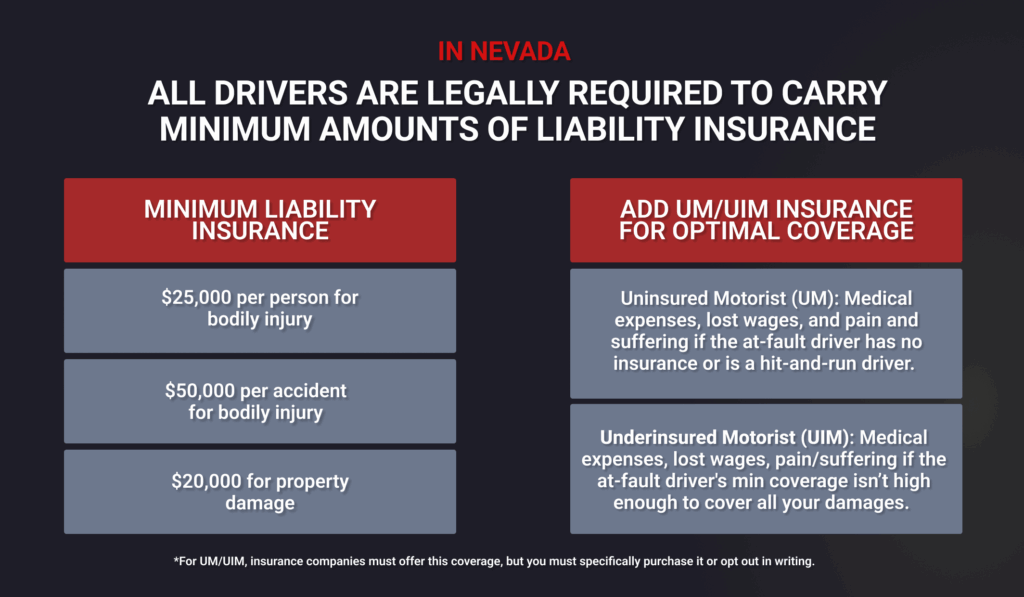
Every driver in Nevada must carry minimum liability coverage of $25,000 per person and $50,000 per accident for bodily injury, plus $20,000 for property damage. These are floor amounts, not real coverage for a serious injury.
A single hospitalization after a severe crash can burn through the $25,000 per-person limit before surgery, rehab, or specialist care is even counted. When the at-fault driver carries only the minimum and your damages run past it, other options may exist: additional applicable policies, umbrella coverage, or your own uninsured/underinsured motorist coverage.
UM/UIM is one of the most valuable — and most overlooked — protections on your own policy. If the driver who hit you carried only the minimum and your injuries are serious, your UM/UIM coverage may be what ultimately makes you whole. It’s worth understanding what happens when the other driver has no insurance before you assume there’s nothing to recover.
How Liability Actually Gets Proven
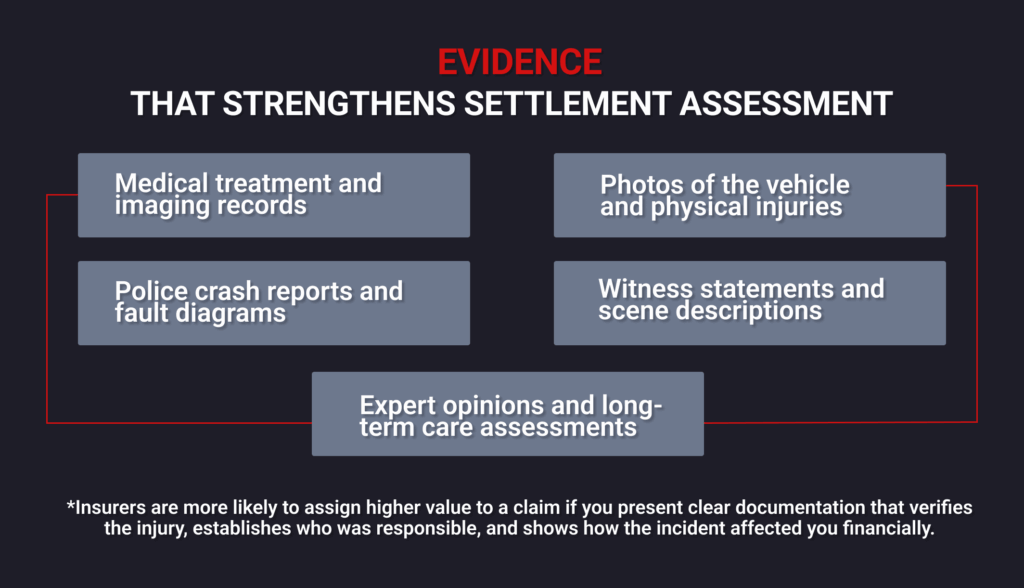
Establishing liability isn’t just stating what happened. It takes evidence — the kind that holds up when the other side disputes your account.
The police report is the starting point. It records the officer’s observations, any citations, and a preliminary read on fault. It isn’t the final word — insurers and attorneys challenge its conclusions regularly — but it sets the official record.
Beyond the report, the strongest evidence includes crash-scene and vehicle-damage photos, road conditions, and visible injuries captured right after the collision; witness contact info; dashcam or traffic-camera footage; medical records tying your injuries to the crash; and, where relevant, cell-phone records or toxicology results.
Some of this vanishes fast. Traffic-camera footage is often overwritten within 24 to 72 hours. Witnesses scatter. Scene evidence changes. The earlier an attorney gets involved, the more of it survives. And if you’re worried you don’t have a case because no report was filed, read whether you can file a claim without a police report in Las Vegas — the answer may surprise you.
When a Government Entity May Share Liability
Sometimes road design or maintenance contributes to a crash — bad signage, a failed signal, dangerous geometry, poorly maintained pavement — which can make a government entity partly liable alongside the at-fault driver.
Claims involving a government entity follow different procedures than a standard crash claim. You generally have to file a formal written notice of claim with the correct body — the State, or the specific city, county, or district — and naming the wrong entity can derail an otherwise strong case. You still have time to act, but the added procedural steps make it important to identify a government’s possible role early and get guidance before deadlines and paperwork requirements start working against you.
Frequently Asked Questions
Is Nevada a no-fault state for car accidents?
No. Nevada is an at-fault (tort) state. The driver who caused the crash is financially responsible for the resulting injuries and damage, and their liability insurance is the primary source of recovery up to its limits. That’s different from a no-fault state, where you’d turn to your own insurer for your injuries regardless of blame. Because Nevada is at-fault, proving the other driver’s negligence — and defending against attempts to blame you — is central to every claim.
Are you liable if someone else crashes your car?
You can be. Under Nevada’s negligent entrustment principle, a vehicle owner can be held responsible for lending their car to someone they knew, or should have known, was unfit to drive — for example, someone intoxicated, unlicensed, or with a history of reckless driving. Even without entrustment, the owner’s insurance typically provides the first layer of coverage when their permitted driver causes a crash. So if you loaned your car out, your policy may be exposed; and if a borrowed vehicle hit you, the owner’s coverage may be an important source of recovery worth investigating.
What is the minimum liability coverage in Nevada?
Nevada requires at least $25,000 per person and $50,000 per accident for bodily injury, plus $20,000 for property damage — often written as 25/50/20. These are legal minimums, not adequate coverage for a serious injury. A single hospital stay can exhaust the per-person limit quickly. When the at-fault driver carries only the minimum and your damages exceed it, your own uninsured/underinsured motorist coverage, additional policies, or umbrella coverage may fill the gap. It’s one reason carrying solid UM/UIM coverage on your own policy is worth the small added cost.
What is the average settlement for a car accident in Nevada?
There’s no reliable “average,” and anyone quoting a single number is guessing. Value depends on the severity of your injuries, the treatment required, lost income, how clearly liability falls on the other side, and the available insurance coverage. A minor soft-tissue claim and a case involving surgery or permanent impairment aren’t in the same universe. Rather than anchor to a figure, it helps to understand what a car accident settlement in Las Vegas actually depends on. The honest answer for your situation comes from a case review, not a chart.
What if the other driver doesn’t have insurance?
Nevada requires liability insurance, but not everyone carries it. If an uninsured driver caused your crash, your own uninsured motorist coverage usually becomes the primary way to recover. If you don’t carry UM coverage, your options narrow — though a judgment against the at-fault driver may still be pursued. This is one of the strongest arguments for keeping robust UM/UIM coverage on your own policy.

Liability Is Assignable — Let’s Assign It Correctly
Who is liable in a motor vehicle accident in Nevada rarely has a one-line answer. The at-fault driver, the vehicle owner, an employer, a rideshare company — liability can reach further than most people expect. And because Nevada’s comparative negligence rules reward the other side for shifting blame onto you, the insurer will work hard to do exactly that.
Howard Injury Law represents injured people across Las Vegas and Nevada. We investigate liability thoroughly, preserve evidence before it disappears, and build claims that hold up when the other side pushes back. Glen Howard’s years as a former insurance defense attorney mean we know where the coverage is and how the other side thinks. There’s no fee unless we recover for you.
Not sure whether you even have a case, or who can be held responsible? That’s the exact question a free case review answers. Start with our Las Vegas motor vehicle accident attorneys — no obligation, and no fees unless we win. If more than one driver was involved or liability feels murky, you may still have a stronger claim than you think; here’s whether you can sue after a motor vehicle accident in Nevada.