

The other driver convinced you not to call. Or police responded but declined to write a report because the crash happened on private property. Or you were shaken up, in pain, and just didn’t think clearly about next steps in the moment.
Whatever the reason, you’re now dealing with injuries, insurance calls, and a growing worry: without a police report, do you even have a case?
The answer is yes — in most situations. Nevada law does not require a police report as a prerequisite for filing a personal injury claim. What it does require is evidence. And a police report is just one form of evidence among many. Here’s exactly what that means for your case and what you need to do right now.

Is a Police Report Required to File a Personal Injury Claim in Nevada?
No. There is no Nevada statute that requires a police report as a condition of filing a personal injury claim or pursuing a lawsuit against an at-fault party. Your legal right to seek compensation for injuries caused by another party’s negligence exists independently of whether law enforcement responded to your accident.
That said, a police report carries real value. It’s a contemporaneous, official record created by a neutral third party close in time to the incident. It documents the parties involved, each driver’s account of what happened, witness information, the officer’s observations, and sometimes a preliminary fault determination. That official record is useful — and its absence creates challenges that need to be addressed proactively.
When Nevada Law Requires You to Report
While a police report isn’t required to file a claim, Nevada law does impose reporting obligations on drivers. Under NRS 484E.030, drivers must report any accident involving injury, death, or property damage exceeding $750 to law enforcement. If police didn’t respond to your accident and damage meets that threshold, the reporting obligation falls on you.
If you’re unsure whether police were notified or a report was filed, you can submit an incident report directly through the Las Vegas Metropolitan Police Department. Filing that report — even weeks after the accident — creates an official record that didn’t exist before and strengthens your claim’s foundation.
The Nevada DMV SR-1 Form
If no law enforcement officer assisted at the scene, Nevada also requires drivers to file a written report with the Nevada DMV within 10 days of the accident using the SR-1 form. This applies to crashes meeting the damage or injury threshold.
Filing the SR-1 matters because it creates a timestamped official record of the accident independent of a police report. Without any official documentation — no police report, no SR-1 — your claim relies entirely on private evidence. That’s manageable, but it means every other piece of documentation you gather carries more weight.
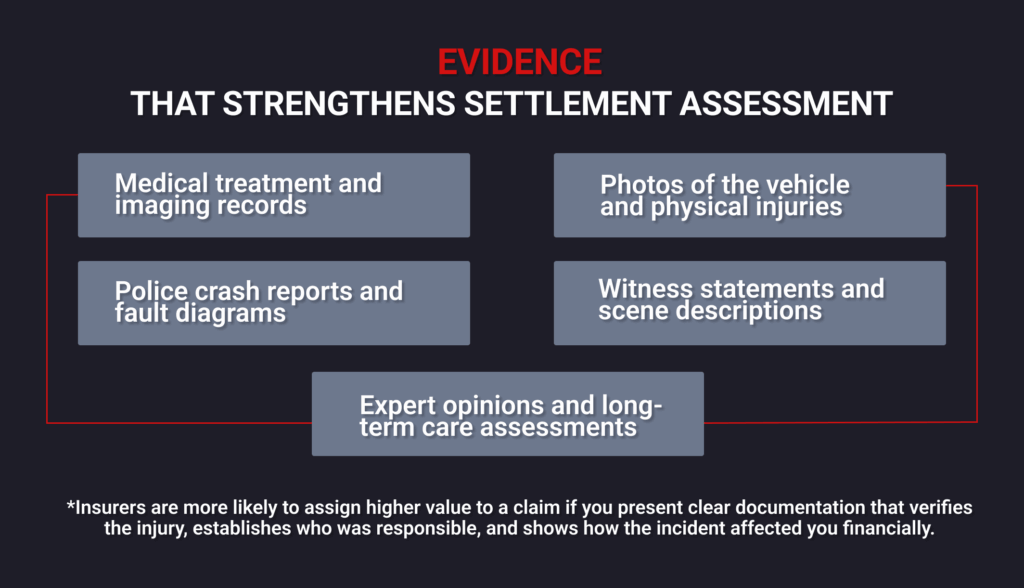
What Evidence Replaces a Police Report
Building a strong personal injury claim without a police report means replacing the official narrative with a body of private evidence that tells the same story — or a better one.
Photos and Video — The Most Time-Sensitive Evidence
If you took photos at the scene — vehicle damage, positions of the cars, road conditions, traffic signals, visible injuries — those images are powerful. They’re contemporaneous. They’re objective. And they don’t require a badge to carry evidentiary weight.
If you didn’t take photos at the scene, photos taken in the hours or days following the accident still document vehicle damage and visible injuries. They’re not as strong as immediate scene photos, but they’re far better than nothing.
Video is even more valuable. Las Vegas is one of the most camera-dense cities in the world. Casino perimeter cameras, hotel security systems, business surveillance cameras, NDOT traffic signal cameras, rideshare dashcams, and residential doorbell cameras all potentially captured what happened. The critical issue is timing — most systems overwrite footage on a 24 to 72-hour cycle. If your accident was recent, preserving that footage requires a preservation letter sent to the relevant property owners immediately.
An attorney can send those letters within hours of being retained. Once the footage is gone it cannot be recovered.
Witness Statements — Get Them While Memories Are Fresh
Anyone who saw the accident — other drivers, pedestrians, business patrons, bystanders — is a potential witness. In Las Vegas, this presents both an opportunity and a challenge. The density of foot traffic near the Strip, casino corridors, and major intersections means witnesses are often present. But many are tourists who leave the city within 24 to 48 hours.
If you exchanged contact information with witnesses at the scene, reach out immediately. If you didn’t, identify any businesses near the crash location whose patrons or employees might have observed what happened. An attorney can conduct that outreach systematically — tracking down witnesses before they’re gone and obtaining formal statements while recollections are still clear.
A witness who saw the other driver run a red light at Flamingo and Koval is worth more to your case than almost any other single piece of evidence. But only if you find them before they fly home.
Medical Records — Your Most Important Documentation
Your medical records establish two things that are fundamental to any personal injury claim: that you were injured, and that the injury connects to the accident.
Get evaluated as soon as possible if you haven’t already. Walk into an urgent care clinic, an emergency room, or your primary care physician and tell them exactly what happened — the date and nature of the accident, every symptom you’re experiencing, and when those symptoms began. The medical record created from that visit documents your injury’s onset in direct relation to the accident date.
Consistent, continuous medical treatment is what builds the documentation picture over time. Every follow-up appointment, every specialist visit, every imaging study adds another layer of evidence connecting your physical condition to the original accident. Gaps in treatment are the primary tool insurers use to minimize these claims — which is why staying consistent with your care matters as much as getting that first evaluation.
If cost is preventing you from seeking treatment, Nevada’s medical lien system allows providers to treat you now and receive payment from your settlement later. You don’t need to pay anything upfront. Read our full guide on how medical liens work in Nevada personal injury cases to understand how the process works.
Communications and Documentation From the Scene
Anything exchanged between you and the other driver at the scene has evidentiary value. Text messages sent after the accident. Emails. Written notes. Any communication in which the other driver acknowledges fault, apologizes, or describes what happened is potentially powerful evidence — especially when no police report exists to establish the basic facts.
Save every communication. Screenshot texts. Print emails. These create a paper trail that supplements the absence of an official record.
Your Own Written Account
Write down everything you remember — today, before more time passes. The sequence of events leading up to the crash. What the other driver did. What you said to each other. Road and weather conditions. Time of day. Any other vehicles involved. The full description of your symptoms from the moment of impact through the present.
This contemporaneous account is your own evidence. It documents the accident from your direct perspective during a period when no medical record or official report exists to tell your story. Date it. Be specific. Your attorney will use it.
How Fault Gets Determined Without a Police Report
This is the core concern for most people in this situation: if there’s no official report, how does anyone establish who was at fault? How do you prove your version of events?
Fault Is Established Through Evidence — Not Just Reports
A police officer’s fault determination in a report is one input into the liability picture. It’s useful but not definitive — courts and insurance companies conduct their own independent analysis. The absence of that input doesn’t mean fault can’t be established. It means it needs to be established through other means.
The evidence types described above — surveillance footage, witness statements, physical damage documentation, accident reconstruction if warranted — establish the factual record of what happened independently of what any officer observed or wrote down.
Nevada’s Comparative Fault Framework
Nevada follows a modified comparative fault rule under NRS 41.141. In accidents where fault is disputed — which is more common when no police report exists — each party’s percentage of responsibility is determined based on the available evidence. Your recovery is reduced by your percentage of fault and eliminated entirely if you’re found more than 50% responsible.
This is where having an attorney managing the evidence picture from the beginning matters most. Insurance companies representing the at-fault driver will assign as much fault to you as the evidence allows them to. Countering that requires building a specific, documented factual narrative — not just asserting that the other driver was wrong.
The “My Word Against Theirs” Problem
Without a police report, the other driver has the same freedom to assert their version of events that you do. Insurance adjusters navigate conflicting accounts by looking at the physical evidence — damage patterns, vehicle positions, skid marks — and by weighing the credibility of the available witness statements.
This is not a coin flip. A crash where the damage pattern clearly shows a rear impact, combined with two witnesses who confirm the other driver was speeding, is a winnable liability picture regardless of what the other driver claims. Building that picture is the work — and it starts with preserving the evidence that exists right now.
Private Property Accidents — A Common No-Report Scenario
Many accidents in Las Vegas happen on private property — casino driveways, resort entrance roads, hotel parking structures, shopping center lots. Police frequently decline to respond to private property accidents or may not file a formal report when they do.
Your Rights on Private Property Are the Same
Your right to pursue a personal injury claim is not limited to accidents on public roads. Negligence on private property is fully actionable under Nevada law. What changes is the evidence landscape and potentially the scope of liability.
In Las Vegas specifically, private property accidents often raise questions about the property owner’s potential liability alongside the at-fault driver’s. Resort driveways are notoriously poorly designed from a traffic safety standpoint. Casino parking structures have lighting issues, unclear traffic flow patterns, and high pedestrian density. If the property’s design or maintenance contributed to your accident — inadequate signage, poor visibility, dangerous curb layout — the property owner may share liability.
Surveillance Access on Private Property
Private property accidents almost always happen within range of a security camera. Casinos, hotels, and retail properties operate comprehensive camera systems. Once a property owner receives written notice that their footage may be relevant to a legal claim, they have an obligation to preserve it.
That preservation letter needs to go out immediately. Without it, the footage cycles on its normal schedule and disappears. This is one of the most time-sensitive actions in any no-report accident case — and it’s one of the first things Howard Injury Law does when retained.
What to Do Right Now
If your accident was recent and no report was filed, your priority order is clear.
File a report. If the accident just happened or was recent, file an incident report with LVMPD and complete the Nevada DMV SR-1 form within 10 days if you haven’t already.
Preserve surveillance footage. Contact an attorney today so preservation letters go out immediately to every relevant property and business near the crash location.
Get a medical evaluation. Today or tomorrow morning. Document every symptom, every limitation, and the full timeline of your injury. Your medical record from this point forward is your most important evidence.
Write down your account. Everything you remember — the accident, the other driver’s behavior, what was said, your symptom timeline. Date it and keep it.
Do not give a recorded statement to the other driver’s insurer before speaking with an attorney. Without a police report to anchor the factual record, your words carry even more weight — and adjusters know it.
For a detailed walkthrough of the claims process when evidence is limited, read our guide on what evidence you need for a personal injury injury claim and the steps to take when filing an auto accident claim in Nevada.

Frequently Asked Questions
Can the insurance company automatically deny my claim because there’s no police report?
No. An insurer cannot deny a valid claim solely because no police report was filed. What they can do is scrutinize your claim more heavily and raise the absence of a report as a credibility challenge. A denial based purely on the absence of a report — without evidence of actual prejudice to their investigation — can constitute bad faith under Nevada law.
What if the other driver is now claiming the accident didn’t happen?
This is one of the harder no-report scenarios. Without a police report or SR-1 establishing the accident occurred, you’re relying on your own evidence — medical records, photos, witness statements, surveillance footage, and any communications with the other driver. An attorney assesses what exists, what can still be obtained, and whether the claim is viable given the evidentiary picture.
Does the lack of a police report affect the value of my settlement?
It can, in the sense that fault disputes are harder to resolve without an official record. A clearly documented accident with strong photo evidence, witnesses, and consistent medical records can produce a strong settlement even without a police report. The settlement value tracks the strength of the evidence — not whether a badge was present at the scene.
What if my accident happened in a casino parking garage or resort driveway?
Contact an attorney immediately and ask specifically about surveillance preservation. Casino and resort properties operate some of the most comprehensive camera systems in the world — and footage from a parking structure accident can be the single most valuable piece of evidence in your case. But it needs to be preserved before the system overwrites it.
How long do I have to file my claim in Nevada?
Nevada’s statute of limitations for personal injury claims is two years from the date of the accident under NRS 11.190. For property damage it’s three years. But certain situations — particularly accidents involving government vehicles — impose much shorter notice requirements. Read our full breakdown of Nevada’s personal injury statute of limitations to understand what applies to your situation.
No Report Doesn’t Mean No Case
Wondering if you can file a Personal Injury Claim Without a Police Report in Las Vegas? The absence of a police report creates challenges — not closed doors. Every challenge has a documented answer. The evidence exists. The legal framework supports your claim. What it requires is moving quickly while the evidence is still recoverable and building the factual record that the missing report would have anchored.
Howard Injury Law handles no-report accident cases in Las Vegas regularly. The first step is a free consultation where we assess what evidence exists, what needs to be preserved immediately, and what your realistic path forward looks like.
Call (702) 331-5722 or contact us here. Available 24/7. No fees unless we win.