


You’re hurt after a Las Vegas crash, you don’t have health insurance, and you’re scared a doctor will turn you away — or that the bills will bury you before your case ever settles. A medical lien is how injured people in Nevada get treated now and pay for it later, out of the settlement instead of out of pocket.
It’s a normal, everyday tool in personal injury cases. Used right, it gets you the care you need immediately and keeps the cost off your credit and out of your bank account until your case resolves. Used carelessly, it can quietly eat a big chunk of your settlement. Here’s how a medical lien actually works in Nevada, and where a lawyer changes the math.

What Is a Medical Lien?
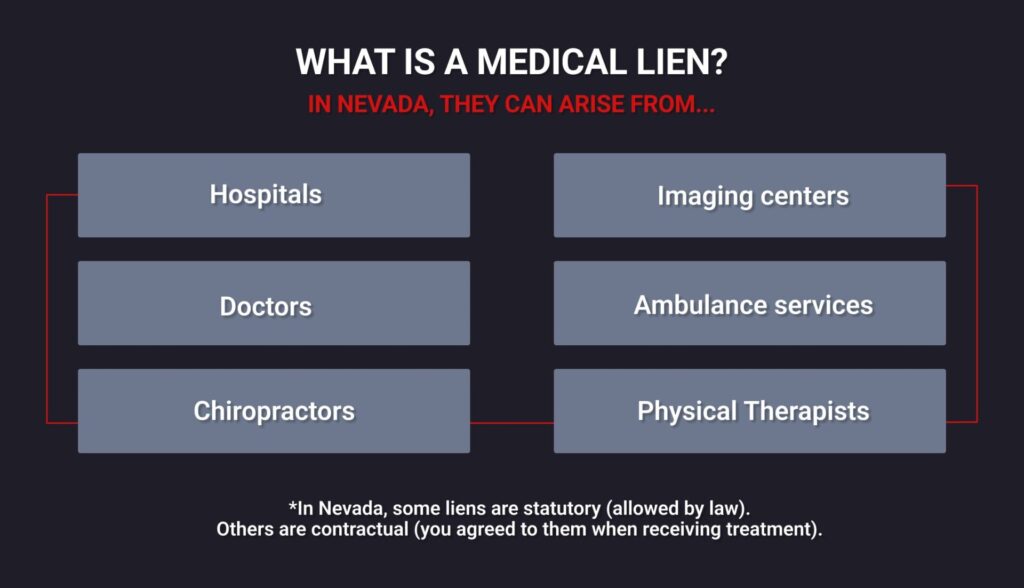
A medical lien is an agreement that lets you get treatment with little or no money upfront, in exchange for the provider being paid directly from your future settlement or verdict. Instead of billing you now, the doctor, chiropractor, or hospital agrees to wait and collect from your injury case when it resolves.
You’ll often hear this called a letter of protection. It’s a signed promise — usually between you, your medical provider, and your attorney — that the provider will be paid out of your recovery. In plain terms: you get care today, and the bill gets handled when your case is over.
Liens come into play most often when you lack health insurance, Medicare, or MedPay coverage, or when you can’t afford the deductibles and copays under a policy you already have. If paying out of pocket isn’t realistic, a lien keeps you from having to choose between treatment and rent.
How a Medical Lien Works, Step by Step
The process is simpler than it sounds:
- You sign the agreement. You, your provider, and often your Las Vegas personal injury lawyer sign a lien or letter of protection.
- You get treated now. You see the doctor, get the imaging, start the physical therapy — with no upfront payment.
- Your case resolves. You reach a settlement with the at-fault driver’s insurer, or you win a verdict.
- The provider gets paid from the settlement first. Before the remaining money reaches you, your attorney pays the medical provider out of the settlement funds.
- You keep the rest. What’s left after liens, costs, and fees is yours.
That fourth step is the one people underestimate. Lien-based bills are paid off the top, so what you take home depends heavily on how large those liens are and whether anyone negotiates them down.
Can I See a Doctor Without Insurance After a Las Vegas Accident?
Yes. If your injuries came from an accident, many Nevada providers will treat you on a lien basis — doctors, chiropractors, physical therapists, orthopedists, and imaging centers among them. You don’t need health insurance to start getting better after a wreck on the 215 Beltway or a pileup near Sahara and Decatur.
The hard part is finding providers who accept liens and who actually document your injuries well enough to support your claim. Doing that alone, while you’re in pain, is rough. Firms that handle injury cases every day keep relationships with providers who treat accident victims this way — which is why part of the value of a lawyer early on is simply getting you in front of the right doctor.
If money is the thing standing between you and treatment, read what to do when you can’t afford medical care after an accident. And if you’re worried a claim is even possible without coverage, here’s whether you can sue for injuries without health insurance.
The Types of Liens That Can Touch Your Settlement
“Medical lien” is really an umbrella term. Several different claims can attach to your recovery, and they don’t all work the same way.
- Treatment liens (letters of protection). The private agreement above, with the provider who treated you on a lien. Its terms are whatever you signed — which is exactly why you should have a lawyer read it first.
- Hospital liens. Under Nevada law (NRS 108.590), a hospital can claim a lien on your settlement or verdict for the reasonable value of the care it gave you for the injury. It isn’t an automatic blank check, though: the lien has to be properly perfected — filed and served the way the statute requires — and it’s limited to reasonable value. An inflated or improperly filed hospital lien can be challenged.
- Health-insurer reimbursement (subrogation). If you used health insurance to cover accident treatment, your insurer may later ask to be repaid from your settlement. Nevada law lets group health plans include these provisions, but the claim generally has to be properly perfected to attach.
- Government liens. Medicare and Medicaid have strong federal and state reimbursement rights that must be resolved before your case closes. If Medicaid paid for your care, Nevada requires notice to the state before you settle.
The mechanics of how all of these get paid out of the final check — the order, the math, the reimbursement fights — are their own subject. For that, see how medical bills and liens are paid after a settlement, and for the bigger-picture view of every possible payer, who pays your medical bills after an accident.
How Liens Affect What You Actually Take Home
Every lien comes out of the gross settlement, so the number that lands in your pocket is smaller than the headline figure. That’s the part clients feel. The good news is that Nevada law gives injured people real protection here — and liens are far more negotiable than most people realize.
A few things work in your favor:
- The made-whole doctrine. As a default rule in Nevada, an insurer generally can’t take reimbursement out of your settlement until you’ve been fully compensated — “made whole” — for your losses, including medical bills, lost wages, and pain and suffering. It’s a genuine shield, but not an absolute one: policy language can contract around it, and certain employer plans governed by federal ERISA law can override it. Whether it applies to your claim is fact-specific, which is why it’s worth having someone enforce it.
- MedPay can’t be subrogated. In Nevada, medical payments (MedPay) coverage under your own auto policy is not subject to subrogation. If MedPay paid some of your bills, your insurer generally can’t claw that money back out of your settlement.
- The common-fund rule. When an insurer recovers money through your case, it typically has to share in the attorney’s fees that made that recovery possible — so it can’t take a full reimbursement while you carry all the cost of the fight.
Because liens aren’t set in stone, a skilled attorney can often negotiate reductions or payment arrangements — especially when the settlement comes in smaller than hoped, or when a provider would rather take a fair reduction than wait through a long collections process. Every case is different, so treat this as general information, not a promise about your specific numbers.
Why a Lawyer Matters for Your Medical Liens
Handling liens alone is where a lot of settlement money quietly disappears. A Las Vegas personal injury lawyer does several things you can’t easily do yourself:
- Verifies the lien is valid and was properly perfected in the first place.
- Audits the bills for inflated, duplicate, or unrelated charges.
- Negotiates reductions so the liens don’t swallow your recovery.
- Enforces the protections above — made-whole, common-fund, MedPay — that insurers won’t volunteer.
This is also where Glen Howard’s background matters. Before founding Howard Injury Law, Glen spent years as an insurance-defense attorney — the lawyer on the other side, arguing to pay injured people as little as possible. He knows how carriers and their liens are valued, pressured, and reduced, because he used to run that playbook. Now he uses it for you.
And you’re not paying to find out where you stand. HIL works on contingency — no fee unless we win — and we advance case costs, so getting your liens sorted doesn’t cost you anything upfront.

Frequently Asked Questions
How do medical liens work in a personal injury case?
A medical lien lets you receive treatment now and pay for it later, from your settlement or verdict instead of out of pocket. You sign an agreement — often a letter of protection — where the provider treats you on the promise of being paid from your recovery when the case resolves. When you settle or win, your attorney pays the provider from the settlement funds before the remaining money is disbursed to you. It gives you access to doctors, chiropractors, and specialists you might not otherwise afford, and it’s common in Nevada car accident cases where the injured person has no health insurance or can’t cover copays.
How long does it take for a medical lien to clear?
A lien clears when your case resolves and the funds are disbursed — not before. Once you settle and the settlement check clears into your attorney’s trust account, your lawyer pays the liens (usually after negotiating them down) and releases your share. In straightforward cases that can take a few weeks after settlement. Liens involving government payers like Medicare or Medicaid tend to take longer, because their reimbursement amounts have to be confirmed through a federal or state process before anything is paid. If you want the bigger picture on timing, see our guide on how long it takes to get a settlement check.
How is a Medicare lien handled in a Nevada injury case?
If Medicare paid for accident-related treatment, it has a federal right to be repaid from your settlement. The amount isn’t something you calculate on a napkin — Medicare determines what it’s owed through a formal process, issuing a conditional payment amount and then a final demand, and that figure is often reduced to account for the costs of getting your recovery. Your attorney resolves the Medicare claim before your settlement is disbursed, so it’s handled correctly and you’re not left with a surprise bill later. Because these federal rules are strict and unforgiving, this is one area you don’t want to navigate without a lawyer.
Do I still owe the lien if I lose my case?
It depends on what you signed. Many treatment liens and letters of protection make you responsible for the bill regardless of whether your case succeeds — the provider treated you, and that debt exists on its own. Some providers will negotiate or reduce what’s owed if there’s no recovery, but that’s not guaranteed. This is exactly why you should have an attorney review any lien agreement before you sign it, so you understand your obligations up front rather than after the fact.
Talk to a Las Vegas Lawyer About Your Medical Liens
If you’re hurt and staring at bills you can’t pay, the answer isn’t to skip treatment or sign the first lien handed to you. It’s to get in front of the right provider and have someone who knows the insurance side make sure those liens don’t gut your recovery.
Howard Injury Law offers a free consultation to review your situation, connect you with lien-based care if you need it, and tell you honestly whether you have a case worth pursuing. There’s no fee unless we win. Request your free case review and find out where you actually stand — before the bills, and the insurance company, decide for you.