


The moments after a crash are disorienting. Your heart rate spikes, you’re trying to process what just happened while simultaneously figuring out what to do next after a serious motor vehicle accident in Las Vegas.
Many people don’t know what Nevada law requires them to do or what helps their claim, what quietly hurts it, nor do they know some of the most damaging mistakes they can make in the first hour — not because people are careless, but because nobody told them what those mistakes look like.
At Howard Injury Law, we’ll inform you on what to do after a motor vehicle accident in Las Vegas, what Nevada law requires, what evidence matters most, how to handle medical care, and how to protect your claim from the insurance company’s first move.
We handle all types of motor vehicle accident cases throughout Las Vegas and Nevada. Attorney Glen Howard spent years on the insurance defense side before representing injured people — which means he knows where claims get damaged before an attorney is ever involved. Available 24/7. No fees unless we win.
Step One: Stop, Check for Injuries, and Move to Safety
Nevada law requires every driver involved in a crash to stop immediately. Leaving the scene of an accident — even a minor one — carries serious legal consequences that can compound whatever happened in the crash itself.
Once stopped, check yourself and any passengers for injuries before anything else. Don’t assume you’re fine because you don’t feel pain immediately. Adrenaline is a powerful masking agent. Injuries to the neck, back, and head — the most common serious injuries from motor vehicle accidents — frequently don’t produce noticeable symptoms for hours or even days after the collision.
If the vehicles are drivable and can be moved out of active traffic lanes without disturbing evidence, do so. Nevada law allows and in some cases requires vehicles to be moved from a traffic lane when it’s safe to do so. If the vehicles can’t be moved, turn on hazard lights and stay clear of oncoming traffic while waiting for police.
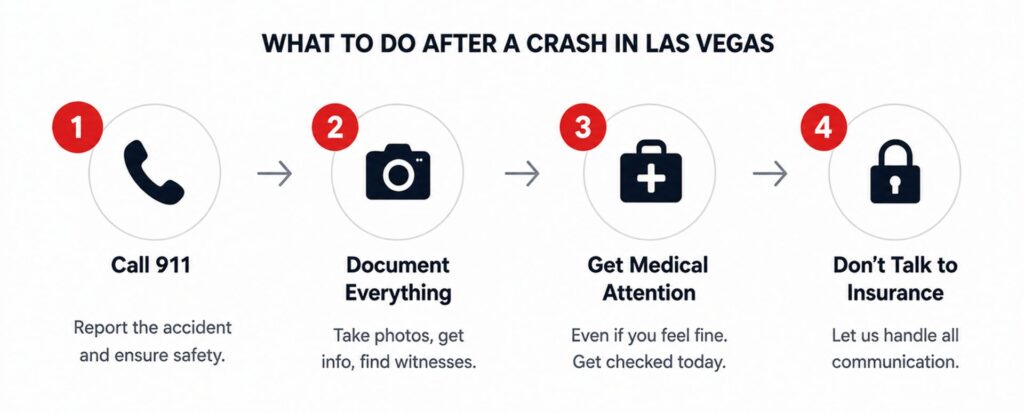
Step Two: Call 911 — Even If It Seems Minor
Call 911 immediately. Don’t assess whether the crash is “serious enough” to warrant police involvement. In Nevada, you are legally required to contact law enforcement if the crash involves any injury, any fatality, or property damage that appears to exceed $750. In Las Vegas, that threshold is met by almost any collision that causes visible vehicle damage.
A police report is the official record of the crash. It documents the scene, the vehicles involved, the initial accounts from both drivers, any observable violations, and the officer’s preliminary assessment. Your insurance company will request it. If you pursue a personal injury claim, your attorney will use it, fault is disputed, it becomes a critical piece of the evidentiary record.
If LVMPD or Nevada Highway Patrol responds, cooperate fully with the responding officer. State the facts of what happened clearly and accurately. Don’t speculate about fault, don’t apologize, and don’t minimize your injuries by saying you’re fine when you haven’t been examined.
If police do not respond to the scene — which can happen in lower-speed crashes with no apparent injuries — you may need to file an SR-1 form with the Nevada DMV within 10 days if the damage exceeds the reporting threshold or if there was any injury. Your attorney can advise whether this applies to your situation.
Step Three: Document the Scene Thoroughly
While waiting for police, document everything you can reach safely. The evidence you collect at the scene is often the most valuable evidence in your entire case — and it exists for only a few minutes before vehicles are moved, witnesses leave, and conditions change.
Photograph the following in this order: both vehicles from multiple angles showing all damage, the license plates of every vehicle involved, the overall crash scene including road conditions and any skid marks, traffic signals or signage at the intersection, any visible injuries on yourself or passengers, and any debris or fluid on the road.
Take more photos than you think you need. The detail that seems obvious standing at the scene often becomes the contested point six months later when your case is in negotiation.
Get witness contact information. Anyone who stopped or was nearby when the crash happened is a potential witness. Name and phone number is enough. Don’t ask them to make statements or commit to anything — just get their contact information while they’re still there. Witnesses who leave without being identified are gone permanently.
Write down or record a voice memo of exactly what happened while it’s fresh. Your memory of the sequence of events is sharpest in the immediate aftermath and degrades quickly under stress and time.
Step Four: Exchange Information — Carefully
Exchange the following information with every other driver involved: full name, date of birth, driver’s license number, license plate number, vehicle make, model and year, insurance carrier name, and policy number. If the vehicle is registered to someone other than the driver, get the registered owner’s information as well.
Do this calmly and factually. You are not required to discuss fault, explain your driving, or engage with an aggressive or upset driver beyond the information exchange. If the other driver becomes confrontational or refuses to provide information, document that fact and inform the responding officer.
Verify the insurance information they provide. An insurance card at the scene may be expired, belong to a different vehicle, or have been cancelled. You’ll confirm validity later — but get the card photographed regardless.
If the other driver claims not to have insurance, read what your options are when the other driver doesn’t have vehicle insurance before you make any decisions about how to proceed. Your own uninsured motorist coverage may be your primary path to recovery.
Step Five: Get Medical Attention — The Same Day
This step is non-negotiable. Get medical attention on the day of the crash, even if you feel okay.
The most common serious injuries from motor vehicle accidents in Las Vegas — soft tissue injuries, disc injuries, concussions, and internal injuries — frequently produce little or no immediate pain. The adrenaline response suppresses pain signals. The full symptom picture often doesn’t emerge until 24 to 72 hours after the crash, by which point the window to document an immediate connection between the collision and your injuries has started to close.
Insurance adjusters look hard at the gap between the crash date and your first medical visit. A delay of even a few days gives them a narrative to work with: that your injuries weren’t serious, that they predated the crash, or that something else caused them. Getting evaluated the same day eliminates that argument entirely.
Go to an emergency room, urgent care clinic, or your primary care physician. Tell them you were in a motor vehicle accident and describe every symptom, however minor it seems. Headache. Neck stiffness. Back pain. Dizziness. Difficulty concentrating. All of it goes in the record. That record becomes a foundation of your injury claim.
Follow all treatment recommendations. Gaps in treatment — weeks where you didn’t see a doctor because you felt better — are used by insurance companies to argue that your injuries resolved or were never serious. Consistent treatment documentation tells a consistent story.
Step Six: Protect Your Claim Before You Talk to Insurance
The other driver’s insurance company will contact you. They’ll be professional, even sympathetic. They’ll ask for a recorded statement about what happened.
Do not give a recorded statement to the other driver’s insurance company without speaking to an attorney first. This is not about being uncooperative — it’s about understanding that the adjuster taking your statement is specifically trained to ask questions that produce answers useful to their evaluation, not yours. A statement that seems straightforward can be used to assign you partial fault, minimize your injuries, or lock you into a version of events before you fully understand your injuries.
Your own insurance company may also request a statement. Your policy likely requires you to cooperate with your own carrier, but that obligation has limits. Consulting an attorney before either conversation protects your position without violating your policy terms.
Don’t accept any settlement offer — from either insurer — until you understand the full extent of your injuries. Early settlement offers are made before your treatment is complete specifically because insurers know that signing a release forecloses future claims, regardless of how your condition evolves.
Understanding why you shouldn’t talk to the insurance company alone after an accident is one of the most important things you can read before that first call comes in.
Step Seven: Understand What Your Claim Is Actually Worth
Most people who settle motor vehicle accident claims without legal representation recover significantly less than people who have an attorney managing the process. That’s not a sales pitch — it’s a documented pattern across personal injury claims nationwide.
The reason is simple. Insurance companies have experienced adjusters, internal guidelines for claim valuation, and legal teams available at every stage. An unrepresented claimant negotiates alone against all of that, without access to the comparable case data, medical cost projections, and legal leverage that shape what a fair offer actually looks like.
Before you decide to handle your claim independently, understand what your personal injury case may be worth — including medical costs, lost wages, future treatment needs, and non-economic damages like pain and suffering. Nevada doesn’t cap non-economic damages for most motor vehicle accident cases, which means serious injuries have significant value that early offers rarely reflect.
Also understand what the insurance adjuster is actually doing with your claim behind the scenes. Their process is systematic and strategic. Knowing what that process looks like helps you recognize when an offer is reasonable and when it’s not.
Nevada’s Reporting Requirements
Nevada law imposes specific reporting obligations after a motor vehicle accident that go beyond calling 911.
If the crash is investigated by police, the responding officer files the official accident report. You can request a copy through LVMPD for crashes within Las Vegas Metro jurisdiction, or through Nevada Highway Patrol for crashes on state highways and interstates.
If police do not respond and the crash involved injury, death, or property damage exceeding $750, you are required to file an SR-1 form with the Nevada DMV within 10 days. Failure to file when required can affect your license status and complicate your insurance claim.
Nevada law also requires drivers to remain at the scene until information has been exchanged and, if there are injuries, until emergency services have arrived and released them. Leaving prematurely — even to get medical care — should only be done after informing police or other involved parties of your destination.
Frequently Asked Questions
How long do I have to report a car accident to police in Nevada?
If the crash involves injury, death, or property damage exceeding $750, you should contact law enforcement immediately at the scene. If police do not respond and the damage threshold is met, file an SR-1 with the Nevada DMV within 10 days of the crash.
What if I feel fine after the accident?
Get medical attention anyway. Many serious injuries from motor vehicle accidents — including concussions, disc herniations, and soft tissue damage — don’t produce immediate symptoms. A same-day medical evaluation creates a contemporaneous record that protects your claim if symptoms develop later.
Should I accept the insurance company’s first offer?
Almost never. First offers are made before your treatment is complete and before the full value of your claim is established. Accepting a settlement releases the insurer from future liability regardless of how your injuries progress. Read more about whether to accept the first settlement offer from insurance in Las Vegas before making that decision.
How do I get the police report after a Las Vegas crash?
For crashes within LVMPD jurisdiction, reports can be requested through the LVMPD Records and Fingerprint Bureau online or in person. For crashes on state highways, contact Nevada Highway Patrol. Your attorney can also request the report on your behalf and often obtains it faster through established channels.
How is fault determined if the other driver disputes what happened?
Physical evidence, witness accounts, traffic camera footage, and the police report all contribute to fault determination. Nevada’s modified comparative negligence standard allows recovery even if you share some fault — as long as your percentage doesn’t exceed 50 percent. Read the full breakdown of how fault is determined in a motor vehicle accident in Nevada and how the process works.

The Next Step Is a Phone Call
What to do after a motor vehicle accident in Las Vegas comes down to this: document everything, get medical care immediately, protect your statements, and don’t accept anything until you understand what your case is worth.
The motor vehicle accident attorneys at Howard Injury Law represent injured people throughout Las Vegas and Nevada. We handle the insurance companies, the documentation, and the legal process so you can focus on recovering. Glen Howard and our team are available around the clock. Start with a free case review — no obligation, no fees unless we recover for you.
One call starts everything.