


It’s one of the first questions we hear, and it deserves a straight answer: your case is worth what you can prove it cost you — in medical bills, lost income, and the toll the injury takes on your life. There’s no fixed price and no formula that spits out a reliable figure. What there is is a set of factors that push your Nevada personal injury settlement up or down, and understanding them is how you avoid accepting far less than your claim is worth.
At Howard Injury Law, we value cases the way an insurance company does — because our founder spent years on that side of the table — and then we fight to push the number where it belongs. Here’s what actually drives it.

What Actually Determines Your Case Value
A handful of factors carry most of the weight. Some raise your claim’s value; others complicate it. This is where an experienced Las Vegas personal injury lawyer earns their keep.
How Badly You Were Hurt
Injury severity is the single biggest driver of value. A soft-tissue injury that heals in a few weeks sits at one end; a surgery, a permanent disability, or an injury that keeps you from doing your job sits at the other. The more serious and lasting the harm — and the better it’s documented — the higher the claim. That’s why thorough medical documentation quietly does more for your case than almost anything else.
Who Was at Fault
Nevada uses a modified comparative negligence rule. If you share part of the blame, your compensation is reduced by your percentage of fault — and if you’re found more than 50% at fault, you recover nothing. So a claim where the other driver is clearly and entirely responsible is worth more than one where the insurer can pin 30% of the blame on you. Adjusters know this and work hard to shift fault onto injured people, because every percentage point they move is money out of your pocket.
Your Total Damages — Economic and Non-Economic
Your damages fall into two buckets. Economic damages are the tangible costs: medical bills, lost wages, future treatment, and other out-of-pocket losses. These are easier to prove with records and receipts. Non-economic damages are the harder-to-measure harms — pain and suffering, emotional distress, loss of enjoyment of life, scarring, and strain on your relationships. They’re just as real, but they depend on documentation and how convincingly your story is told. In rare cases involving egregious conduct — a DUI crash, for example — Nevada also allows punitive damages meant to punish the wrongdoer, on top of your other compensation.
The Insurance Coverage Available
Even a strong claim is often capped by how much coverage exists to pay it. Nevada’s minimum auto liability limits are just $25,000 per person and $50,000 per accident for bodily injury. If your damages run higher than the at-fault driver’s policy, collecting the rest means looking to underinsured motorist coverage or other sources — which takes strategy. It’s one more reason the “sticker value” of a case isn’t the whole story.

How Pain and Suffering Gets Estimated
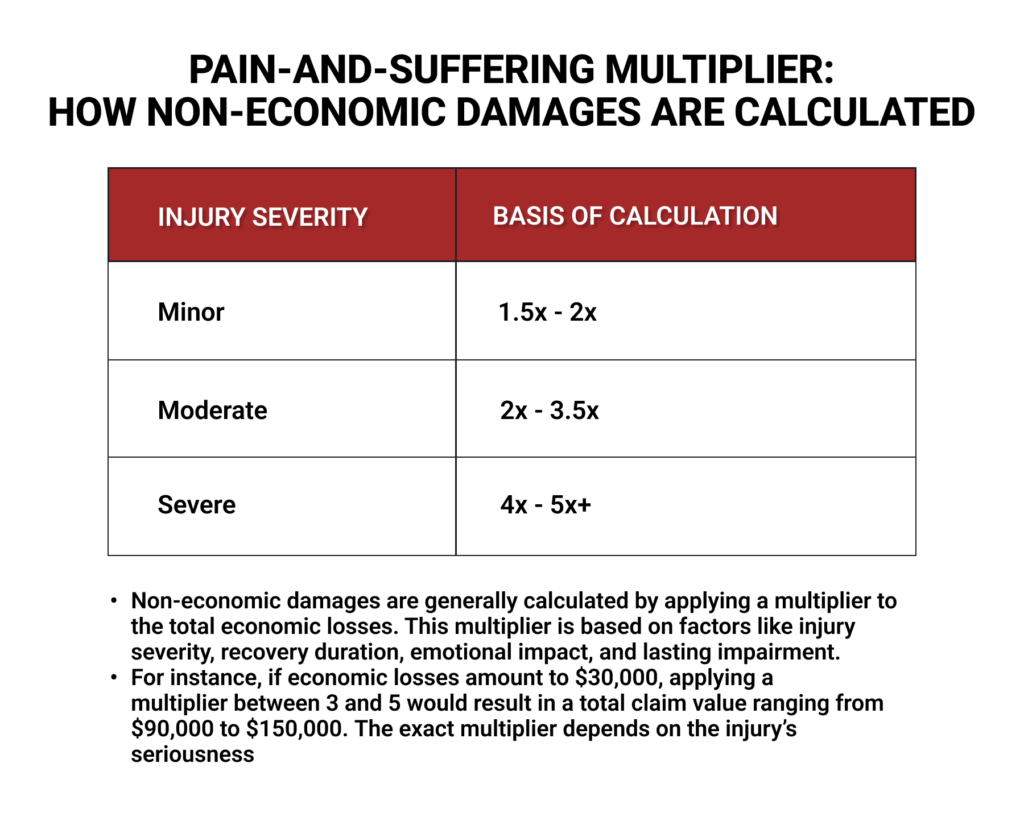
Because there’s no receipt for pain, lawyers and adjusters often start with the multiplier method — taking your economic damages and multiplying them by a figure (commonly between 1.5 and 5) based on how severe and lasting your injuries are. It’s a starting point, not a rule, and the right multiplier is heavily argued.
What it is not is a number you can trust from a web form. Online settlement calculators apply that formula blind, ignore your fault percentage and future costs, and hand you a figure that has nothing to do with what an insurer’s own software will offer. Treat any online estimate as entertainment, then get a real one from an attorney who’s seen your file.
What Increases — and Decreases — Your Settlement
The same injury can settle for very different amounts depending on how the claim is built. A few things reliably move the number:
- Strong documentation. Provable losses beat sympathetic stories. Medical records, wage statements, photos, and witness accounts are what an adjuster respects.
- Not accepting the first offer. Insurers open low, hoping mounting bills push you to sign before you know your full prognosis. The first number is almost never the real one.
- Having a lawyer who knows the other side. This is where Howard Injury Law is different. Glen Howard worked as an insurance-defense attorney before switching to representing injured people, so he knows exactly how adjusters value claims, where they stall, and which delay tactics are bluffs. That insider view is hard for the other side to play around.
And because we work on contingency, there’s no upfront cost to find out what your case is worth — and no fee at all unless we win.
Every case is different, and nothing here is a promise about yours. The only way to know your real range is to have an attorney review the specific facts.
Frequently Asked Questions
How much is my personal injury case worth?
There’s no single figure, because value depends on the specifics: how serious and permanent your injuries are, how clearly the other party is at fault, your total economic and non-economic damages, and the insurance coverage available to pay. A minor injury with a quick recovery is worth far less than one requiring surgery or causing lasting disability. Anyone who promises a dollar amount before reviewing your medical records and the facts of your accident is guessing. The honest way to get a real estimate is a case review with a Nevada personal injury attorney who can weigh all of those factors and give you a grounded range instead of a formula’s guess.
How is pain and suffering calculated in Nevada?
There’s no fixed formula. Nevada lawyers and insurance adjusters often start with the multiplier method — multiplying your economic damages (like medical bills and lost wages) by a number, commonly between 1.5 and 5, based on how severe and long-lasting your injuries are. A minor injury sits at the low end; a permanent or life-altering one at the high end. But the multiplier is a negotiating starting point, not a rule, and it’s heavily disputed. The real value of your pain and suffering comes from documentation — medical records, treatment history, and evidence of how the injury changed your daily life. A skilled injury attorney backs those damages with proof so the insurer can’t dismiss them.
Does having a lawyer increase my settlement?
Often, yes. An experienced injury attorney knows how to document damages fully, value future costs a claimant might overlook, and push back on lowball offers and inflated fault percentages. Because a lawyer understands how insurers evaluate claims, they can counter the tactics adjusters use to minimize payouts. That matters most in serious cases, where the gap between an early offer and a fully-built claim can be substantial. At Howard Injury Law, that edge comes from Glen Howard’s background defending insurance companies before he began representing injured people. Since we work on contingency, there’s no upfront cost — you only pay if we recover for you.
How long do I have to file a personal injury claim in Nevada?
Generally two years from the date of the injury, under Nevada’s filing deadline. Miss it and you can lose the right to recover entirely, no matter how strong your case is. A few situations change the clock — claims against a government entity, injuries discovered later, or cases involving a minor can carry different deadlines — so don’t assume. That deadline is about filing a lawsuit in court; it’s separate from how long your case takes to resolve or how long you negotiate with an insurer. If you’re unsure how much time you have, talk to a Las Vegas injury attorney early so the deadline never becomes the reason you lose.

Find Out What Your Case Is Really Worth
You don’t need a calculator or a guess — you need someone to look at your actual case and tell you the truth about it. Call Howard Injury Law for a free consultation, and a Las Vegas personal injury attorney will walk you through the specific factors that shape your claim’s value and what it would take to pursue it. No upfront cost, no obligation, and no fee unless we win.