


Don’t talk to the insurance company alone after an accident. That call isn’t a courtesy. The adjuster isn’t on your side. They work for the insurance company — and their job is to pay you as little as possible on your claim. Everything you say in that conversation becomes part of your permanent file and gets used to accomplish exactly that.
Here’s exactly what happens when you talk to the insurance company alone, why it consistently costs injured people money, and what to do instead.
The Adjuster’s Job Is Not What You Think
Insurance adjusters are trained claims professionals. They spend their careers evaluating accident claims, identifying statements that can reduce the company’s payout, and closing files at the lowest defensible number.
They are not neutral. They are not there to help you understand your rights. They are employees of a company with a financial interest in minimizing your recovery — and they’re very good at their job.
Understanding this dynamic before you take that first call changes everything about how you approach it. The adjuster who sounds genuinely concerned about your well-being is doing their job. Part of their job is sounding that way.
How Recorded Statements Get Used Against You
The recorded statement request comes early — sometimes within 24 hours of the accident. The adjuster explains it’s just routine, just a few questions to document what happened.
You have the right to decline a recorded statement from the other driver’s insurance company. You are not legally required to provide one. Most people don’t know this.
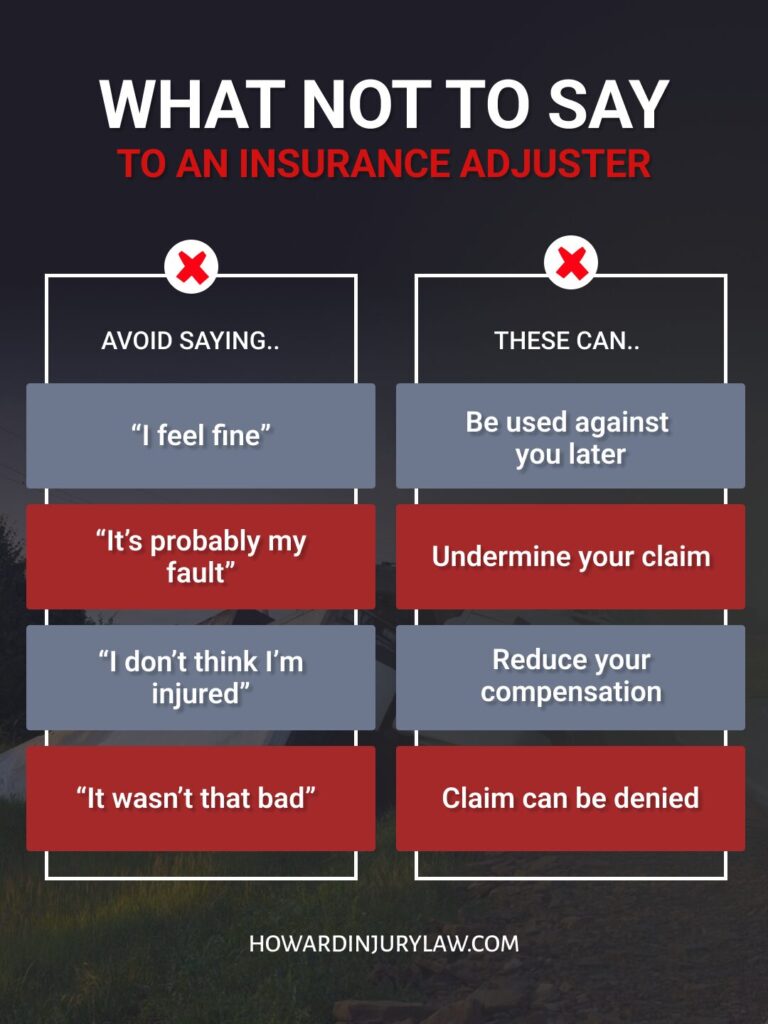
Here’s why it matters. The questions in a recorded statement sound harmless. “How are you feeling today?” “Were you able to drive away from the accident?” “Did you seek medical treatment right away?” Each answer creates a documented record that shapes how your injury gets characterized in the file.
“I’m doing okay” becomes evidence that your injuries aren’t serious.
“I drove myself home” becomes evidence that you weren’t significantly impaired.
“I didn’t go to the ER immediately” becomes evidence that your injuries didn’t warrant urgent care.
None of these statements accurately represent what actually happened to you. Adrenaline masked your pain at the scene. You didn’t know how injured you were yet. Your symptoms developed over the next 48 hours. But the recorded statement captured the version of events that existed before any of that was clear — and that version now lives in your file permanently.
An attorney intercepts this immediately. When Howard Injury Law takes your case, all insurer communication routes through us. The adjuster calls the attorney, not you. The recorded statement never happens.
The Unintentional Admission Problem
People say things after accidents that they don’t mean in a legal context. “I’m so sorry.” “I didn’t even see you.” “I was distracted.” “I should have been paying more attention.”
These statements come from shock, social conditioning, and basic human decency. They don’t reflect legal fault. But insurance companies treat them as admissions.
Under Nevada’s comparative fault rules under NRS 41.141, your recovery is reduced by your percentage of fault. If the adjuster can document that you said something that suggests partial responsibility — even an offhand apology — that statement becomes part of their argument for assigning you a share of fault and reducing their payout proportionally.
The adjuster doesn’t need you to say “it was my fault.” They need you to say anything that can be framed that way. “I didn’t see them” suggests inattention. “I was running late” suggests rushing. “The sun was in my eyes” suggests impaired visibility. Any of these gets entered into the file as a factor that could support comparative fault.
An attorney who takes over your communication eliminates this risk entirely. They speak for you. You speak to them. Nothing you say to the adjuster becomes part of your file because you stop talking to the adjuster.

The Early Settlement Offer Is a Trap
If you haven’t hired an attorney before the adjuster calls, you may receive a settlement offer early — sometimes within days of the accident.
The offer sounds reasonable. It might cover your current medical bills. It might feel generous given that you’re not sure how serious your injuries are yet. The adjuster might suggest it could expire soon or that it’s the best they can do.
Accepting that offer and signing the release closes your claim permanently. The release is a binding legal document that waives your right to pursue any further compensation for this accident — regardless of what your injuries turn out to cost.
If your soft tissue injury becomes a herniated disc requiring injections over the next three months, the release you signed covers that. If your treatment extends for six months rather than three weeks, the release covers that. If surgery becomes necessary, the release covers that.
The early offer works because your medical picture is incomplete at the time you receive it. The insurer knows this. They make the offer precisely because your future costs are unknown and you’re more likely to accept a lower number now than after you understand what your case is worth.
Howard Injury Law’s free case review gives you an independent assessment of your claim’s value before you respond to any offer. That assessment costs nothing and commits you to nothing — but it gives you the information the insurer is betting you don’t have before they make that call.
For more on why first offers are almost never fair value and what to do when you receive one, read our guide on should I accept the first settlement offer from insurance.
The Medical Records Request
After the initial contact, the adjuster may ask you to sign a medical release — a document authorizing them to request your medical records. They present this as routine, necessary to process your claim.
Don’t sign a broad medical release without attorney review.
Here’s what a broad medical release actually authorizes. The insurer gains access to your complete medical history — not just records related to your current injury, but years of prior treatment, pre-existing conditions, past injuries, and anything in your medical history that could be characterized as relevant to your current complaint.
Adjusters use this information in a specific way. They look for any prior treatment involving the same body part or the same type of complaint — a back issue from five years ago, a prior neck injury, chronic pain documented anywhere in your history. They use that history to argue that your current injury is a pre-existing condition rather than a new injury caused by the accident.
Under Nevada law, the eggshell plaintiff doctrine holds that defendants take their victims as they find them — a pre-existing condition that was aggravated by an accident doesn’t eliminate your right to recover. But the insurer’s goal is to muddy the causation picture sufficiently to minimize what they offer.
An attorney reviews medical release requests before you sign anything. They negotiate limited, specific releases that cover what’s genuinely relevant to your current claim — not your entire medical history going back a decade.
Your Own Insurance Company Isn’t Always on Your Side Either
Many people assume they can at least talk freely to their own insurer. That assumption deserves examination.
Your own insurer is obligated to handle your claim in good faith. But they also have a financial interest in minimizing payouts — even to their own policyholders. In UM/UIM claims, where you’re making a claim against your own policy because the at-fault driver was uninsured or underinsured, your insurer becomes an adverse party. They evaluate the claim the same way the other driver’s insurer would — looking for reasons to offer less.
The same principles apply. Don’t give recorded statements to your own insurer without attorney guidance on UM/UIM claims, nor sign broad medical releases without review. Don’t accept early offers without understanding the full picture of your damages.
For more on how UM/UIM claims work and why they create a conflict of interest with your own insurer, read our guide on what is uninsured motorist coverage in Nevada.
What to Say When the Adjuster Calls
You don’t need to be combative or evasive. You just need to be brief.
“I’ve retained an attorney and all communications about this claim should go through them.”
If you haven’t retained an attorney yet: “I’m in the process of consulting with an attorney. I’m not prepared to make any statements or discuss the claim at this time.”
That’s it. You’re not required to elaborate, or explain. You’re not required to be available for follow-up calls on their timeline.
The adjuster may push back. They may suggest that getting a lawyer will slow things down, that they just need a few minutes, that this will be easier without an attorney involved. These responses are designed to keep you talking without representation. Don’t engage.
Get a free case review at Howard Injury Law before your next call with any insurance company. The review costs nothing. It gives you a clear picture of your rights, your claim’s value, and what the insurer is likely to do next.
What Howard Injury Law Does the Moment You Hire Us
When you retain Howard Injury Law, we send representation letters to all insurance companies involved within 24 to 48 hours. From that point forward:
Every insurer call goes to our office, not to you. And we handle all adjuster requests to get evaluated by an attorney before you respond to anything, as well as your medical release before you sign it. And every settlement offer gets assessed against the documented value of your claim before you consider it.
You stop being a source of statements the insurer can use against you. You start being represented by an attorney who understands exactly how the insurance company is approaching your claim — because Glen Howard has worked on the defense side of these cases and knows how insurers build their files.
That shift happens immediately. And it changes the entire dynamic of how your claim gets handled from that point forward.
Frequently Asked Questions
Can I refuse a recorded statement from the insurance company?
Yes. You are not legally required to provide a recorded statement to the other driver’s insurance company. Politely decline and state that you’re consulting with an attorney. You have no obligation to cooperate with the adverse insurer’s recorded statement request.
What if I already gave a recorded statement?
Contact an attorney immediately. A recorded statement creates challenges but doesn’t close your case. Howard Injury Law assesses what was said, how it affects the claim picture, and how to build a strategy that addresses it. Don’t assume a prior statement ends your options.
What should I do if the insurance company contacts me before I have an attorney?
Tell them you’re consulting with an attorney and will have your attorney contact them. Write down the name of the person who called, the date and time of the call, and what they said. Do not agree to anything, schedule a recorded statement, or accept any offer.
Does getting a lawyer make the process take longer?
Sometimes the timeline extends — because the case gets built to its full value rather than closed at whatever the first offer was. A case that takes an additional three months to settle but produces a significantly higher recovery serves you better than a fast settlement at a fraction of your claim’s worth.
How do I start a free case review at Howard Injury Law?
Call (702) 331-5722 or visit our free case review page. Available 24/7. No fees unless we win. You don’t need documents ready — just tell us what happened and we’ll give you a straight assessment of where you stand.
The Call You Should Make Before You Answer Theirs
The insurance company calls quickly because early contact benefits them. Call Howard Injury Law first — before you respond to anything, before you give any statement, and before you sign anything.
A free case review gives you the information the insurer is counting on you not having. Once you have it, you’re no longer negotiating from a position of uncertainty. You know what your case is worth and you have an attorney making sure the insurer respects it.
Start your free case review today. Howard Injury Law is available 24/7. Call (702) 331-5722 or contact us here.