


Most people don’t know what not to say to an injury lawyer or anyone else involved in a personal injury claim. They say things reflexively — out of politeness, out of shock, out of a genuine desire to cooperate. And some of those statements get used against them.
But words matter more after an accident than at almost any other point in your life. The things you say at the scene, to the other driver, to the police officer, to the insurance adjuster, and yes — even to your own attorney — become part of a permanent record that shapes what your case is worth.
At Howard Injury Law, we’ll covers the specific phrases, habits, and communication mistakes that most consistently damage personal injury cases in Las Vegas — and what to do instead.

What Not to Say at the Accident Scene
The accident just happened. Adrenaline is running. You’re shaken. This is exactly when the most damaging statements tend to get made — and the most damaging are often the most natural.
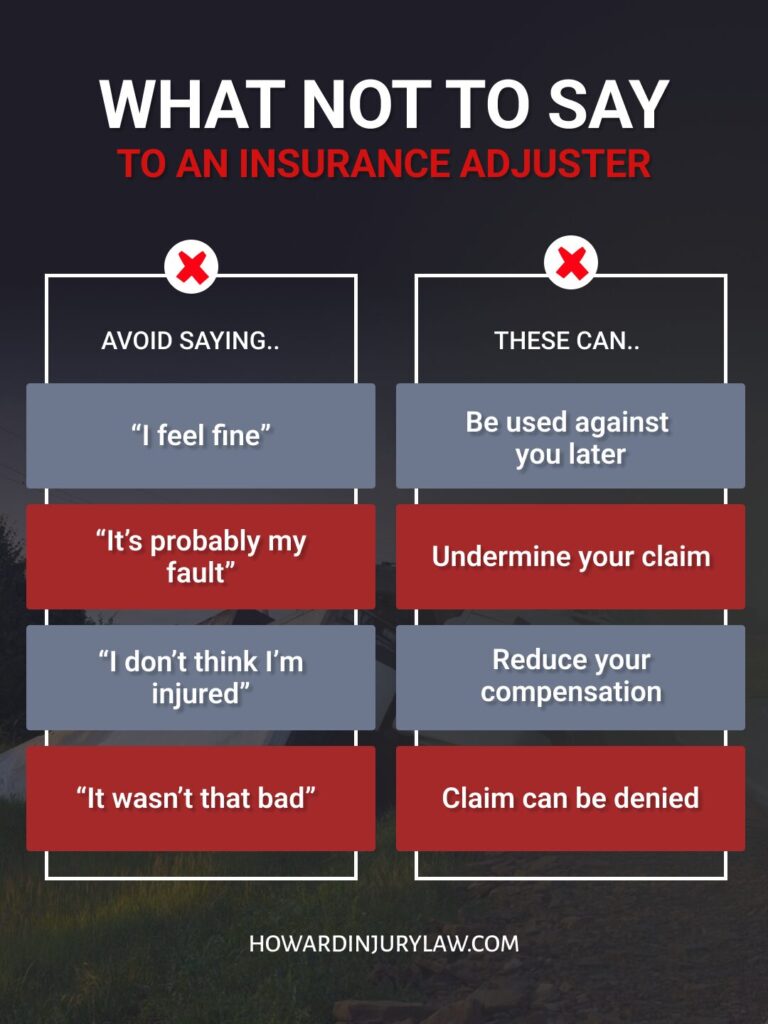
“I’m Fine” or “I’m Okay”
This is the single most common and most damaging thing said at accident scenes in Las Vegas. When the other driver, a bystander, or a police officer asks if you’re okay — the instinctive answer for most people is some version of yes.
The problem is adrenaline. Your body’s stress response during and immediately after an accident floods your system with adrenaline and cortisol — powerful pain suppressants that mask symptoms. You may genuinely feel okay at the scene and wake up the next morning unable to turn your neck. That delayed onset is medically documented and completely normal.
But “I’m fine” ends up in the police report. It gets repeated to the adjuster. It becomes part of the narrative that your injury wasn’t serious — and insurance adjusters use it relentlessly.
What to say instead: “I need to be evaluated by a doctor before I can assess my condition.” That’s accurate, measured, and creates no statement you’ll later have to explain.
“I’m Sorry” or “It Was My Fault”
Apologizing is a deeply ingrained social reflex. Many people say sorry automatically in stressful situations — even when they’ve done nothing wrong. After a car accident on Flamingo Road or a slip and fall in a casino parking structure, the instinct to apologize can be overwhelming.
In a personal injury context, “I’m sorry” or any version of “it was my fault” is an admission. Insurance adjusters are trained to document these statements. Defense attorneys will use them. Under Nevada’s comparative fault rules under NRS 41.141, any percentage of fault assigned to you reduces your recovery proportionally — and an admission at the scene hands the insurer exactly the argument they need.
What to say instead: Nothing about fault. Exchange insurance and contact information. Let the evidence establish what happened.
Speculating About What Happened
“I didn’t see the light.” “I was going too fast.” “I wasn’t paying attention.” Speculation about your own actions or observations — even offered innocently — creates a version of events that can be very difficult to walk back.
You don’t know yet exactly what happened. You were in an accident. Your adrenaline was spiking. The sequence of events may have been confusing. Don’t fill gaps in your knowledge with guesses. Stick to what you directly observed.
What Not to Say to the Insurance Company
The other driver’s insurance company will call. They’ll call quickly — sometimes within 24 hours of the accident. The adjuster will be friendly, efficient, and prepared.
Don’t Give a Recorded Statement
You are not legally required to give the other driver’s insurer a recorded statement. This bears repeating because many people don’t know it and many adjusters don’t volunteer the information.
A recorded statement is a formal opportunity for the insurer to document anything you say that can be used to minimize your claim. “The accident wasn’t that bad.” “I’ve been moving around okay.” “I’m not sure if my back pain is from this or an old injury.” Every one of those statements, captured on a recording, becomes ammunition.
Politely decline: “I’m represented by an attorney and all communications should go through them.” If you haven’t hired an attorney yet: “I’m not prepared to give a recorded statement at this time.” Then call a lawyer before you say anything further.
Don’t Accept the First Settlement Offer
The first offer from an insurer is almost never a full-value offer. It’s a test — made early, before your full injury picture has developed, before you know what your treatment will cost, before anyone knows the long-term impact of your injuries.
The adjuster who makes that call is friendly and the number may sound reasonable. But signing a release closes your claim permanently. If your soft tissue injury turns out to be a herniated disc requiring surgery three weeks later, there is no reopening the file.
Don’t discuss settlement with the insurance company at all before speaking to an attorney. What you’re entitled to recover includes medical expenses, lost wages, future treatment costs, and pain and suffering. The early offer reflects none of that.
What Not to Say to Your Own Attorney
This is the part of what not to say to an injury lawyer that surprises people — because the advice here is the opposite of what applies everywhere else.
Don’t Hide Your Medical History
People frequently worry that pre-existing conditions will hurt their case — a prior back injury, a previous car accident, a chronic pain condition. The instinct is to keep those details quiet.
This is one of the most damaging mistakes in personal injury cases. Here’s why.
Insurance companies investigate medical history. They request medical records, check prior claims, look for prior injuries that overlap with your current complaint — and when they find one you didn’t disclose, your credibility takes a serious hit that extends beyond just the pre-existing condition question.
Your attorney, on the other hand, can work with pre-existing conditions. Nevada law follows the eggshell plaintiff doctrine — a defendant is responsible for aggravating a pre-existing condition just as they’re responsible for a new injury. An accident that worsened a prior back condition is fully compensable. But your attorney needs to know about the prior condition to build that argument correctly.
Tell your attorney everything. The history you think will hurt you is often manageable. The history they discover because you didn’t disclose it is the history that actually causes damage.
Don’t Minimize Your Symptoms
The same impulse that makes people say “I’m fine” at the accident scene sometimes carries into conversations with their own attorney. People downplay pain, understate limitations, and describe their symptoms as less severe than they are — either because they don’t want to seem like they’re exaggerating or because the symptoms seem minor compared to what they expected.
Your attorney builds your damages picture from what you tell them — and from your medical records. If you describe mild discomfort when you’re actually having significant pain, that description shapes the demand package. Tell your attorney exactly how you feel, what you can’t do, what has changed since the accident. Specificity serves you.
Don’t Exaggerate Either
The opposite mistake is equally damaging. Overstating symptoms, claiming limitations that don’t exist, or describing pain that isn’t present gives the defense exactly the evidence they need to attack your credibility across your entire case.
Insurance defense attorneys are skilled at identifying exaggeration. Surveillance, social media, inconsistent medical records — the tools for exposing overstatement are well-developed. When a claim is caught in an exaggeration, the insurer’s response is to discount the entire case — including the legitimate injuries — on credibility grounds.
Tell your attorney what’s actually happening. Accurate, complete, and specific. That’s the standard that produces the best outcomes.
What Not to Post on Social Media
This one catches people off-guard because social media activity feels disconnected from a legal claim. It isn’t.
Anything About the Accident
Don’t post about the accident, the other driver, the injuries, or anything related to the claim on any platform. Don’t post to seek sympathy, to process the experience, or to update friends and family. Every post is potentially discoverable in litigation.
Anything About Your Activity Level
Defense teams and insurance investigators actively monitor the social media accounts of personal injury claimants. A post showing you at a concert, on a hike, at the gym, or dancing at a wedding — even once, even on a good day — gets used to argue your injuries aren’t as limiting as claimed.
Private accounts are not safe. Privacy settings don’t eliminate discoverability in legal proceedings. Courts have ordered the production of private social media content in personal injury cases.
The rule is simple: don’t post anything about your life, your activities, or your physical condition for the duration of your case. This applies to Instagram, Facebook, TikTok, X, Snapchat, and any other platform where content could be screenshotted and preserved.
Check-Ins and Location Tags
Even an innocent check-in at a location that suggests physical activity — a hiking trail, a sports venue, a gym — can be used to challenge your claimed limitations. Suspend location sharing and check-in features during your case.
What Not to Say About Your Case to Anyone Other Than Your Attorney
Attorney-client privilege protects your communications with your attorney. It doesn’t protect conversations with friends, family members, or coworkers about your case.
Don’t Discuss Case Details Broadly
Well-meaning friends and family members sometimes share information about your case without realizing the implications. “She told me the accident was partly her fault” said by a friend on social media, or a family member discussing your claim in a public setting — these conversations can surface in ways you don’t anticipate.
Keep case details within the attorney-client relationship. Tell your attorney everything. Tell everyone else as little as possible about the specifics.
Don’t Post Complaints About the Other Driver or Their Insurer
Venting online about the other driver or the insurance company — however justified — creates a discoverable record of statements that can be characterized as biased, hostile, or inconsistent with your claimed damages.
Process those frustrations privately. Let your attorney handle the substantive communication.
The One Thing You Should Always Say
After an accident in Las Vegas, there is one statement that protects you better than any other in the first moments:
“I need to speak to my attorney before I answer questions or make any statements.”
You don’t need to be aggressive or uncooperative. You can be calm, polite, and matter-of-fact. But establishing that boundary immediately — before you’ve said anything potentially damaging — is the single most protective step available to you.
For a full picture of what to look for when choosing the attorney you’ll be protecting your communication for, read our guides on questions to ask during a personal injury consultation and red flags when hiring a personal injury lawyer.
Frequently Asked Questions
What if I already said “I’m fine” at the accident scene?
It creates a challenge — not a closed case. What you said at the scene is one piece of evidence. Your medical records, your treatment timeline, and your documented symptoms are also evidence. An experienced attorney can contextualize early statements against the full picture of what your injuries actually turned out to be.
Does saying sorry really count as admitting fault?
In Nevada, apologies made in the context of an accident can be treated as admissions. Nevada does not have an apology statute that excludes expressions of sympathy from evidence. Err on the side of saying nothing about fault.
Can the insurance company access my private social media?
In active litigation, yes — courts can order production of social media content. Private settings don’t guarantee protection. The safest approach is treating everything you post as potentially visible to the defense.
What if I already gave a recorded statement?
Call an attorney immediately. A recorded statement creates challenges but doesn’t end your claim. An experienced attorney assesses what was said and builds a strategy around the full evidence picture — not just the recorded statement in isolation.
What’s the difference between minimizing symptoms and just not wanting to complain?
Tell your attorney everything — even the things that feel minor. What seems like minor discomfort to you may be legally significant. Your attorney determines what matters for your claim. Your job is to give them accurate, complete information and let them make that evaluation.
Say Less to Everyone Else. Say Everything to Your Attorney.
Knowing what not to say to an injury lawyer — and to everyone else involved in your claim — comes down to one principle: be fully transparent with your attorney and carefully conservative with everyone else.
Your attorney is bound by privilege and professional ethics to use everything you tell them in your interest. Everyone else — adjusters, the other driver, social media followers — is not.
Howard Injury Law is available 24/7 for free consultations. If you’ve already said something you’re worried about — or if you’re still in the early hours after an accident — call now. (702) 331-5722 or contact us here.