


What does the insurance adjuster actually do with your claim after an accident in Las Vegas? You noticed how they call quickly and expresses concern. The conversation feels helpful…
But what actually happens behind that call is a methodical process designed to minimize what the insurance company pays you. Understanding what the insurance adjuster actually does with your claim — from the moment they open your file to the moment they make an offer — removes the mystery and puts you in a better position to protect your recovery.
Here’s the full picture of how adjusters build, evaluate, and settle personal injury claims in Nevada.

What an Insurance Adjuster Is
An insurance adjuster is a claims professional employed by or contracted to an insurance company. Their job is to investigate accidents, evaluate claims, and determine how much the company should pay — or whether it should pay at all.
Adjusters are not neutral third parties. They work for the insurer, and their performance gets measured partly by how efficiently they close files and how much they contain claim costs. Understanding this incentive structure explains every tactic that follows.
Some adjusters handle claims in-house as company employees. Others work as independent adjusters contracted by insurers. Either way, their job and their loyalties are the same — they work for the insurance company, not for you. However, at Howard Injury Law, we work for you. Contact us for a free case review.
Step One — Opening the File
The moment an accident gets reported, the adjuster opens a file. Everything that enters that file from this point forward shapes the claim’s outcome.
The adjuster immediately documents the basics — the date, time, and location of the accident, the parties involved, the vehicles, and the initial description of what happened. They pull the police report if one was filed, note any witness information, document your initial contact and what you said during it.
That first phone call — the one that comes within 24 to 48 hours — serves a specific purpose. The adjuster wants your account of the accident while the details are still fresh and before you’ve spoken to an attorney. They’re building the initial narrative of what happened and gathering statements they can use throughout the file.
What you say in that first call gets documented word for word. “I didn’t see them coming.” “I might have been going a little fast.” “I’m not sure who had the right of way.” Each of these becomes a file entry that the adjuster references throughout the claim.
Step Two — Investigating Liability
After opening the file, the adjuster investigates liability — the question of who caused the accident and to what degree.
How Adjusters Assign Fault
The adjuster reviews every available piece of evidence to construct their liability determination. The police report is their primary anchor — officer observations, citations issued, and any fault determination in the report carry significant weight.
They review photographs from the scene, looking at vehicle positions, damage patterns, skid marks, and the surrounding environment. Damage patterns tell a story about the mechanics of the collision — where the impact occurred, the direction of force, and the speeds involved.
They contact witnesses. Witness accounts that align with their preferred liability narrative get weighted heavily. Conflicting accounts get noted but managed strategically.
They review any surveillance footage obtained early in the process. In Las Vegas, this includes traffic signal cameras operated by NDOT, casino perimeter cameras, and business security systems along major corridors. Adjusters request this footage themselves — which is exactly why your attorney needs to request preservation of the same footage immediately, before the insurer has shaped the evidentiary record.
Comparative Fault — The Reduction Tool
Nevada’s comparative fault rules under NRS 41.141 reduce your recovery by your percentage of fault. The adjuster actively looks for any evidence that assigns you a share of responsibility — because every percentage point of fault assigned to you is a percentage point reduction in what the insurer pays.
They review your statements for admissions, look at the police report for any indication you contributed to the accident, and examine your driving history if it becomes relevant. They analyze whether your vehicle had any issues — tires, brakes, lights — that could suggest contributory negligence.
An adjuster who can document that you were 20% at fault reduces their client’s payment obligation by 20%. That’s a significant financial incentive to find fault wherever the evidence allows.

Step Three — Medical Review
After establishing the liability picture, the adjuster turns to your injuries. This is where the file-building process most directly affects your payout.
What Adjusters Look for in Medical Records
Adjusters review your medical records with a specific lens — they’re looking for anything that reduces the connection between the accident and your injuries or limits the severity of what they’ll have to compensate.
They look for gaps in treatment. If you saw a doctor the day after the accident and then didn’t follow up for three weeks, the adjuster documents that gap and uses it to argue your injuries weren’t serious enough to require consistent care. Gaps in your treatment timeline are one of the primary tools for minimizing claims.
They look for pre-existing conditions. Any prior treatment involving the same body part — a prior neck injury, a previous back complaint, documented chronic pain — becomes a basis for arguing your current symptoms predate the accident. They request broad medical releases specifically to find this history, then use it to suggest your current condition is a continuation of something that was already there rather than a new injury caused by the crash.
They look for inconsistencies between your reported symptoms and your documented treatment. If you tell the adjuster your pain is severe but your medical records show you declined physical therapy recommendations, they document the inconsistency and use it to challenge the severity of your complaint.
The Broad Medical Release Request
The adjuster may ask you to sign a medical release authorizing them to request your records. A broad release gives them access to your complete medical history — not just records related to your current injury, but years of prior treatment.
Don’t sign a broad medical release without attorney review. An attorney negotiates limited, specific releases covering what’s genuinely relevant to your current claim — not a blank check to dig through your entire medical history looking for anything that could reduce the payout.
Step Four — Calculating the Offer
After building the liability picture and reviewing the medical file, the adjuster calculates what they’ll offer. This calculation uses specific internal systems and formulas.
How Adjusters Value Claims
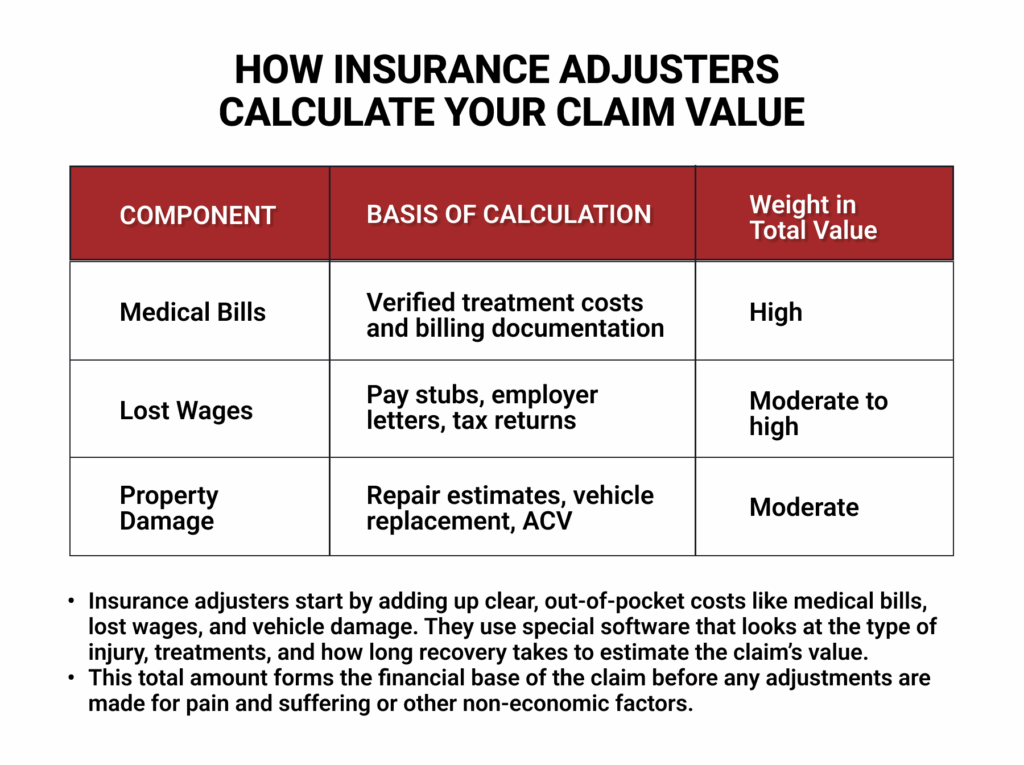
Most insurance companies use proprietary software systems — Colossus is the most widely known — to calculate claim values. The software inputs your documented medical expenses, injury type, treatment duration, and other factors, then generates a value range for the claim.
The system has built-in tendencies. It weights documented medical treatment heavily — which is why gaps in treatment reduce the calculated value so significantly. It categorizes injury types and applies value ranges to each category, which is why how your injury gets documented and described affects the system’s output.
Adjusters work within the range the system produces. They typically start at the lower end of that range. Their opening offer reflects what they think you’ll accept — not the full value of what the system calculated.
How the Insurance Defense Background Changes This
Glen Howard’s experience working on the insurance defense side of personal injury claims includes direct exposure to how these internal valuation systems work. We understand which factors drive value in the adjuster’s calculation and which documentation gaps they exploit to push the value down.
We build every case from day one with adjuster evaluation criteria in mind. Medical documentation gets assembled to address the factors the software weights most heavily. Demand packages get structured to counter the arguments we know the adjuster will raise — because we’ve raised those arguments ourselves.
For more on how that inside knowledge affects your claim, read our guide on intimate knowledge of Nevada insurance law.
Step Five — Making the Offer
The adjuster makes their opening offer based on the file they’ve built. That opening offer reflects their lowest defensible position — what they believe they can settle for before you push back effectively.
Why the First Offer Is Almost Never Fair Value
The first offer comes before your medical treatment is complete, before your future costs are known, and before a documented demand has been submitted. It reflects the adjuster’s best guess at the minimum you’ll accept — not the full value of your documented damages.
The insurer’s goal at the offer stage is to close your file before the full damages picture develops. Early settlement eliminates their exposure to future medical costs, escalating treatment expenses, and the increased leverage that comes from thorough case preparation.
Accepting the first offer and signing the release closes your claim permanently. For a complete explanation of why first offers are almost always below fair value and what to do when you receive one, read our guide on should I accept the first settlement offer from insurance.
How Adjusters Respond to Represented Claimants
The dynamic changes significantly when an attorney enters the picture. When Howard Injury Law sends a representation letter, several things happen immediately.
The adjuster stops calling you. All communication routes through the attorney. The recorded statement opportunity closes. The informal information-gathering that produced your early file entries stops.
The adjuster’s internal evaluation of the claim changes. Represented claimants are more likely to litigate. Litigation costs money. It extends timelines. And in Clark County, juries can award significantly more than the insurer’s internal valuation. That exposure affects how the adjuster calculates what a reasonable settlement looks like.
An attorney who is known to be trial-ready — who has demonstrated willingness to file lawsuits and try cases to verdict — produces a different file evaluation than an unknown or settlement-focused attorney. For more on how trial readiness affects settlement value, read our guide on elite trial strength and what it means for your Las Vegas personal injury case.
What You Can Do With This Information
Understanding what the insurance adjuster actually does with your claim gives you a clear picture of where your claim is vulnerable and what protects it.
Don’t give a recorded statement before consulting an attorney. Every statement you make becomes a file entry that shapes the adjuster’s liability and damages analysis.
Don’t sign a broad medical release without attorney review. Limit the adjuster’s access to your medical history to what’s genuinely relevant to your current injury.
Stay consistent with your medical treatment. Treatment gaps are the adjuster’s primary tool for minimizing injury severity. Consistent documentation closes that vulnerability.
Don’t respond to settlement offers without an independent assessment. The adjuster knows what your file says. You should know what your case is worth before you respond to anything they offer.
Start your free case review at Howard Injury Law before your next interaction with any adjuster. The review gives you the information the adjuster is counting on you not having — and it costs nothing.
Frequently Asked Questions
Can the adjuster access my social media?
Yes — adjusters actively monitor the social media accounts of personal injury claimants. Posts showing physical activity, travel, or normal daily function get used to challenge claimed injury severity. Treat all social media as potentially visible to the defense and avoid posting anything about your activities or physical condition during your case.
What if the adjuster says their offer is final?
A “final offer” from an adjuster before a documented demand has been submitted is a negotiating position, not a legal fact. Adjusters have authority to increase offers — they simply prefer not to unless they believe the alternative is litigation. The offer becomes more final when the claimant has legal representation and the representative has demonstrated willingness to file suit.
How long does the adjuster have to settle my claim in Nevada?
Nevada law imposes timeline obligations on insurers for settling claims once liability is reasonably clear and damages are documented. Violations of these timelines can support bad faith claims under Nevada’s Unfair Claims Settlement Practices Act. Your attorney monitors these timelines as part of managing your claim.
Should I talk to the adjuster at all?
After an accident, the safest approach is to report the claim to your own insurer and then direct all further communication through your attorney. For the at-fault driver’s insurer, you have no obligation to speak with them at all. For more on why you shouldn’t talk to the insurance company alone, read our guide on why you shouldn’t talk to the insurance company alone.
What does a free case review at Howard Injury Law involve?
A free case review covers the facts of your accident, the liability picture, your injury documentation, and an honest assessment of what your claim is worth and how the adjuster is likely to approach it. It costs nothing and commits you to nothing — but it gives you the information you need to make informed decisions about every interaction with the insurance company.
Know What They’re Doing Before They Do It
The adjuster who calls you is not working in your interest. They’re building a file designed to minimize what the insurance company pays. Understanding that process — the liability investigation, the medical review, the internal valuation, the strategic offer — puts you in a position to protect your claim instead of inadvertently weakening it.
Start your free case review at Howard Injury Law before your next adjuster interaction. Available 24/7. Call (702) 331-5722 or contact us here.