


You didn’t call a personal injury lawyer in Las Vegas the day it happened. Maybe you thought you’d be fine. Maybe you were dealing with work, family, the ER bill — everything life doesn’t pause for after an accident. Maybe you didn’t feel seriously hurt until days later, and by the time you realized something was wrong, weeks had already passed.
Now you’re wondering if you waited too long. If the window closed. If the insurance company can just say no because you didn’t move fast enough.
Here’s the direct answer: in most cases, no — you haven’t waited too long. Nevada law gives you significantly more time than most people realize. What has changed is the evidence picture — and how you handle the next few days matters more than how many weeks have already passed.

What Nevada Law Actually Says About Filing Deadlines
There are two separate deadlines in Nevada personal injury cases — and most people confuse them or don’t know both exist.
The Statute of Limitations — Your Legal Deadline to File a Lawsuit
Nevada’s statute of limitations for personal injury claims is two years from the date of the accident under NRS 11.190. For property damage claims — your vehicle — it’s three years.
These are the hard legal deadlines. Miss them and your right to file a lawsuit is permanently barred regardless of how strong your case is. No exceptions, no extensions, no matter how compelling your circumstances.
If your accident was three weeks ago, you have approximately 23 months remaining on the personal injury deadline. That is not a tight window. That is substantial time — but it is not infinite time, and every week that passes makes evidence harder to reconstruct.
One Critical Exception — Government Vehicles
If your accident involved a city bus, a county vehicle, a state-owned car, or any other government-operated vehicle, the rules change dramatically. The Nevada Tort Claims Act requires you to file a formal Notice of Claim within six months of the accident. Miss that window and your claim against the government entity is gone — even though the two-year personal injury statute hasn’t expired.
If there’s any possibility a government vehicle was involved, contact a Las Vegas personal injury attorney immediately. Six months sounds like plenty of time until you realize how fast it moves.
Insurance Policy Deadlines — The Other Clock
The statute of limitations is your legal deadline. Your insurance policy has its own separate reporting requirements — and these are often much shorter.
Most Nevada auto insurance policies require you to report an accident “promptly” or “as soon as practicable.” Some policies specify 30 days. Some are vaguer. The specific language in your policy determines what “too late” means for your insurer.
This matters because failing to report within your policy’s window can give your own insurer grounds to deny coverage — even if you’re well within Nevada’s two-year legal deadline. These are two different clocks running simultaneously, and both need to be addressed.
If weeks have passed without notifying your insurer, call them now — before doing anything else. Then call a lawyer.
The Delayed Injury Problem — Why People Wait and What It Costs
Most people who call weeks after an accident didn’t wait because they were being strategic. They waited because they genuinely didn’t think they were seriously hurt.
Why Injuries Appear Days or Weeks After a Crash
The physiology of crash injuries explains delayed symptoms completely. When your body is in a stress response — which it is during and immediately after an accident — adrenaline and cortisol suppress your perception of pain. You feel shaken but okay. You tell the officer you’re fine. You drive home.
Forty-eight hours later, you can’t turn your neck. A week later, you’re getting headaches that won’t go away. Three weeks in, your lower back has gotten progressively worse and your doctor is ordering an MRI.
This is the documented pattern of soft tissue injuries, whiplash, herniated discs, and in some cases traumatic brain injuries. None of these require a violent crash. A rear-end collision at 20 mph can produce a cervical disc herniation with delayed symptom onset. The crash looked minor. The injury wasn’t.
What the Delay Actually Costs You
The problem with a delay isn’t that your injury isn’t real. It’s that the gap between the accident date and your first medical record creates a narrative that insurance adjusters exploit relentlessly.
“If you were really hurt, why did you wait three weeks to see a doctor?”
That question — asked by an adjuster, raised in a deposition, argued by defense counsel — is the weapon that delayed treatment creates. It doesn’t invalidate your claim. But it requires a direct, documented counter-narrative.
The counter-narrative is built on the medical evidence of what actually happened — your body’s stress response at the scene, the typical onset timeline for your specific injury type, the clinical documentation showing your symptoms began in direct relation to the accident, and your explanation for why you delayed. All of that can be documented. None of it requires you to have done everything perfectly in the first 24 hours.
What an Insurance Company Can and Cannot Do With a Delayed Claim
Insurance companies use delayed reporting and delayed medical treatment as tools to minimize or deny claims. Understanding exactly what they can and can’t do puts you in a stronger position.
What They Can Legitimately Argue
An insurer can argue that the delay in reporting made their investigation harder — that evidence was lost, witnesses dispersed, and the accident scene changed before they had a chance to evaluate it. That argument reduces their obligation to accept your account of events at face value.
They can argue that the gap in medical treatment suggests your injuries were not as serious as claimed, or that a subsequent event — not the original accident — caused your current symptoms.
These are legitimate legal arguments. They’re not automatic denials. They’re challenges that need to be addressed with specific evidence and a clear factual narrative.
What They Cannot Do
They cannot automatically deny your claim solely because weeks passed before you reported. Nevada law does not require same-day reporting to preserve your legal rights. An insurer who denies a valid claim purely on delay grounds — without demonstrating actual prejudice from the delay — may be acting in bad faith under NRS 686A.310.
They also cannot use the absence of a police report as grounds for automatic denial. No police report is a challenge to your claim, not a disqualifier. If you need to understand your options when no report exists, read our full guide on filing a personal injury claim without a police report in Nevada.
The Evidence Problem — What’s Gone and What Isn’t
This is the real cost of waiting — not the legal deadline, but the evidence window.
What’s Almost Certainly Gone
Surveillance footage. In Las Vegas, casino cameras, traffic signal systems, and business security footage typically overwrites on a 24 to 72-hour cycle. If your accident was three weeks ago, that footage is gone. That’s a permanent loss regardless of how strong the rest of your case is.
Skid marks and physical road evidence. Road surfaces in an active city get cleaned and repaired quickly. Physical evidence at the crash scene is almost certainly gone.
Witness recollections. Memories that were sharp in the first 48 hours are significantly hazier three weeks later. In Las Vegas specifically, witnesses near tourist corridors — the Strip, Fremont Street, casino parking structures — may have been visiting from out of state and are now home. Tracking them down is possible but exponentially harder.
What’s Still Fully Available
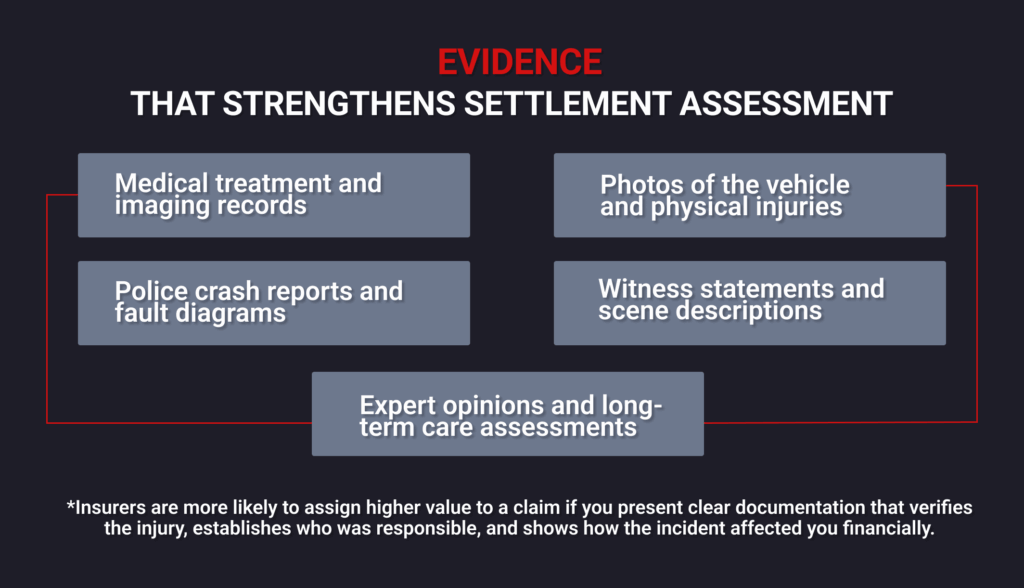
Your medical records. Every examination, every symptom documented, every imaging result — your complete medical history is preserved and buildable from this point forward. A gap in early treatment is a narrative challenge, not a records destruction.
The police report. If one was filed, it still exists and is fully obtainable regardless of when you request it.
Your vehicle damage documentation. Repair estimates, insurance photos, body shop records — all of these exist in systems and are retrievable.
Your own account. Written contemporaneously — meaning today, while your memory is still relatively clear — your description of the accident, the symptoms you experienced, and the timeline of your physical decline is valuable evidence. Write it down. Specifically. Date it. Send it to your attorney.
The other driver’s information. Insurance policy, license, registration — all of this is still traceable.
What to Do Right Now — In This Order
The gap between what happened and today is fixed. What you do in the next 72 hours is not.
Step 1 — Notify Your Insurance Company Today
Don’t wait another day. Call your insurer, report the accident, and ask them to note the date of the original incident. Do not elaborate extensively on why you waited — keep it brief and factual. Get a claim number.
Step 2 — See a Doctor Today or Tomorrow Morning
If you haven’t sought medical treatment, do it now — not next week. Your medical records from this point forward establish the injury timeline. Every additional day without documentation is another day the gap widens and the adjuster’s narrative gets stronger.
When you see your provider, tell them the complete story — the date of the accident, every symptom you’ve experienced since, and how your condition has changed over time. Don’t minimize anything. That clinical record is the foundation of your claim.
If cost is a barrier, Nevada’s medical lien system allows providers to treat you now and get paid from your settlement later. You don’t need to pay out of pocket to access care. Read our guide on how medical liens work in Nevada for the full breakdown.
Step 3 — Write Down Everything You Remember
Today, before more time passes. The accident itself — where you were, what happened, the sequence of events, what the other driver said, what you saw, road conditions, time of day. Then the symptom timeline — what you felt immediately after, how it changed over the following days and weeks, what’s happening right now.
This contemporaneous account has real evidentiary value. It documents your experience during the gap period when no medical records exist.
Step 4 — Contact Howard Injury Law Before Talking to the Other Driver’s Insurer
The at-fault driver’s insurance company may already be aware of the accident. They may contact you. Do not give them a recorded statement before speaking with an attorney.
A Las Vegas personal injury attorney will assess your specific situation — how long has passed, what evidence still exists, what your insurance policy requires, and what a realistic path forward looks like. That assessment is free. It costs you nothing and commits you to nothing.
Frequently Asked Questions
Can the other driver’s insurance deny my claim because I waited weeks to report?
They can raise the delay as a challenge to your claim — arguing it complicated their investigation. They cannot automatically deny a valid claim solely because of the delay without demonstrating actual prejudice. Nevada’s bad faith insurance statutes under NRS 686A.310 impose obligations on insurers to handle claims in good faith regardless of reporting timeline. An insurer who denies without proper basis faces legal exposure.
What if I didn’t file a police report at the time?
The absence of a police report is a challenge, not a disqualifier. Many accidents happen in ways where police don’t respond or a report isn’t filed — private property crashes, minor-seeming accidents where both drivers agree not to call. Without a report, your claim relies on other evidence. An attorney assesses what’s available and builds around the gap. For a full guide see our post on filing a personal injury claim without a police report in Nevada.
Does the two-year deadline apply to uninsured motorist claims too?
Generally yes — Nevada’s two-year personal injury statute applies to UM/UIM claims as well, though your specific policy language may impose shorter reporting requirements. This is exactly the kind of policy-specific question that needs a legal review before you assume you’re still within your window.
What if I settled a small claim with the driver directly after the accident?
If you signed any document — even an informal written agreement — those documents need to be reviewed immediately. A signed release, even an informal one, can bar your right to pursue further compensation. Contact an attorney before assuming any informal agreement is binding or unenforceable. Read our guide on what to expect when you call a personal injury lawyer for what that conversation looks like.
How does Nevada’s comparative fault rule affect a delayed claim?
Nevada’s modified comparative fault rule under NRS 41.141 allows you to recover compensation even if you were partially at fault — as long as your fault doesn’t exceed 50%. Your percentage of fault reduces your recovery proportionally. A delay in treatment doesn’t assign fault — but it does affect the damages calculation if an insurer argues your injuries worsened due to lack of treatment rather than the original accident. Learn more about Nevada’s statute of limitations and fault rules.
Time Has Passed — But Your Options Haven’t Expired
A few weeks is not the end of your claim. Nevada gives you two years. The evidence window has narrowed — but what remains is still buildable into a strong case with the right approach.
The move right now is simple: notify your insurer, see a doctor, write down what you remember, and get a free legal assessment before talking to anyone else.
Howard Injury Law is available 24/7. Call (702) 331-5722 or contact us here. No fees unless we win. No obligation on the call. Just a straight answer about where you stand.