


You’ve been in an accident. You’re dealing with pain, medical appointments, insurance calls, and a hundred questions you don’t know how to answer. Somewhere in the back of your mind, you’re wondering whether you should call a lawyer — but you’re not sure what that actually means.
What happens on that call? What do they ask? What do you have to bring? How much does it cost? And do you have to commit to anything?
These are the questions most people have before they ever dial. This is the honest, no-jargon answer to all of them.

The First Call — What It Actually Is
Calling a personal injury lawyer in Las Vegas is not a commitment. It’s a conversation.
When you call Howard Injury Law at (702) 331-5722, someone answers — not a voicemail system, not an answering service. We’re available 24 hours a day, seven days a week, because accidents don’t happen on business hours and neither should your access to legal help.
That first call is an intake — a brief, informal conversation designed to understand your situation. It takes 10 to 15 minutes. You don’t need documents in front of you. You don’t need to have your facts perfectly organized. You just need to tell us what happened.
What We Ask You on the First Call
We’ll ask a few direct questions:
What type of accident were you in and when did it happen? Were you injured and have you seen a doctor? Has the other driver’s insurance company contacted you? Have you given any recorded statements?
None of these questions have wrong answers. We’re not testing you — we’re building the initial picture of your situation so we can tell you, honestly, whether you have a case worth pursuing.
What Happens if the Insurance Company Has Already Called
This is more common than people realize. Adjusters move fast — sometimes calling within 24 hours of an accident. If that’s already happened, tell us immediately. What you said in that conversation — especially if it was recorded — is now part of your claim record.
That doesn’t end your case. But it does affect how we approach it. The sooner you have legal representation, the sooner all insurer communication routes through your attorney instead of directly to you.
The Free Consultation — What It Covers
If the first call indicates you have a viable claim, we’ll schedule a free consultation. This can happen by phone, video, or in person at our Las Vegas office — wherever works best for you.
The consultation runs 30 to 60 minutes and goes deep on four areas: your accident, your injuries, the legal framework that applies to your situation, and an honest assessment of your options.
What to Bring —
Bring whatever you have. A police report if you got one. Photos from the scene. Any correspondence from insurance companies. Your own notes about what happened. Medical records or bills you’ve received.
If you don’t have any of that — come anyway. We work with what exists and identify what still needs to be gathered. The absence of documentation is a problem we solve, not a reason to delay.
What the Lawyer Needs to Know
We’ll walk through the facts of your accident and ask specific questions about liability — meaning who was at fault and what evidence exists to establish it. We’ll ask about your injuries, when symptoms started, what treatment you’ve received, and how your injury has affected your work and daily life.
We’ll also ask whether you gave any recorded statements to insurers, whether you’ve signed anything, and what offers — if any — have been made. Each of these affects the legal picture significantly.
A client we worked with came to us several weeks after her accident. She’d already given a recorded statement and received an initial offer. After reviewing everything, we identified that her settlement offer was substantially below the actual value of her claim. She’d been in pain the entire time and had no idea. The offer she almost accepted wasn’t even close to covering her full medical costs.

Do You Have a Case? How Lawyers Evaluate Your Claim
This is what most people are really asking before they call. Do I have a case? Is my accident serious enough? Was the other driver clearly at fault?
Here’s how a personal injury attorney in Nevada evaluates your claim.
The Four Elements of a Nevada Personal Injury Case
To have a viable personal injury case in Nevada, four things generally need to be true:
Duty. The other party had a duty of care toward you — drivers have a duty to operate vehicles safely, property owners have a duty to maintain safe premises.
Breach. They breached that duty — they were driving negligently, they failed to fix a hazard they knew about, they ran a red light on Flamingo Road at rush hour.
Causation. Their breach caused your injury. This is where medical documentation matters — the connection between the accident and your physical harm needs to be clearly established.
Damages. You suffered actual losses — medical bills, lost wages, pain and suffering, property damage. Without damages, there’s no claim to pursue even if the other party was clearly negligent.
Most legitimate accident cases satisfy all four. The variables are in the strength of the evidence, the clarity of liability, and the extent of damages.
What Your Case Might Be Worth
This is a question every caller asks and every honest attorney will tell you: there’s no precise number at the consultation stage. What we can tell you is what categories of loss are recoverable and what factors drive the number up or down.
Economic damages include all medical expenses — past and projected future costs — lost wages from time you couldn’t work, property damage, and any other out-of-pocket losses the accident caused.
Non-economic damages include pain and suffering, emotional distress, loss of enjoyment of life, and in cases involving a spouse, loss of consortium. Nevada doesn’t cap non-economic damages in most personal injury cases — which is meaningful in serious injury situations.
Nevada’s comparative fault rule under NRS 41.141 matters here too. If you were partially at fault for the accident — even 10% — your recovery is reduced by that percentage. Insurance companies routinely try to assign fault to injured parties to reduce their exposure. Understanding how that argument might be raised in your case, and how to counter it, is part of what the consultation covers.
For a deeper look at how Nevada calculates injury claim values, read our guide on the multiplier method used in personal injury claims.

The Cost Question — What You Actually Pay
This is the question most people are afraid to ask directly. Here’s the direct answer.
The Consultation Is Free
No charge. No commitment. No obligation. The consultation exists to give you information, not to lock you in.
Personal Injury Lawyers Work on Contingency
If you hire Howard Injury Law, you pay nothing upfront. Personal injury attorneys in Nevada work on a contingency fee — meaning our fee is a percentage of your recovery, paid at the end of your case from the settlement or verdict. If your case doesn’t result in compensation, you owe no attorney fee.
This structure exists specifically so that injured people can access legal representation regardless of their financial situation. You don’t need savings, you don’t need to pay by the hour, and you don’t need to worry about a legal bill piling up while you’re already dealing with medical bills.
For a full explanation of how contingency fees work and what they cover, read our guide on what a contingency fee is and how it works in Nevada.
What About Case Costs — Filing Fees, Medical Records, Expert Witnesses?
These are real expenses that exist in personal injury cases — and they’re separate from the attorney fee. At Howard Injury Law, we advance these costs on your behalf throughout the case. They’re reimbursed from your settlement at the end.
Ask any attorney you consult with directly: who advances case costs, when are they reimbursed, and does reimbursement happen before or after the contingency fee is calculated? Get the answer in writing before you sign anything.
Who Actually Handles Your Case?
This is one of the most important questions you can ask — and one of the most revealing.
The Settlement Mill Problem
At high-volume personal injury firms, the attorney you meet at the consultation signs the retainer agreement and then largely disappears. Your case is handed to a paralegal or case manager. You never speak to the attorney who’s supposed to be representing you. If your case goes to settlement, a staff member runs the negotiation.
This is not unusual. It’s the standard operating model at volume-based firms. It’s also one of the primary reasons clients at those firms get lower settlements than they should.
How Howard Injury Law Handles Cases
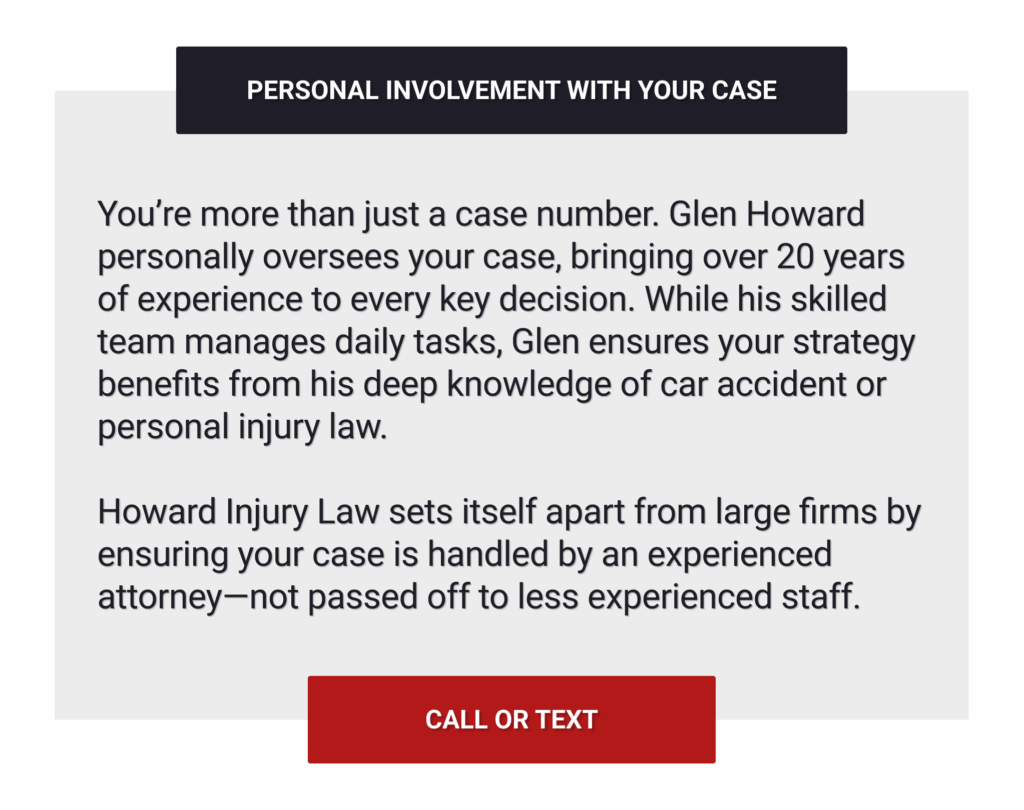
When you hire Howard Injury Law, you work directly with your attorney throughout the entire case — from the intake call to the final settlement check. Glen Howard personally takes calls, answers questions, and manages the legal strategy on your case. You’re not passed to a junior associate or a case manager.
That direct access matters specifically because of our background. Our attorneys have direct insurance defense experience — meaning we’ve been on the other side of these claims. We know how adjusters evaluate cases, what arguments they run, and where their positions are weak. That knowledge shapes how we build your case from day one.
A client we worked with described it well — he’d never been through a personal injury case before and expected to be handed off to staff. Instead, he had Glen’s direct number and could call anytime. That level of access, he said, was what made the difference in how comfortable he felt through the whole process.
Will I Have to Go to Court?
Most personal injury cases in Nevada settle before trial. That said, how a case is prepared matters enormously — and insurers know which firms are trial-ready and which ones will settle for whatever is offered to avoid litigation.
Howard Injury Law prepares every case as if it’s going to trial. That preparation is not performative — it’s what produces better settlements. When the other side knows your attorney will take the case to a jury if necessary, the settlement conversation changes.
How Long Does a Personal Injury Case Take in Nevada?
Timeline is one of the most common questions callers ask and one of the hardest to answer without knowing the specifics of a case. Here’s what genuinely affects it.
Settlement Before Litigation
Cases that settle before a lawsuit is filed — which is the majority — typically resolve in three to twelve months depending on injury severity, how quickly medical treatment concludes, and how cooperative the insurer is. Simple, clear-liability cases with documented injuries and reasonable insurers can resolve on the faster end. Disputed liability, multiple parties, or insurers who stall extend that timeline.
When a Lawsuit Is Filed
Once a lawsuit is filed in Nevada, the timeline extends significantly. Discovery, depositions, expert witnesses, and potential mediation add months. Most litigated cases that don’t go to trial resolve within one to two years. Cases that go all the way to verdict can take longer.
Why You Shouldn’t Settle Before Maximum Medical Improvement
One of the most important timeline factors is reaching maximum medical improvement — the point at which your treating physician determines your condition has stabilized. Settling before that point means settling before anyone knows the full cost of your injury. Insurance companies push for early settlements specifically because of this.
Your attorney’s job is to make sure the settlement reflects the full scope of your losses — not just the bills you have today.
For a full breakdown of the personal injury process from first call to resolution, read our guide on how long a personal injury case takes in Nevada.
Frequently Asked Questions
Do I have to decide anything on the first call?
No. The first call is information gathering — for you and for us. You can take days or weeks to decide whether you want to proceed. The only time pressure that’s real is the evidence window — surveillance footage disappears within 72 hours, witnesses move on, physical evidence at crash scenes gets cleared. The consultation itself carries no deadline.
What if I already gave the insurance company a recorded statement?
Call us anyway. A recorded statement creates challenges but it doesn’t end your claim. We assess what was said, how it affects the liability picture, and how to build around it.
What if my accident happened somewhere specific in Las Vegas — the Strip, a casino parking lot, US-95?
Location matters because it affects evidence sources and sometimes liability. A crash on I-15 near the Spaghetti Bowl involves NDOT camera systems. A crash in a casino driveway may involve resort security footage and potentially the property’s own liability. A rideshare accident on Tropicana involves layered insurance questions. We handle all of these — and knowing the local crash landscape is part of what we bring to every case.
What if I was partially at fault?
Nevada’s modified comparative fault rule under NRS 41.141 means you can still recover compensation even if you were partially responsible — as long as your fault doesn’t exceed 50%. Your recovery is reduced by your percentage of fault, not eliminated. Whether and how fault is assigned is often the most contested part of any Nevada personal injury case. Read more about Nevada’s comparative fault rules.
What if I can’t afford medical treatment right now?
This doesn’t have to stop you from getting care. Nevada’s medical lien system allows providers to treat you now and get paid from your settlement later — no upfront cost. We connect clients with reputable providers who work on lien every day. Read how medical liens work in Nevada.

The Bottom Line
Calling a personal injury lawyer costs you nothing and commits you to nothing. What it gives you is a clear picture of where you stand — whether you have a case, what it might be worth, and what your options are before you make any decisions.
The insurance company on the other side of your claim has already made their call. They have an adjuster, a file, and a strategy. You deserve the same.
Howard Injury Law is available right now — 24/7, no obligation, no fees unless we win. Call (702) 331-5722 or contact us here. Tell us what happened. We’ll take it from there.