

Wondering if your injury case is worth pursuing? Most people who ask this question already suspect the answer is yes. They’re just not sure how to prove it — or whether their situation is “serious enough” to bring to a lawyer.
Here’s the honest answer: if someone else’s negligence caused your injury and you’ve incurred real costs because of it, your case is worth a conversation. Whether it’s worth pursuing beyond that depends on four specific factors that every personal injury attorney in Las Vegas evaluates before taking a case. Understanding those factors yourself changes how you approach the decision.
Knowing how to assess whether your injury case is worth pursuing doesn’t require a law degree. It requires knowing what to look for — and what evidence to start gathering right now.

The Four Pillars Every Personal Injury Case Rests On
Liability: Did Someone Else Cause This?
The foundation of any personal injury case is liability. Someone had a duty to act reasonably. They failed to meet that duty. Their failure caused your injury. That chain — duty, breach, causation, harm — is the legal definition of negligence, and it’s what an attorney evaluates first.
Liability isn’t always clean. Nevada follows a modified comparative negligence rule, which means your compensation is reduced by whatever percentage of fault is assigned to you. As long as you’re less than 51% at fault, you can still recover. A case where you were partially responsible isn’t necessarily dead — but the liability picture has to be clear enough to build on.
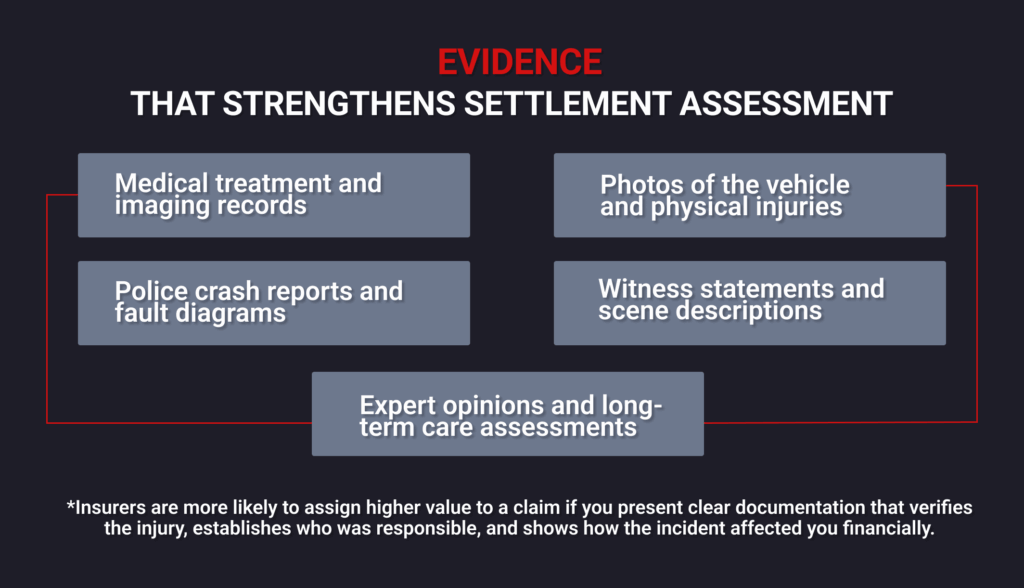
Evidence of liability includes the police report, photos of the scene, witness statements, traffic camera footage, and sometimes accident reconstruction. The stronger that evidence, the stronger the foundation of your case.
Damages: What Did the Injury Actually Cost You?
Liability without damages isn’t a case. You need measurable harm — costs you’ve actually incurred or will incur because of what happened. In personal injury law, damages fall into two categories.
Economic damages are the concrete numbers: medical bills, future treatment costs, lost wages, reduced earning capacity, property damage. These are documented through medical records, pay stubs, employer statements, and expert projections.
Non-economic damages are harder to quantify but just as real: pain and suffering, emotional distress, loss of enjoyment of life, and the ongoing impact on your daily functioning. Nevada law allows recovery for both. Adjusters routinely try to minimize non-economic damages — which is exactly why having an attorney who understands their full value matters.
Causation: Can You Connect the Injury to the Incident?
This is where insurance companies push back hardest. Even when liability is clear and damages are documented, they’ll argue your injuries were pre-existing, unrelated to the accident, or exaggerated. Your medical records need to tell a coherent story that connects the incident directly to the harm you’re claiming.
Gaps in treatment hurt causation arguments. Waiting weeks to see a doctor gives the insurance company room to argue the injury came from somewhere else. Seeking medical attention promptly — and continuing treatment consistently — builds the documentation trail that supports your claim.
If you have prior injuries to the same area of your body, that complicates causation but doesn’t eliminate it. An attorney who knows how to work with medical experts can establish what the accident aggravated or worsened, which is still compensable under Nevada law.
Collectibility: Can You Actually Recover What You’re Owed?
A strong case against a defendant with no insurance and no assets can still result in a judgment you can’t collect. Collectibility is the practical side of case evaluation — who is the at-fault party, what coverage do they carry, and what happens if the judgment exceeds their policy limits?
In Nevada, minimum auto insurance requirements are relatively low. Drivers carry uninsured and underinsured motorist coverage to fill that gap — or they don’t, which creates a different problem. Part of what a Las Vegas personal injury attorney evaluates early is whether there are multiple sources of coverage to pursue: the at-fault driver’s policy, your own UM/UIM coverage, commercial liability policies if a business was involved, or product liability coverage if a defective vehicle or component played a role.

What Evidence Makes a Case Stronger Right Now
The Police Report Is Your Starting Point
If law enforcement responded to your accident, a police report was filed. That document records the responding officer’s observations, the parties involved, preliminary fault determinations, and in many cases witness information. Obtain a copy as soon as possible — it becomes part of the foundation your attorney builds on.
If no police report was filed because you didn’t call law enforcement at the scene, that’s a hurdle but not a permanent barrier. Other documentation can substitute for it, but the absence of a report is something you’ll need to address.
Medical Records Do More Than Track Treatment
Your medical records are the single most important piece of evidence connecting your injuries to the incident. Every evaluation, every diagnosis, every treatment, and every referral creates a documented timeline. That timeline is what your attorney uses to establish what the accident caused and what it cost.
Seek medical attention promptly — even if you think your injuries are minor. Injuries that feel like soreness in the first 24 hours frequently develop into more serious conditions. A documented medical record that starts close to the accident date is far more valuable than one that begins weeks later when symptoms became impossible to ignore.
Photos and Video Evidence Lose Value Fast
Scene conditions change. Vehicles get repaired. Skid marks fade. Security footage gets overwritten. Collecting visual evidence quickly matters because the window for capturing the most useful documentation closes fast.
Photograph the vehicles from multiple angles, the road conditions, any visible injuries, traffic signals, signage, and the surrounding area. If there are businesses nearby with external cameras that may have captured the accident, your attorney can send preservation letters to prevent that footage from being deleted before it can be obtained.
Witnesses Are Most Valuable Before They Move On
Bystander accounts carry weight because they have no stake in the outcome. Contact information gathered at the scene is worth far more than trying to locate witnesses weeks later. If you didn’t collect witness information at the scene, your attorney may still be able to identify and contact witnesses through the police report or other means — but acting early is always better.
How Much Is a Personal Injury Case Worth in Las Vegas?
There Is No Universal Number — But There Is a Framework
Online settlement calculators exist and they’re largely useless. Case value depends on the specific facts of your situation: the nature and severity of your injuries, your total economic losses, the clarity of liability, the defendant’s coverage, and a dozen other variables. Anyone who gives you a number before reviewing your records is guessing.
What an experienced Las Vegas personal injury attorney can tell you — after reviewing the actual facts — is a realistic range based on comparable cases, the strength of your evidence, and how Nevada courts have valued similar injuries. That’s a very different thing from a generic estimate.
For a deeper look at what goes into calculating case value, read our post on what your personal injury case is worth.
Nevada’s Comparative Negligence Rule Affects the Number
If you were partly at fault for the accident, your recovery is reduced proportionally. Being 20% at fault on a $100,000 case means recovering $80,000. Being 51% or more at fault means recovering nothing under Nevada’s modified comparative negligence standard.
Insurance companies often dispute fault percentages specifically because shifting blame shifts the payout. Understanding how comparative negligence works — and how to counter arguments that inflate your share of responsibility — is part of what an attorney handles during negotiations.
When the Injury Seems Minor — Is It Still Worth Pursuing?
“Minor” Injuries Have a Way of Becoming More Expensive
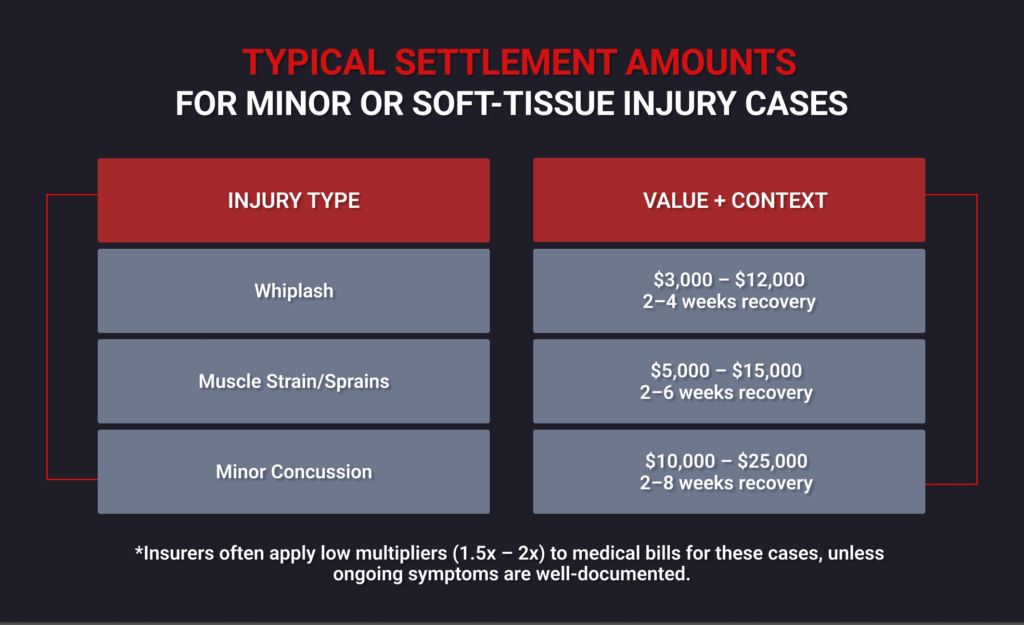
Soft tissue injuries, whiplash, and what emergency room doctors sometimes characterize as minor trauma routinely evolve into more serious conditions requiring extended treatment. The injury that feels manageable at the two-week mark can mean months of physical therapy, specialist visits, and lost income by the time the full picture emerges.
Settling before you’ve reached maximum medical improvement — the point at which your condition has stabilized — means settling before you know what your case is actually worth. The fact that an injury initially seemed minor is exactly why accepting an early offer is risky. Read our post on why insurance companies make quick settlement offers to understand the financial logic behind that pressure.
The Cost of Hiring a Personal Injury Attorney Is Not Upfront
One reason people don’t pursue valid cases is the assumption that legal representation costs money they don’t have right now. Personal injury attorneys, including Howard Injury Law, work on a contingency fee basis. You pay nothing unless your case settles or results in a verdict. There are no hourly fees, no retainers, and no upfront costs.
The contingency model means your attorney’s financial incentive is aligned with yours. Getting you a better outcome is what gets them paid.
Frequently Asked Questions
What if I don’t know who was at fault yet?
Fault is often disputed in the early stages of a claim. An attorney can investigate liability through accident reconstruction, witness interviews, traffic data, and other means. You don’t need certainty about fault before consulting a lawyer — that’s part of what the evaluation process determines.
How long do I have to file a personal injury claim in Nevada?
Nevada’s statute of limitations for most personal injury claims is two years from the date of the accident. Missing that deadline forfeits your right to pursue compensation through the courts, regardless of the strength of your case. If the at-fault party was a government entity, shorter notice deadlines apply. Don’t assume you have time to spare — consult an attorney early.
What if my injuries showed up days after the accident?
Delayed onset injuries are common and do not automatically disqualify your claim. Medical records documenting when symptoms appeared and how they developed still support a causation argument. Seeking treatment as soon as symptoms present — and being clear with your provider about the accident history — preserves that connection in your file.
Do I need a lawyer for a minor accident in Las Vegas?
It depends on the facts. For accidents with no injuries and minimal property damage, handling it directly with insurance may be reasonable. Any time there is an injury — even one that initially seems minor — a free consultation with a personal injury attorney helps you understand what your claim may actually be worth and what risks come with settling early. The consultation costs nothing.
The Answer Is Closer Than You Think
Most people who wonder whether their injury case is worth pursuing are underestimating what they’re actually owed. Medical bills feel overwhelming. Lost wages feel personal. Pain and suffering feels like something you’re supposed to just push through. None of that means you aren’t entitled to compensation — it means the insurance company is hoping you’ll move on before you find out what your case is really worth.
Four things determine whether your case is viable: clear liability, documented damages, a solid causation link, and a collectible defendant. If those elements exist, pursuing your claim isn’t just possible — it’s the financially rational decision.
A client we worked with came to Howard Injury Law convinced his injury was too minor to bother with. He’d been rear-ended on US-95, had some neck soreness, and figured he’d just deal with it. By the time he finished treatment, the costs were far higher than he’d anticipated. Because he came to us before settling, we were able to document the full impact and negotiate a result that reflected what he’d actually been through — not what he’d assumed it was worth at the outset.
If you’re asking whether your case is worth pursuing, the first step is finding out for certain. Request a free case review at Howard Injury Law. Glen Howard reviews the facts directly — available 24/7, no upfront cost, no obligation. What you learn in that conversation will tell you exactly where you stand.