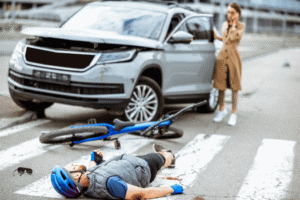


The most common causes of bicycle accidents in Las Vegas aren’t mysteries or bad luck. They’re driver choices: a turn made without looking, a phone checked at 40 mph, a pass that left 18 inches instead of three feet. If a car hit you while you were riding, the reason it happened is the most important fact in your case, because the cause of the crash is the evidence of who’s responsible.
This guide covers what causes most bike crashes in Las Vegas and where they happen. It also covers how insurance companies try to rewrite the cause, and what proof sets the record straight.
What Causes Most Bicycle Accidents in Las Vegas?
Most bicycle accidents in Las Vegas are caused by drivers who fail to see or yield to cyclists. The usual reasons are inattention, distraction, impairment, unsafe passing, and speed. The risk climbs after dark and on the valley’s wide, fast arterial roads.
The national data backs this up. According to the most recent federal crash data (2024):
- 81% of cyclist deaths happened in urban areas.
- 60% happened away from intersections, mostly mid-block on through roads, not at a crosswalk or signal.
- 52% happened in the dark, and the deadliest window was 6:00 to 8:59 p.m.
- Alcohol, from the driver or the rider, was involved in about one-third of fatal bike crashes.
Nevada lost 15 cyclists on its roads in 2024, and 11 of those deaths were in Clark County. Local cyclist deaths kept climbing into 2025. Those numbers describe a Las Vegas problem, not a rare one.
The Most Common Causes of Bicycle Accidents in Las Vegas: Driver Behaviors
Failure to Yield at Turns and Driveways
This is the classic “I never saw them” crash. A driver turning left looks for oncoming cars and cuts across a cyclist, or passes a rider and then turns right straight into their path. Drivers pulling out of driveways, parking lots, and casino garages do the same thing. Nevada treats cyclists as having the same right to the road as other traffic, so a driver who turns across a rider’s path usually owes the duty to yield. How fault works in these car-vs-bike crashes depends on which duty the driver broke.
Distracted Driving
A driver glancing at a phone for two seconds at 45 mph travels more than 130 feet without watching the road. A cyclist takes up a sliver of the lane, so they’re the first thing a distracted driver misses. Distraction also explains many crashes where the driver “drifted” into a bike lane or rear-ended a rider who was plainly visible.
Impaired Driving in a 24-Hour City
Las Vegas doesn’t close, so neither does its impaired-driving risk. Drunk and drugged drivers react slowly, judge distance badly, and drift across lane lines, and every one of those failures is deadly to someone on a bike. Impairment crashes cluster in the evening and overnight, the same hours when cyclists are hardest to see.
Unsafe Passing and Crowding the Lane
Under NRS 484B.270, Nevada drivers must give a cyclist at least 3 feet when passing, and on a multi-lane road they must move into the next lane when it’s available and safe. Drivers also can’t drive, stop, or park in a bike lane except in narrow situations. A driver who breaks these rules and causes a crash with a cyclist faces an added penalty under Nevada law. The details are in our guide to Nevada’s 3-foot passing rule.
Speed on Wide Arterials
Speed turns a close call into a crash, and a crash into a catastrophic injury. Many Las Vegas bike lanes are painted stripes on roads where traffic moves at 35 to 45 mph or faster. At those speeds a driver has less time to react, and a rider absorbs far more force.
Dooring
A driver or passenger in a parked car opens a door into a cyclist’s path, and the rider hits it or swerves into traffic. NRS 484B.153 prohibits opening a door on the traffic side unless it can be done without interfering with moving traffic, so the person who opened it generally bears responsibility. Dooring happens most on busy corridors with street parking, rideshare pickups, and delivery stops.
Why Las Vegas Roads Make These Mistakes More Dangerous
The same driver error is more likely to seriously hurt a cyclist here than in many cities, because the roads amplify it:
- Wide, fast arterials. The valley is built on a grid of multi-lane roads spaced about a mile apart, which funnels cyclists onto high-speed routes.
- Bike lanes that end. Lanes often disappear mid-block or at intersections and push riders into mixed traffic. There’s a reason Las Vegas ranks among the least bike-friendly cities in national ratings.
- Long evening commutes in the dark. Winter sunsets come early. Many service and hospitality workers ride to and from shifts in the 6 to 9 p.m. window, the most dangerous hours of the day.
- Visitors who don’t know the roads. Out-of-town drivers are watching GPS, signs, and the Strip skyline, not the bike lane.
None of this excuses a driver. It explains why careful drivers slow down and look twice, and why the law expects them to.
Where Cyclists Get Hit Most in Las Vegas
Bike crashes concentrate on the valley’s busiest multi-lane corridors, including Charleston Boulevard, Flamingo Road, Tropicana Avenue, Sahara Avenue, Maryland Parkway, and Las Vegas Boulevard. These roads combine heavy traffic, frequent driveways and turn lanes, and speeds that punish any mistake.
Most serious bike crashes don’t happen in the middle of a big intersection. They happen mid-block, where a driver turns into a shopping center, pulls out of a side street, or passes too close. For a wider view of the valley’s most dangerous roads and interchanges for all traffic, see our breakdown of crash hotspots in Las Vegas.
“The Cyclist Came Out of Nowhere”: How Insurers Flip the Cause
Glen Howard spent years as an insurance defense attorney before he started representing injured people, so he knows how these claims get defended from the inside. In bike cases, the playbook almost always attacks the cause of the crash:
- “They came out of nowhere.” This is really an admission that the driver wasn’t looking. Cyclists don’t materialize; drivers miss them.
- “They weren’t visible.” The adjuster will ask about lights, clothing, and time of day, trying to shift the cause onto the rider.
- “Cyclists break the rules.” This is a stereotype, not evidence. Research on cyclist behavior shows riders follow traffic laws at rates similar to drivers.
These arguments matter because Nevada uses a modified comparative negligence rule (NRS 41.141). Every percentage of blame shifted onto you shrinks your recovery, and if you’re found more at fault than the driver, you recover nothing. The insurer doesn’t need to prove you caused the crash. It only needs to make the cause look murky.
Matching the Cause of Your Crash to the Evidence That Proves It
Every cause leaves a trail. The problem is that much of it disappears within days.
| Cause | Evidence That Proves It |
|---|---|
| Failure to yield / turning crash | Scene photos, vehicle positions, damage location, witness statements, nearby business and traffic video |
| Distracted driving | Cell phone records, the driver’s own statements, witnesses who saw the phone |
| Impaired driving | Police report, arrest records, toxicology, bar or restaurant receipts |
| Unsafe passing / lane crowding | Side-impact damage patterns, helmet or bike-mounted camera footage, rider and witness accounts |
| Speed | The vehicle’s event data recorder, skid marks, crash reconstruction |
| Dooring | Door damage, parked-vehicle position, rideshare trip logs, witness statements |
Doorbell and business cameras often overwrite footage within days, and vehicle data can be lost once a car is repaired or sold. An experienced bicycle accident attorney in Las Vegas sends preservation letters and pulls this evidence before it’s gone. It’s one of the most important things that happens in the first weeks after a crash.
Simple Ways Las Vegas Cyclists Cut Their Risk
You can’t control a distracted driver, but a few habits make you harder to miss:
- Light up after dark. Nevada law requires a white front light and a red rear reflector at night, and a flashing rear light adds a margin of safety. Here’s what else Nevada’s bicycle laws require of riders.
- Ride predictably. Hold a steady line, signal turns, and take the lane when it’s too narrow to share safely.
- Watch driveways and turn lanes. Assume the car waiting to turn hasn’t seen you until the driver makes eye contact.
- Choose routes and times. When you can, avoid the busiest arterials during the 6 to 9 p.m. window.
Doing all of this right doesn’t make a crash your fault if a driver still hits you. Drivers carry the legal duty to watch for cyclists, whether or not you had a flashing light.

Frequently Asked Questions
What is the most common cause of bicycle accidents?
The most common cause is a driver failing to see or yield to the cyclist. That includes turning left across a rider’s path, turning right directly in front of one, or pulling out of a driveway or side street without looking. Distraction, impairment, speed, and unsafe passing are close behind, and most of them come back to a driver who wasn’t paying full attention. Conditions raise the stakes: most fatal bike crashes happen in cities, away from intersections, and after dark. In Las Vegas, wide arterial roads and heavy evening traffic make these driver errors more dangerous. Every crash is different, so the specific cause of yours should be looked at closely by a Nevada attorney before you talk to the insurer.
What causes 90% of bicycle accidents?
No official statistic says a single cause accounts for 90% of bicycle accidents. The “90%” figure usually comes from federal research on motor vehicle crashes, which traced the large majority of crashes to human error rather than vehicle defects or weather. Bike crashes follow the same pattern: most come down to a person’s decision, and in a car-vs-bike collision that person is usually the driver. Common examples are failing to yield, looking at a phone, driving impaired, or passing too close. The practical point for an injured rider is that crashes are rarely pure accidents. There’s usually a choice behind them, and that choice can be proven.
Which state has the most bicycle accidents?
Florida has the most cyclist deaths in the country, with 208 in 2024, followed by California and Texas. Measured by population, Louisiana had the highest cyclist fatality rate that year, with Florida second. Nevada recorded 15 cyclist deaths in 2024, 11 of them in Clark County, and local cyclist deaths kept rising into 2025. Nevada’s numbers are smaller than the biggest states’ in raw terms, but Las Vegas’s wide, fast roads and nightlife traffic make serious bike crashes a real and growing local problem.
What is the major cause of accidents in Nevada?
Across all vehicle types, the major causes of accidents in Nevada are distracted driving, impaired driving, speeding, and failure to yield. These are the same behaviors behind most bicycle crashes; the difference is that a cyclist has no metal frame or airbag to absorb the impact. Las Vegas adds its own risk factors: round-the-clock nightlife, heavy tourist traffic, and multi-lane roads built for speed. For a closer look at the driver behaviors behind crashes statewide, see what causes most motor vehicle accidents in Nevada, part of our broader Las Vegas motor vehicle accident coverage.

Hit by a Driver While Riding? Find Out What Caused It Before the Insurer Decides
Right now, the driver’s insurance company is building its version of what caused your crash, and that version will be the one where you share the blame. You deserve someone building the real version first.
Glen Howard used to defend insurance companies. He knows the “came out of nowhere” defense because he’s seen it from the other side of the table, and he knows what evidence takes it apart. If you’re wondering whether you have a case, the answer starts with one question: what caused the crash, and can we prove it?
A free case review with our Las Vegas bicycle accident lawyer costs nothing, and you pay no fee unless we win. Nevada generally gives you two years to file an injury claim, but the evidence that proves the cause can be gone in days. Request your free case review now and we’ll start preserving it.
This article is general information about Nevada law, not legal advice for your specific situation. Every case is different, so talk to an attorney about yours.