

You already know the crash wasn’t your fault. The hard part is proving it — and in a T-bone collision, that comes down to evidence you can still gather in the hours and days after impact. Knowing how to document a T-bone accident is what turns “I had the green light” into something an insurance company can’t argue away. This guide walks a Las Vegas driver through exactly what to capture, what disappears fast, and where a lawyer can pull proof you can’t get on your own.
Why documentation decides T-bone cases in Nevada
Side-impact crashes almost always happen at intersections, which means fault comes down to one question: who had the right of way? Who had the green, who ran the red, who turned left across oncoming traffic. When the evidence is thin, it becomes your word against the other driver’s — and the other driver’s insurer is happy to sit in that gray area and pay you less.
Solid documentation removes the gray. It ties the other driver to a specific violation, like failure to yield or one of the left-turn crashes that fill Las Vegas intersections. The stronger your proof of who had the right of way, the less room the adjuster has to shift blame onto you.
What to do at the scene of a T-bone crash in Las Vegas
If you’re reading this from the scene or the days right after, start here.
- Get police to the scene. Call 911 for any crash with injuries. Under Nevada law (NRS 484E), you must stop, exchange information, and render aid — and if no officer responds, you’re required to report the crash to law enforcement. A written report is required within 10 days when there’s an injury or property damage of $750 or more. The responding officer’s report and event number become the backbone of your file, so ask how to get a copy.
- Stay put and stay safe. Move out of traffic if you can, but don’t leave the scene until you’ve handled your duties.
- Don’t admit fault. Don’t apologize, don’t guess out loud about what happened, and don’t accept blame — even to be polite. Those offhand comments get repeated back to you later.
- Exchange and collect. Get the other driver’s name, phone, insurance, and plate. Then get the names and numbers of anyone who saw it happen. Witnesses vanish once the intersection clears.
The T-bone accident evidence checklist
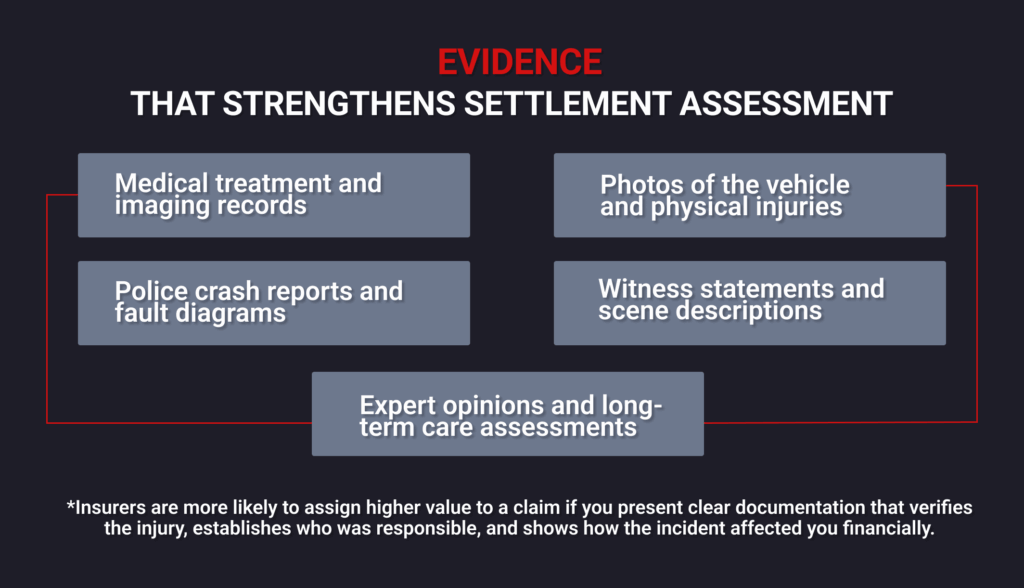
This is the part that protects your claim. Capture as much as you safely can, and don’t assume the police report covers all of it.
Photos and video that matter most
- The point of impact. Photograph the side of your vehicle that was hit — which door, how deep the intrusion is — and the front end of the car that struck you. The angle of damage tells the story of who hit whom.
- Both vehicles’ resting positions. Before anything gets moved, shoot wide photos showing where each car ended up relative to the intersection and the lanes.
- The traffic control. Get the signal or stop sign and which direction it faced. In a T-bone, this is often the single most important image you’ll take.
- The road itself. Skid marks, debris, gouges in the pavement, and anything that shows speed or direction.
- Conditions. Lighting, weather, sun glare, and any obstructed sightlines — a hedge or parked truck that hid the view.
The intersection evidence unique to T-bones
A T-bone lives or dies on intersection evidence, and this is where most people lose ground.
- Nearby cameras. Gas stations, casinos, storefronts, and traffic cameras near intersections like Sahara & Decatur or Tropicana & I-15 often capture the crash — but that footage is frequently overwritten within days. It has to be requested fast.
- Witnesses who saw the light. A neutral witness who can say which driver had the green is worth more than almost anything else.
- The exact location. Note the intersection precisely. “Northbound Decatur at Sahara, left-turn lane” is far more useful later than “near the Strip.”
Medical documentation that links your injuries to the crash
- See a doctor right away. Same-day or next-day care creates a clean link between the crash and your injuries. Gaps in treatment are the first thing an insurer uses to argue your pain came from something else.
- Follow through. Keep every referral, bill, and record. T-bone injuries like soft-tissue damage and concussions often surface a day or two later, so don’t brush off new symptoms.
For the broader picture of what any claim needs, this rundown on evidence for a car accident injury claim covers the fundamentals that apply to every crash type.
Evidence only a lawyer can pull for you
You can do a lot from the scene. Some of the most decisive proof, though, isn’t available to you at all — and it’s usually gone within weeks.
A Las Vegas T-bone accident lawyer can subpoena surveillance footage before a business overwrites it, obtain the vehicle’s black-box (EDR) data showing speed and braking, secure the complete crash report with supplements, and bring in an accident reconstruction expert when fault is disputed. Firm founder Glen Howard spent years as an insurance defense attorney, so he knows exactly how the other side attacks weak documentation — and how to close those gaps before they cost you.
Don’t let the clock run out on your evidence
Evidence is perishable. Camera footage gets recorded over, skid marks wash away, and memories fade — often within the first week or two. Acting quickly is the difference between proof and a guess.
There’s a legal clock, too. In most Nevada cases you have two years from the date of the crash to file an injury lawsuit, but you shouldn’t wait anywhere near that long to protect the evidence. Here’s how long you have to file and why the early days matter most for car accident cases in Las Vegas.
Frequently Asked Questions
Who is at fault in a T-bone collision in Nevada?
Usually the driver who violated the right of way — running a red light, ignoring a stop sign, or turning left across oncoming traffic. Nevada follows modified comparative negligence, which means fault can be split between drivers, and your share of blame reduces (or, past a certain point, bars) your recovery. That’s why proving the other driver caused the crash matters so much. Fault often comes down to failure to yield or left-turn crashes at the intersection. Every crash is different, so if liability is being disputed, talk to an attorney before you accept any version of events from an insurer.
What should I not say to the insurance company after a T-bone accident?
Don’t admit fault, don’t apologize, and don’t speculate about what happened — stick to the basic facts. Avoid guessing at your injuries (“I’m fine,” “it’s just a little sore”) because symptoms can worsen for days, and that quote will be used to minimize your claim. Don’t agree to a recorded statement before you’ve spoken with a lawyer. And never accept the first offer as if it’s your only option. For a fuller breakdown of these conversations, see this guide on talking to the insurance adjuster. When in doubt, say less and get advice first.
What is the average settlement for a T-bone accident in Nevada?
There’s no reliable “average,” because side-impact settlements swing widely based on injury severity, how clear the liability is, and the available insurance coverage. A minor soft-tissue case and a crash with surgery and lasting impairment aren’t in the same universe. What consistently moves the number is strong documentation and clear proof of fault — exactly what this guide is about. For a realistic look at the factors that drive value, see what a T-bone claim is worth. A lawyer can review your specific facts and give you a grounded range rather than a guess.
What if I don’t have photos from the scene?
You’re not out of options. Plenty of strong T-bone cases are built after the fact from the police report, nearby surveillance footage, witness statements, vehicle damage analysis, and accident reconstruction. The key is moving quickly, because outside footage is the piece most likely to be erased. If you left the scene without photos — because you were hurt, shaken, or taken by ambulance — that’s normal, and it’s a big part of why people call a lawyer early. The sooner someone starts preserving evidence on your behalf, the more of it survives.

Talk to a Las Vegas T-bone accident attorney
If the other driver caused your crash and you’re worried it’ll turn into their word against yours, the smartest move is to lock down the evidence now — while it still exists. Howard Injury Law offers a free case review where you can walk through what happened, find out what proof is still recoverable, and hear honestly whether you have a claim worth pursuing.
Glen Howard built his career on the insurance-defense side before switching to represent injured people, so he knows how the other side thinks. You pay nothing unless we win. Call (702) 331-5722 or request your free case review and let’s protect your claim before the clock runs out.