

Here’s the part most drivers get wrong: Nevada law never says who has the right of way at an intersection. It only says who has to yield it. That single distinction usually decides who’s at fault after an intersection crash — and it’s exactly what the other driver’s insurance company will fight you on.
If you were just hit at an intersection somewhere in Las Vegas and the other driver is insisting they had the right of way, this breaks down the actual rules under Nevada law: four-way stops, left turns, crosswalks, and stop signs. Knowing them tells you who was supposed to yield — and whether the driver who hit you broke the law when they didn’t.
Right of way is given, never taken
The most useful thing to understand about right of way at a Las Vegas intersection is that no driver ever owns it. Nevada’s traffic laws are written as yield duties. One driver has a legal duty to slow down, stop, or wait; the other driver is allowed to proceed because the first one yielded.
That matters because a driver can’t “take” the right of way to justify what they did. Rolling into an intersection, gunning a yellow, or turning across traffic doesn’t grant anyone priority — it usually means they failed to yield when the law required it. When you understand who owed the duty to wait, you understand who caused the crash.
Who goes first at a four-way stop in Las Vegas
Four-way stops trip up more Vegas drivers than almost anything else, especially in residential pockets of Spring Valley, Summerlin, and Henderson where they’re common. Nevada’s rule is straightforward:
- First to fully stop goes first. Whoever reaches the intersection and stops before everyone else has the right to proceed first.
- Tie? The driver on the left yields to the driver on the right. When two cars arrive at about the same time, the one on the right goes first. This is the “right-hand rule.”
- Straight beats turning. When a car going straight and a car turning arrive together, the through driver generally goes first, and the turning driver yields.
These priorities come from Nevada’s rules of the road (NRS 484B.250). The practical takeaway: a driver who blows a four-way stop or lunges out of turn didn’t just make a mistake — they violated a yield duty, which is strong evidence they caused the collision.
Left turns: when you yield, and when you don’t
Left turns are one of the most dangerous moves at any Las Vegas intersection, and the fault question hinges on timing. Under Nevada law (NRS 484B.253), a driver turning left must yield to oncoming traffic that is close enough to be an immediate hazard. You wait for a safe gap — you don’t force the turn and expect oncoming cars to slam their brakes.
But the rule cuts both ways. Once a left-turning driver has lawfully yielded, signaled, and safely begun the turn, oncoming drivers are then required to yield to them. So a driver who speeds up to beat a turning car that already had the intersection can be the one at fault.
Left-turn collisions frequently become T-bone accidents, where one vehicle strikes the side of another. Sorting out who yielded — and when — is the heart of every one of these claims.
Right of way at crosswalks: marked and unmarked
Drivers in Nevada owe pedestrians a clear duty at crosswalks, and it’s broader than most people assume. Under NRS 484B.283, drivers must yield to pedestrians crossing within a crosswalk — and that includes unmarked crosswalks, not just the painted ones. In Nevada, an unmarked crosswalk generally exists at intersections wherever sidewalks or logical crossing paths line up, even without stripes on the pavement.
There’s a second rule that catches a lot of drivers: you can’t pass a vehicle that has stopped at a crosswalk. If the car next to you stops, the safe assumption is that it stopped for someone crossing, and overtaking it can put a pedestrian directly in your path. Given how many people cross near the Strip, Fremont Street, and busy corridors like Sahara and Maryland Parkway, these duties come up constantly in Las Vegas.
T-intersections and stop signs: who yields to whom
Not every intersection is a tidy four-way. Two common setups have their own rules:
- T-intersections. When a smaller road dead-ends into a through street, the driver on the road that ends must yield to traffic on the through road (NRS 484B.250). The through street has priority.
- Stop signs. A driver facing a stop sign must come to a full stop, then yield to any vehicle already in or close enough to the intersection to be a hazard before proceeding.
The theme running through all of it is the same: the law assigns a duty to wait. Whether it’s a stop sign at a quiet Henderson corner or a two-way stop where a side street meets a main road, someone owes the duty to yield, and breaking that duty is what creates liability.
What counts as a “failure to yield” — and why it decides fault
A failure to yield is exactly what it sounds like: a driver had a legal duty to wait and didn’t. Running a stop sign, turning left into oncoming traffic, ignoring the right-hand rule at a four-way stop, or hitting a pedestrian in a crosswalk are all failures to yield.
This is why right of way matters so much for your claim. When a driver breaks a yield rule and causes a crash, that violation is powerful evidence they were negligent. It’s often the difference between a disputed claim and a clear one. Intersection collisions in Las Vegas tend to turn on this single question — who was legally required to yield — which is why documenting the scene, signals, and witness accounts early can make or break the case.
The other driver says it was my fault. Now what?
Almost every intersection claim comes with the other driver — and their insurer — pointing the finger back at you. Don’t let that scare you off. Nevada follows a modified comparative negligence rule (NRS 41.141). You can still recover compensation as long as you were not more than 50% at fault, with your recovery reduced by your share of the blame. Even if the other side manages to pin some responsibility on you, that doesn’t automatically end your claim.
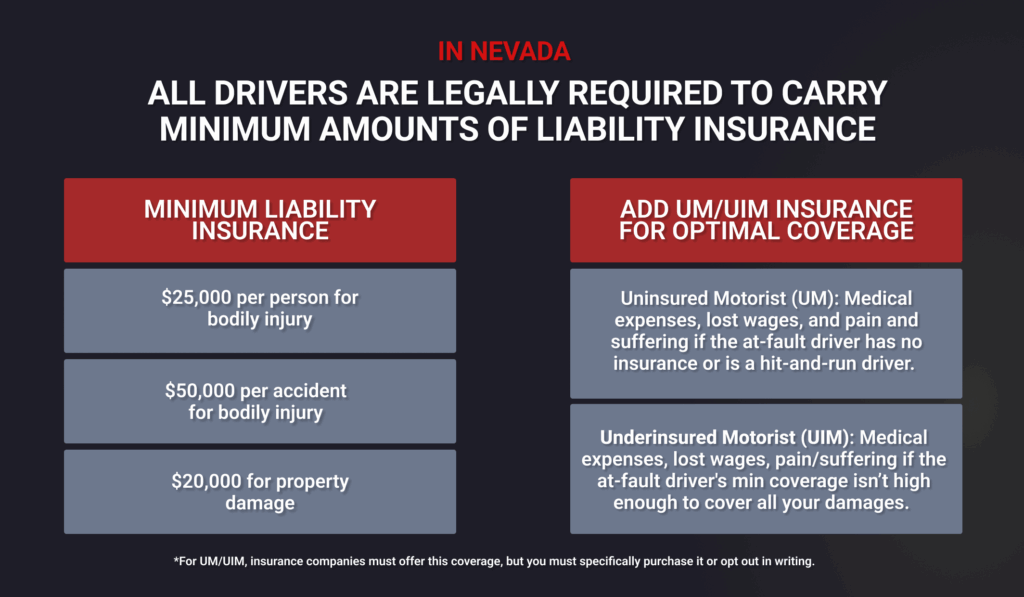
What it does mean is that the insurance company has a financial reason to exaggerate your fault. Every percentage point they shift onto you is money they don’t pay. This is where having the right lawyer matters — and where a disputed-liability car accident claim needs someone who knows how adjusters build these arguments. It also helps to understand what coverage is even available; here’s a plain-English look at Nevada’s minimum car insurance requirements.
Every crash is different, and this is general information — not advice about your specific case. A short conversation with an attorney is the only way to know how these rules apply to what happened to you.
Frequently Asked Questions
Who goes first at a 4-way stop if everyone arrives at the same time?
If two vehicles reach a four-way stop at the same moment, the driver on the left yields to the driver on the right — the “right-hand rule” under Nevada’s rules of the road. In practice, most four-way stops resolve by order of arrival: whoever stops first proceeds first. Simultaneous arrivals are where the right-hand rule kicks in. When a car going straight and a car turning arrive together, the through driver generally has priority. A driver who ignores this order and causes a collision has typically failed to yield, which points to their fault for the crash.
Who has the right of way when two cars reach the intersection at the same time?
It depends on the intersection. At a four-way stop, the car on the right goes first. At a T-intersection, the driver on the road that ends yields to traffic on the through street. When one driver is turning left across another’s path, the turning driver must yield to oncoming traffic that’s close enough to be a hazard. Nevada law never hands anyone the right of way outright — it assigns a duty to yield. Figuring out who owed that duty is what determines who was legally in the wrong.
What is considered a right-of-way violation in Nevada?
A right-of-way violation happens when a driver fails to yield when the law requires it. Common examples include running a stop sign, turning left into oncoming traffic that had the right to proceed, pulling out of a side street in front of through traffic, ignoring the right-hand rule at a four-way stop, and failing to yield to a pedestrian in a marked or unmarked crosswalk. These violations matter beyond a traffic ticket. In an injury claim, breaking a yield rule is strong evidence that the driver was negligent and responsible for the resulting crash.
Do drivers have to yield to pedestrians at unmarked crosswalks?
Yes. Under Nevada law, drivers must yield to pedestrians crossing within a crosswalk, and that duty applies at unmarked crosswalks as well as painted ones. Unmarked crosswalks generally exist at intersections where sidewalks or crossing paths align, even without stripes on the pavement. Drivers also can’t pass a vehicle that has stopped at a crosswalk, since that car may have stopped to let someone cross. With heavy foot traffic near the Strip and downtown Las Vegas, these duties come up often — and a driver who ignores them can be held liable when a pedestrian is hurt.
Who has the right of way at a T-intersection?
At a T-intersection, the through street has priority. The driver on the road that ends must yield to traffic traveling on the continuous through road before entering or crossing it. If a stop sign or yield sign controls the intersection, the driver facing that sign must stop or slow and yield to any vehicle close enough to be a hazard. A driver who pulls out from the ending road into through traffic without yielding has usually caused the collision — and that failure to yield is central to who’s held at fault.

Hit by a driver who didn’t yield? Talk to a Las Vegas attorney
If a driver ran a stop sign, turned across your path, or blew through a four-way stop and hit you, the right-of-way rules above already point to who was at fault. The problem is that the other side’s insurer will spend real energy trying to shift blame onto you — and they’re good at it.
Attorney Glen Howard spent years on the other side of these cases, defending insurance companies. He knows how they build shared-fault arguments to shrink what they pay, and he uses that experience to take them apart for injured people in Las Vegas. Howard Injury Law works on a contingency fee, so there’s no fee unless we win your case.
If you’re not sure whether you have a claim, that’s the exact question a free consultation answers. Tell us what happened at the intersection, and we’ll tell you honestly where you stand. Call (702) 331-5722 or request your free case review — the sooner you reach out, the more evidence we can preserve while it still exists.