

You made a left turn, got hit, and now you’re afraid the whole thing is automatically your fault. Or you were driving straight through a Las Vegas intersection, a left-turning driver cut across your path, and an insurance adjuster is already hinting the blame is “shared.” Left-turn accident fault in Nevada is rarely as simple as either driver fears — and the answer decides who pays for your medical bills, your wrecked car, and your time off work.
Here’s the honest version, before the myths pile up: the driver turning left is usually presumed at fault, but “usually” is not “always.” Nevada law, the specific facts of your crash, and the evidence can all shift that presumption. Let’s break down who’s really to blame — and why an adjuster’s first phone call is not the final word.
Is a Left-Turn Driver Always at Fault in Nevada?
No. A left-turning driver is not automatically at fault in Nevada — they simply start out with the harder position.
Because the turning driver is the one crossing oncoming traffic, they carry the legal duty to yield. When a crash happens mid-turn, police and insurers tend to presume the turning driver failed that duty. That presumption is a starting point, not a verdict.
Fault can flip or split when the oncoming driver did something wrong too — speeding, running a red light, staring at a phone. In those cases, the left-turning driver may share little or none of the blame. What matters is not who was turning, but who actually had the right of way at the moment of impact and who broke the rules to cause the collision.
What Nevada’s Left-Turn Law Actually Says (NRS 484B.253)
Nevada’s left-turn rule lives in NRS 484B.253. It says a driver inside an intersection who intends to turn left must yield to any vehicle coming from the opposite direction that is already in the intersection or close enough to be an immediate hazard.
That’s the part everyone knows. Here’s the part that saves cases:
Once the turning driver has properly yielded, signaled, and lawfully begun the turn, the rule reverses — oncoming drivers then have to yield to the vehicle completing the turn. So a driver who was already turning legally when a speeding car came flying through can be the one with the right of way.
Violating NRS 484B.253 is a failure-to-yield offense. In Las Vegas it typically carries a citation and four DMV demerit points, and in an injury claim that violation can serve as strong evidence of negligence. But the reverse is just as true: if the other driver broke a traffic law, that becomes evidence against them. A citation is a data point in your favor or against you — not the end of the story.
When the Oncoming Driver Is at Fault — or Shares It
This is the section most injured drivers never hear from the insurance company. The oncoming driver can carry part or all of the fault in a left-turn crash when they:
- Were speeding. If the car you yielded to was far enough away to be safe at the legal limit, and only became a hazard because it was flying, that speed can shift fault.
- Ran a red light or a stale yellow. If you had a green arrow or the light changed against them, the right of way was yours.
- Were distracted. Texting, eating, or looking down means they may have failed their own duty to avoid a foreseeable collision.
- Were driving without headlights at night or were otherwise hard to see through no fault of yours.
- Were in the wrong lane — passing illegally, using a turn lane to go straight, or drifting.
Left turns at busy Las Vegas intersections — Sahara and Decatur, Tropicana near I-15, the arterials feeding the Strip — often involve protected green arrows, permissive greens, and heavy cross-traffic. Those details decide fault, and they’re exactly what a rushed adjuster tends to skip. If any of the above happened, you may be looking at a very different fault picture than the one you were handed.
How Insurance Companies Decide Who’s at Fault — and Why the First Call Isn’t Final
Insurance companies decide fault by reviewing the police report, both drivers’ statements, any photos or video, and the physical damage — then applying their own internal rules to assign a percentage of blame to each driver. In a left-turn crash, they lean hard on the shortcut: turning driver = at fault. It’s fast, it’s cheap, and it often understates what really happened.
That first determination is not binding. It’s the insurer’s opinion, made early, usually before anyone has pulled intersection camera footage, measured skid marks, or found the witness who saw the other car blow the light. You can challenge it with evidence.
This is where hiring the right Las Vegas car accident lawyer changes the math. Glen Howard built his career as an insurance-defense attorney before he started representing injured people — he spent years on the side that assigns blame and minimizes payouts. He knows the fault-shifting playbook because he used to run it. That perspective is the difference between accepting a “you were turning, so it’s on you” verdict and taking it apart.
If liability is already being contested in your case, our breakdown of disputed liability car accident claims in Las Vegas walks through how these fights actually get won. For the broader picture, see how fault is determined in a Nevada car accident.
How Nevada’s Comparative Negligence Rule Affects What You Recover
Even when fault is split, you are not automatically shut out. Nevada uses a modified comparative negligence rule under NRS 41.141, often called the 51% bar.
Under that rule, you can still recover compensation as long as you were 50% or less at fault — your award is just reduced by your share of the blame. If a jury or adjuster values your claim at $100,000 and finds you 20% responsible, you recover $80,000. Cross the line to 51% or more at fault, and you recover nothing.
That’s why the fault percentage in a left-turn case is worth fighting over dollar for dollar. Getting your share knocked from 55% down to 40% is the difference between zero and a real recovery. Every fact that pushes blame back onto the oncoming driver — their speed, their light, their phone — directly protects your compensation. This general rule applies to most Nevada crashes, but how it plays out depends on the specifics of your collision, which is worth reviewing with an attorney.
What to Do If You’re Blamed for a Left-Turn Crash in Las Vegas
If the other driver or their insurer is pointing the finger at you, protect yourself:
- Don’t admit fault — not at the scene, not on a recorded call with the adjuster. “I’m sorry” gets used against you.
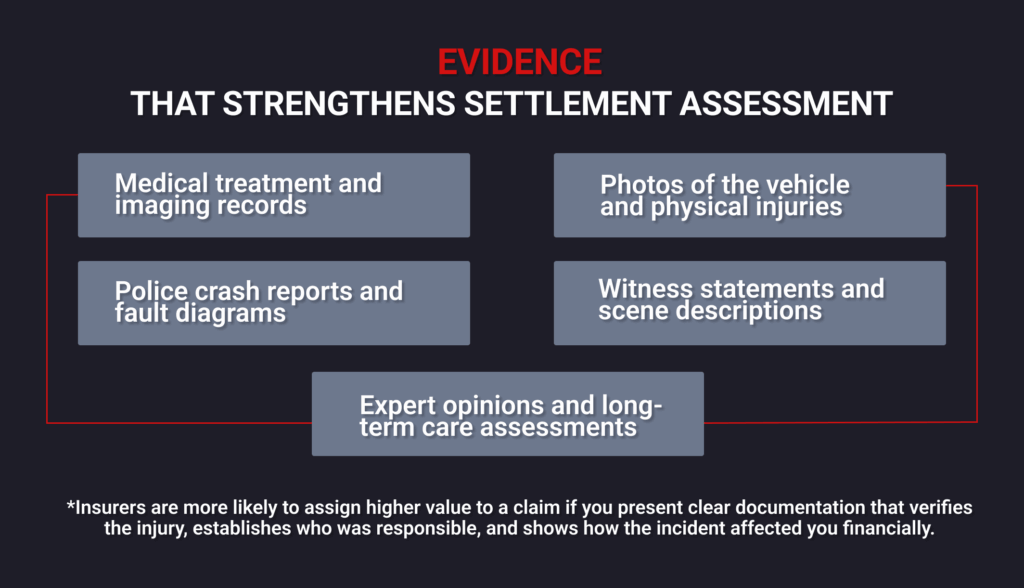
- Get the evidence now. Photos of both vehicles, the intersection, signals and signage, and skid marks. Note any red-light cameras or nearby businesses with security footage before it’s overwritten.
- Find witnesses. A neutral driver who saw the other car speed or run the light can decide your case.
- See a doctor promptly. T-bone and left-turn impacts often cause injuries that surface days later. A treatment gap becomes the insurer’s argument that you weren’t really hurt.
- Talk to a lawyer before you accept any fault determination. Left-turn crashes are frequently full-on T-bone (side-impact) collisions, which tend to cause serious injuries — and serious claims are exactly the ones insurers try to devalue by shifting blame early.
Left turns are one of the most common crash types at Las Vegas intersections, so you’re not dealing with anything our team hasn’t seen. You can review more on intersection car accidents in Las Vegas or the full Car Accidents practice area for related situations.
Frequently Asked Questions
Is a left-turn driver always at fault in Nevada?
No. The left-turning driver is usually presumed at fault because they have the duty to yield to oncoming traffic under NRS 484B.253, but that presumption can be overcome. If the oncoming driver was speeding, ran a red light, was distracted, or was otherwise breaking the law, fault can shift partly or entirely to them. And once a turning driver has lawfully yielded and begun the turn, oncoming traffic must yield to them. Fault depends on who actually had the right of way and who caused the crash — not simply on who was turning.
What are the laws for making a left turn in Nevada?
Under NRS 484B.253, a driver turning left at an intersection must yield the right of way to any oncoming vehicle that is already in the intersection or close enough to be an immediate hazard. You have to wait for a safe gap before turning across traffic. Once you’ve properly yielded, signaled, and lawfully started your turn, oncoming drivers are then required to yield to you. Failing to yield while turning left is a traffic violation in Nevada that generally carries demerit points and can be used as evidence of negligence in an injury claim.
How long does an at-fault accident stay on your record in Nevada?
In Nevada, an accident entry generally stays on your DMV driving record for about three years, while serious crashes tied to a DUI, reckless driving, or hit-and-run conviction can remain far longer. DMV demerit points from any associated citation expire 12 months after the conviction. Your insurance record is separate: insurers commonly look back three to five years — sometimes up to seven through claims databases — when setting your premium. Importantly, if you were not at fault, the crash shouldn’t raise your rates, which is one more reason the fault determination matters.
Do I need a lawyer if the insurance company already blamed me?
That’s often the best time to call one. The insurer’s fault decision is an early opinion, not a final ruling, and it’s frequently based on the “turning driver is at fault” shortcut rather than the full evidence. A lawyer can gather intersection footage, witness statements, and crash analysis to challenge that call and push your fault percentage down — which, under Nevada’s comparative negligence rule, directly affects how much you recover. A consultation costs you nothing, so getting a second opinion before you accept blame carries no downside.

Talk to a Las Vegas Attorney Who Knows the Fault Playbook From the Inside
Being blamed for a crash you didn’t fully cause is stressful — especially when the bills are stacking up and the adjuster sounds so certain. You don’t have to accept that first fault call. If there’s any chance the other driver was speeding, ran the light, or wasn’t paying attention, you may have a stronger case than you were told.
Glen Howard spent years as an insurance-defense attorney before switching sides. That means Howard Injury Law knows exactly how insurers build a left-turn fault argument — and how to take it apart. Your consultation is free, and because we work on contingency, there’s no fee unless we win.
Call (702) 331-5722 or reach out through our contact page to have your left-turn crash reviewed. Bring what you have — photos, the police report, the adjuster’s name — and we’ll tell you honestly whether the fault they assigned holds up.