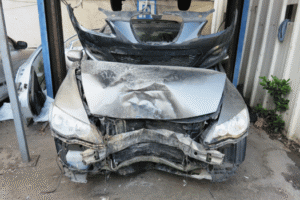
The adjuster called before the tow yard even sent a bill, and the file already has an answer: you braked late, you drifted, you lost control. If you were behind the wheel when the car surged, went soft at the pedal, or failed to protect you, the real question is whether this was a vehicle defect or driver error. That answer decides who pays, and the proof is sitting in a lot somewhere in Las Vegas, waiting to be released.
Here are the five signs that point at the car, the signs that point back at the driver, and how to keep your claim intact while you find out.
Why the Insurance Company Assumes Driver Error First
You have probably heard that drivers cause more than nine out of ten crashes. That number traces back to a federal study published by the National Highway Traffic Safety Administration in 2015, which reviewed roughly 5,500 crashes from 2005 to 2007. Investigators assigned the “critical reason” for the crash to the driver in about 94% of cases, and to the vehicle in about 2%.
Two details rarely get repeated. First, the report itself says the critical reason is not meant to be read as the cause of the crash, and that it does not assign fault to the driver, the vehicle, or the road. Second, nobody took those vehicles apart. Investigators mostly worked from what they could see from the outside, so the failures they recorded were the visible ones, mainly tires and brakes.
So vehicle failures are uncommon, but they are real, and they are easy to miss at a crash scene. An officer working a wreck on US-95 is clearing lanes, not pulling a brake line.
Glen Howard worked as an insurance defense attorney before he represented injured people, and he knows how these files get handled from the inside. Driver error is the fastest, least expensive conclusion an insurer can reach. Once a file is coded that way, nobody on that side has a reason to look under the hood.
5 Signs Your Crash Was Caused by a Vehicle Defect, Not Driver Error
No single sign proves a defect. Each one is a reason to have the car examined before anyone repairs it, sells it, or crushes it.
1. The Car Did Something You Didn’t Tell It To
The engine surged while your foot was on the brake. The car braked hard on an open stretch of the 215 Beltway with nothing ahead. The wheel tugged toward a lane you never chose.
Driver error tends to look like a late reaction or a wrong input. A defect looks like the car acting on its own. Today’s vehicles run throttle, braking, and steering through software and sensors, and those systems can fail. If that matches what happened, read more about who pays after a sudden acceleration or driver-assist failure.
2. A Control Stopped Responding
You did the right thing and nothing happened. The brake pedal sank to the floor or turned rock hard. The steering locked or went heavy. The engine cut out and took the power assist with it.
Write down exactly what you felt, in order, while the memory is fresh. “I pressed the brake and the pedal went down with no resistance” is a very different account from “I couldn’t stop in time,” and the gap between those two sentences can decide a claim. Brakes add one more question, which is whether the brake failure was a defect or a maintenance problem.
3. Something Broke Before the Impact, Not Because of It
Crashes break parts. The question is the order. A bang, a vibration, a wobble, or a sudden pull that came before you lost control suggests a part failed first and the crash followed.
Tread separating from a tire, a wheel coming loose, a suspension or steering part snapping: each leaves marks that an engineer can read. Las Vegas summers are hard on rubber, which is why insurers like to blame heat and wear for every blowout. Sometimes that’s fair. Sometimes the tire was built wrong. This post on heat-related tire blowouts and who is liable explains how to tell the difference.
4. Your Injuries Don’t Match the Crash
This sign surprises people. A defect does not have to cause the crash to matter. If another driver ran the light, but your airbag stayed in the dash, your seat belt released, your seatback collapsed, or the roof caved in during a rollover, the car may have turned a survivable wreck into a serious injury.
Lawyers call these crashworthiness claims. The other driver answers for the collision, and the manufacturer may answer for the part of the harm a safe vehicle would have prevented. If your injuries seem far worse than the damage to the car suggests, say so early.
5. The Car Has a Paper Trail
Defects usually leave a record. Look for:
- An open safety recall on your vehicle identification number
- Other owners of the same model reporting the same failure to federal regulators
- A warning light or odd behavior in the weeks before the crash
- A recent repair or software update to the system that failed
A recall is not automatic proof. The recalled part still has to connect to what happened to you. It can show the manufacturer knew about the problem, though, and that carries weight. If your car had one, start with whether you can sue when your car had an open recall.
Signs It Really Was Driver Error, and Why That Isn’t Always the End
A fair answer has to run both directions. These facts tend to point at a driver:
- Vehicle data showing no braking or steering input before impact
- Phone use, speeding, fatigue, or impairment
- Worn tires or overdue brake service that the owner knew about
- A vehicle that tests normally in every system after the crash
Even then, the picture is often mixed. Another driver’s mistake and your car’s defect can both be true in the same crash. So can a small error of your own.
In a Nevada claim against another driver, you can still recover as long as your share of fault is not greater than theirs, with your compensation reduced by your percentage. Claims against a manufacturer follow different rules, and a driver’s mistake does not automatically erase a defect. For how those percentages get assigned in the first place, see how fault is determined in a motor vehicle accident.
Every case turns on its own facts, so treat this as general information and get advice about yours.
Vehicle Defect or Driver Error: What Actually Settles It
Opinions do not settle this. Evidence does, and most of it is physical.
- The vehicle itself. Unrepaired and unaltered, it lets an engineer inspect, test, and document what failed.
- The failed part. A cracked component or a separated tire carries the story of how it broke.
- The event data recorder. Most modern vehicles store a few seconds of pre-crash data, such as speed, throttle position, and brake application. That record can confirm you were on the brake when the car kept accelerating. Nevada law limits who may download it, generally the registered owner or someone holding a court order.
- The history. Service records, recall notices, and complaints from other owners of the same model.
Nevada holds manufacturers and sellers to strict liability for defective products. In plain terms, you do not have to prove the company was careless. You have to show the vehicle was defective and that the defect caused your injuries. The Nevada Supreme Court measures design defects by what an ordinary driver would reasonably expect, and nobody expects a car to accelerate with a foot on the brake.
Building that proof takes inspections, experts, and manufacturer records, which is the work a defective vehicle accident lawyer in Las Vegas handles for you.
Protecting Your Claim While the Insurer Is Calling
The pressure in the first week or two comes from two places: the adjuster who wants a statement, and the tow yard that wants the car gone. Slow both down.
Watch what you concede. Stick to facts you know. Do not guess at a cause to be agreeable. These lines sink defect claims:
- “I must have hit the wrong pedal.”
- “I guess I just didn’t brake in time.”
- “The car was running fine.”
- “I’m okay, just sore.”
A recorded statement can be played back months later. You can decline to give one to the other driver’s insurer. Your own policy likely requires you to cooperate with your insurer, but cooperating does not mean speculating about what went wrong.
Keep the car. Do not authorize repairs. Do not sign over the title or let the vehicle go to salvage. Once the car changes hands, control over it and its data can go with it. Storage fees add up quickly, and insurers know that makes people fold. An attorney can send written notice demanding that the vehicle be preserved, and can often arrange to move it somewhere safe.
Save what you can today. Photograph the car, the failed part, and the dashboard. Keep service records. Run your vehicle identification number for open recalls and save the result with the date.
Get checked. Pain that arrives two days later is still part of this crash, and a gap in treatment gives the insurer something to argue.
Nevada generally gives injured people two years to file suit. The car may not last two weeks.

Frequently Asked Questions
How do you prove a vehicle defect caused an accident?
You prove it with the vehicle. An engineer inspects the car and the failed part, downloads the event data recorder, and compares the findings against the manufacturer’s design, recall history, and complaints from other owners. Your own account matters as well, especially details about what the car did in the seconds before impact. Under Nevada’s strict liability rules, the goal is to show the vehicle was defective and that the defect caused your injuries. You do not have to show the manufacturer was careless. None of this works if the car has been repaired or scrapped, so preserving it comes first.
What should you not tell your insurance company after a crash?
Do not guess, and do not downplay. Avoid offering a cause you are unsure of, such as saying you may have hit the wrong pedal, and avoid saying you feel fine before a doctor has examined you. Do not agree to a recorded statement for the other driver’s insurer without legal advice. With your own insurer, report the crash promptly and answer truthfully, but keep to what you saw and felt. If you believe the car malfunctioned, say so plainly and ask that the vehicle be held. This guide to how insurance works in a motor vehicle accident covers the claims process in more depth.
How long after a car crash can symptoms show up?
Often within one to three days, and sometimes later. Adrenaline masks pain at the scene, and soft tissue injuries such as whiplash tend to surface as swelling builds over the next 24 to 72 hours. Concussion symptoms, back pain from a disc injury, and signs of internal injury can take longer to become obvious. Feeling fine on the shoulder of I-15 does not mean you were unhurt. Getting examined early protects your health and ties your injuries to the crash on the record. Here is more on when to seek medical care after a vehicle accident.
What are the 5 factors that contribute to accidents?
There is no official list of five, but safety researchers generally sort crash factors into the same groups: driver behavior, vehicle condition, road design and condition, weather and visibility, and the actions of other road users. Most crashes involve more than one. A driver following too closely is a behavior factor. A brake part that fails at the same moment is a vehicle factor, and it can shift who is legally responsible. For the driver-side causes seen most often here, see what causes most motor vehicle accidents in Nevada.

The Adjuster Already Has an Answer. Get a Second One Before the Car Leaves the Lot.
You know what you felt in that driver’s seat. The insurance company has a version that costs it less, and every day the car sits in a tow yard brings it closer to being the only version left.
Howard Injury Law can review what happened, check your vehicle’s recall and complaint history, and move to preserve the car while there is still something to inspect. Glen Howard used to work for the insurers. He now uses what he learned there for injured people across Las Vegas, from Summerlin to Henderson. The consultation is free, and there is no fee unless we win.
If the answer turns out to be driver error, you will hear that from an attorney on your side instead of from the company that profits from it. If it turns out to be the car, a Las Vegas motor vehicle accident lawyer can pursue everyone responsible, and our team handles vehicle defect claims in Nevada against manufacturers, parts makers, and sellers.
Request your free case review before you sign anything or release the car.