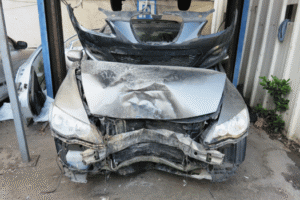
Your car recorded the crash. In the few seconds before impact, a small module logged how fast you were going, whether you hit the brakes, and what the car did in response. In Nevada, car black box data generally belongs to you as the registered owner, and almost no one else can download it without your consent or a court order.
That matters right now, while the adjuster is calling and the car is sitting in a tow yard. Whoever controls the car controls the evidence. Here is what the recorder holds, who is allowed to touch it, and how to keep it from disappearing.
What Is a Car’s Black Box (EDR)?
A car’s black box is officially called an event data recorder, or EDR. It is a small memory module, usually built into the airbag control unit and tucked under the center console or a front seat.
It does not record your whole drive. It constantly watches the car’s sensors and saves a short snapshot only when something triggers it, such as an airbag deployment or a sudden, violent change in speed. Under the current federal standard, that snapshot covers about five seconds before the crash. Newer models will be required to capture more.
Does my car have one?
Almost certainly. Federal rules do not force automakers to install a recorder, but nearly every passenger car and light truck sold in the United States for more than a decade has one. Your owner’s manual will say so. Nevada law requires manufacturers to disclose the recorder there.
What Information Can You Get From a Car’s Black Box?
The exact list depends on the make, model, and year. Most recorders capture:
- Vehicle speed in the seconds before impact
- Accelerator position, meaning how far the pedal was pressed
- Whether the brakes were applied, and when
- Steering input on many newer vehicles
- Seat belt status for the driver, and often the front passenger
- Airbag warning lamp status and the timing of any airbag deployment
- The force of the impact, measured as the change in speed
- Whether there was more than one impact
What it can’t tell you
The recorder shows what the car did. It does not show why. It can prove the brake pedal was pressed while the car kept gaining speed, but it takes an engineer to trace that back to a faulty part.
That gap is where a defective vehicle claim in Las Vegas begins. The data raises the question. The car itself answers it.
Who Owns Car Black Box Data in Nevada?
You do, if you are the registered owner. Nevada law says that, as a general rule, only the registered owner of a vehicle may download or retrieve data from its event recording device. Federal law says much the same thing: the data belongs to the vehicle’s owner or lessee.
Nevada allows someone else to pull the data in a handful of situations:
- You consent
- A court orders it
- It is used for vehicle safety research that does not identify you
- A dealer or repair shop retrieves it to diagnose, service, or repair the car
- It is collected under a subscription service whose agreement disclosed the collection
Outside those exceptions, downloading someone else’s recorder data is a misdemeanor in Nevada.
Leased, financed, and rental cars
If you are still making payments, you count as the owner even though a lender holds a security interest. The same goes for a long-term lease of more than three months.
A short-term rental is different. If you crashed in a car you picked up near Harry Reid International or on the Strip, the rental company is the owner, and it decides who gets access. You can still obtain the data, but it usually takes a formal demand or a court order, which is one more reason to move early.
What changes when the insurer takes the title
This is the part most people miss. When your insurance company declares the car a total loss and you sign the title over, you are no longer the owner. The car, the module inside it, and practical control over the data all move with the title.
From there the car typically goes to a salvage auction. If you are weighing that decision this week, read about letting your insurance company total the car after a defect crash before you sign anything.
Who Is Collecting Data From Your Car?
The crash recorder is only one source. Modern vehicles produce several streams of data, and each one follows different rules.
- The event data recorder. Crash snapshots stored inside the car. This is the data Nevada’s ownership rule protects.
- Connected-car services. Many vehicles send location, trip history, and driving behavior back to the automaker through a built-in cellular connection. You agreed to this in the terms when you set up the car or its app.
- Driver-assist logs. Vehicles with lane-keeping, adaptive cruise, or automatic braking may store or transmit records showing whether those systems were active.
- Insurance apps and plug-in devices. If you enrolled in a safe-driving discount program, your insurer already has its own record of your speed, braking, and phone use.
- Your phone and the infotainment system. Paired phones leave call logs, contacts, and navigation history behind.
So the full answer to “who has my data” is often several companies at once. A thorough investigation asks for all of it, not only the module under the seat.
Can Black Box Data Be Used Against You?
Yes. It can also be the strongest evidence you have. The recorder has no stake in the outcome.
If the data shows no braking before impact, the insurer will call it driver error. If it shows the brake applied and the throttle wide open at the same moment, the story changes completely. That pattern points at the car, as in cases involving sudden acceleration or a driver-assist failure.
Glen Howard spent years as an insurance defense attorney before he started representing injured people. He knows why an adjuster wants the download quickly and on the insurer’s terms: whoever reads the data first gets to frame what it means. An early request for your signature is rarely about helping you.
You are allowed to slow that down. Treat a data authorization with the same caution as a recorded statement to the insurance company. Every case is different, so talk with an attorney before you agree to either one.
How Long Is Black Box Data Stored in a Vehicle?
There is no expiration date. The data sits in memory that does not need battery power, and it can last for years. The real risks are physical.
- Airbag-deployment events are locked. Federal standards require the recorder to protect that data from being overwritten.
- Lesser events are not. A crash without airbag deployment may be stored in a slot that a later hard stop or second impact can overwrite if the car is driven again.
- Repairs can wipe or replace the module. Airbag system repairs often involve swapping the control unit that holds the data.
- Salvage ends it. Once the car is sold for parts or crushed, the module is usually gone for good.
The data does not fade. It gets lost when the car leaves your hands.
How Can I Get Black Box Data From My Car?
Not with a parts-store code reader. Retrieving crash data takes specialized equipment and a trained technician, usually an accident reconstruction expert.
How the download is done matters as much as what it shows. A proper retrieval is documented from start to finish, and the other side is normally given notice and a chance to attend so nobody can later claim the data was altered. A careless attempt can damage the evidence or give the defense an argument to keep it out.
If your crash just happened, these steps protect you:
- Don’t sign a data release yet. Your consent is what gives someone else the right to download.
- Don’t release, repair, or sell the car. Find out which tow yard has it and whether storage fees are running.
- Don’t drive it, even if it starts.
- Put a preservation demand in writing. A dated letter to the insurer and the yard puts them on notice to keep the vehicle and its data intact. Nevada courts expect evidence to be preserved once a claim is reasonably foreseeable.
- Get the car inspected before anything else happens to it. If you are unsure whether the vehicle is to blame, compare your crash against the signs a crash was caused by a defect or driver error.

Frequently Asked Questions
Can police download my car’s black box without a warrant in Nevada?
Generally, no. Nevada’s statute limits downloads to the registered owner unless a specific exception applies, and the two that matter for law enforcement are your consent and a court order, such as a search warrant. After a serious crash, officers may ask for permission at the scene or seek a warrant later. If you consent, the download is lawful. Whether to consent is a decision with real consequences, especially when fault is disputed or someone was badly hurt, so it is reasonable to speak with an attorney first. Separately, a vehicle held as part of a criminal investigation follows its own rules.
Does the insurance company need my permission to download the black box?
While you are the registered owner, yes. An insurer generally needs your consent or a court order. Two things complicate that. First, your own policy likely requires you to cooperate with your insurer’s investigation, so a flat refusal to your own company can create problems. Second, once you transfer the title in a total-loss settlement, the insurer becomes the owner and no longer needs to ask. The practical answer is to agree to a download only on clear terms: a qualified technician, written documentation, and a complete copy of the report delivered to you.
Does a car’s black box record conversations or location?
The crash recorder itself does not record audio or video. The data elements set by the federal standard cover the vehicle’s speed, braking, throttle, seat belts, airbags, and impact forces, not your voice or where you were. Location is a separate matter. Connected-car services, built-in navigation, and insurance tracking apps can log where the vehicle traveled, and Nevada’s disclosure law recognizes that some devices keep a history of where a vehicle goes. If your car has an active data connection or you enrolled in a tracking program, assume location records exist somewhere.
Can I disable or erase my car’s black box?
Not in any practical way. The recorder is part of the airbag control system, so disconnecting it can disable the airbags and trigger warning lights. Erasing data after a crash is a far worse idea. Once a claim is foreseeable, you have a duty to preserve relevant evidence, and that duty applies to you as much as to the insurance company. If data is destroyed, a Nevada court can instruct the jury to assume it would have hurt the person responsible, and intentional destruction carries heavier consequences. Preserved data that looks unhelpful is still better than missing data.

The Insurer Wants the Download. Get a Second Opinion Before You Sign.
If the adjuster has already asked for the car or for your signature, you are being asked to give up control over evidence you have not seen. You do not have to decide that alone, or today.
Howard Injury Law offers a free consultation, and there is no fee unless we win. Glen Howard used to handle these files for insurance companies. As a Las Vegas vehicle defect attorney, he now uses that experience for the people hurt when a vehicle fails.
Before you call, gather three things: the name of the tow yard holding your car, any form the insurer asked you to sign, and your claim number. With those, a lawyer can tell you quickly whether the data needs protecting and whether you have a case. Whether the wreck happened on the 215 Beltway, on I-15, or on a side street in Henderson, our Las Vegas motor vehicle accident lawyers can get a preservation demand out before the car moves.
Request your free consultation and find out where you stand before the car leaves the lot.