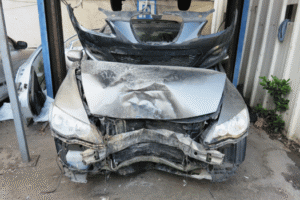
A defective car injury vs. lemon law question comes down to one thing: did the defect cost you money, or did it hurt you? Nevada’s lemon law deals with the car. A personal injury claim deals with you. If a defect caused a crash and you were injured, the lemon law is not the claim that pays your medical bills, and waiting on it can cost you the claim that does.
That matters right now, because the insurer is already calling and the car is sitting in a tow yard. Here is how to tell which claim you have, whether you have both, and what to do before anyone takes the vehicle.
Defective Car Injury vs. Lemon Law: The Short Answer
Both claims start with a car that didn’t work the way it should. After that, they have almost nothing in common.
| Lemon law claim | Defective car injury claim | |
|---|---|---|
| What it fixes | A car that can’t be repaired under warranty | Harm to a person caused by a defect |
| Who pays | The manufacturer | The manufacturer, parts maker, or seller, usually through their insurers |
| What you show | Repeated failed repairs during the warranty period | The defect existed and it caused your injury |
| What you recover | A replacement car or a refund | Medical bills, lost income, pain and suffering, future care |
| Nevada deadline | 18 months from original delivery | Generally two years from the injury |
If the car kept breaking down but nobody was hurt, you are looking at a lemon law or warranty problem. If the car failed and someone was hurt, you are looking at an injury claim, and possibly both.
What Nevada’s Lemon Law Actually Covers
Nevada’s lemon law (NRS 597.600 through 597.688) is a warranty law. It forces a manufacturer to stand behind a new vehicle it can’t fix. It was never written to compensate anyone for an injury.
Which cars qualify
The law covers new vehicles bought for personal, family, or household use that are still under the manufacturer’s express warranty. Motor homes and off-road vehicles are left out.
You have to report the problem in writing to the manufacturer before the warranty expires or within one year of delivery, whichever comes first. The defect also has to substantially affect the car’s use and value. A rattle in the dash won’t qualify. Brakes that fade or an engine that stalls on the 215 Beltway might.
Nevada presumes the manufacturer has had a fair chance to fix the car when either of these is true within that same window:
- The same problem has been in for repair four or more times
- The car has been out of service for repairs for 30 or more days in total
What you get, and what you don’t
If the car qualifies, the manufacturer has to replace it with a comparable vehicle or buy it back. A buyback refunds the purchase price, taxes, and fees, minus a deduction for the miles you drove. The manufacturer may also require you to go through its dispute program before you can sue.
What’s missing from that list is anything for a person. The lemon law pays no medical bills, no lost wages, and nothing for pain. It returns your money for the car and stops there.
When a Defect Becomes a Personal Injury Claim
Once a defect injures someone, a different body of law takes over. Nevada holds companies that make and sell dangerous products responsible for the harm those products cause. You generally don’t have to prove the manufacturer was careless. You have to show the vehicle or part was defective, that the defect was there when it left the company’s hands, and that it caused your injury.
Nothing in that test asks whether the car is new, used, or out of warranty. A ten-year-old car with 140,000 miles has no lemon law rights at all. If its airbag inflator ruptures in a crash on I-15, the person in the driver’s seat may still have a defective vehicle injury claim in Las Vegas.
An injury claim also reaches people the lemon law ignores: passengers, and people in other cars who were hit when the defective vehicle failed. And it covers what the crash did to your life, including hospital and rehab bills, missed paychecks, future treatment, and pain and suffering.
Not sure whether a defect was involved at all? Start with the signs a crash was caused by a defect rather than driver error.
Can You File Both a Lemon Law Claim and an Injury Claim?
Yes. Nevada’s lemon law says outright that it does not limit any other right or remedy a buyer has. If your new car spent weeks in the shop for a steering problem and then the steering failed and put you in the hospital, the warranty claim and the injury claim can exist side by side.
The risk is the order you handle them in. A lemon law buyback ends with the manufacturer taking the car back. That car is the single most important piece of evidence in your injury case, and you would be handing it to the company you are about to make a claim against.
Buyback paperwork deserves the same caution. Settlement documents can include release language that reaches further than the car. Have an injury attorney read anything a manufacturer or dealer puts in front of you before you sign it.
Two Claims, Two Deadlines
The two clocks start at different moments, which is where people lose rights without realizing it.
- Lemon law: A lawsuit must be filed within 18 months of the date the vehicle was originally delivered. The clock starts at delivery, not when the problem shows up.
- Injury claim: Nevada generally gives you two years from the date you were hurt.
So a driver can be patiently waiting on a fourth repair attempt while the lemon law window closes. An injured driver can spend a year arguing with a dealership’s service department while the injury deadline keeps running in the background. Neither clock pauses for the other. Every case has its own facts, so get the dates checked by an attorney instead of counting them yourself.
Can I Sue a Dealership for Selling Me a Lemon Used Car?
Sometimes, but usually not under the lemon law. A used car is covered only if it changed hands while the original manufacturer’s warranty was still running. Most used cars on a lot along West Sahara are past that point.
That doesn’t leave a used-car buyer with nothing. Depending on the facts, there may be a claim if the dealer:
- Gave you a written warranty and refused to honor it
- Lied about the car’s accident, flood, or title history
- Sold a manufacturer buyback without disclosing it, which Nevada law requires
- Knew about a safety problem and said nothing
An “as is” sticker limits warranty claims. It does not excuse a dealer who misrepresented the car. Complaints against Nevada dealers go to the DMV’s Compliance Enforcement Division, and a consumer warranty attorney can tell you what the money claim is worth.
If the used car’s defect injured you, that is a different conversation. Sellers can share responsibility for injuries from a dangerous vehicle, and a dealer who sold a car with an unrepaired recall is a common example. See whether you can sue when your car had an open recall.
What to Do Before the Insurer or Dealer Takes the Car
Glen Howard spent years as an insurance defense attorney before he started representing injured people. He knows why the other side moves fast after a suspected defect crash: once the car is repaired, sold for salvage, or returned to the manufacturer, the proof goes with it. Before that happens:
- Keep the car. Don’t authorize repairs, release it to salvage, or return it in a buyback yet. Here is how to handle an insurer that wants to total the car after a defect crash.
- Pull your repair history. Every service order showing the same complaint helps both claims.
- Put it in writing. Phone calls to a service desk leave no record. Written notice does.
- Protect the vehicle’s data. The car’s event recorder may show what the brakes, throttle, and airbags did in the final seconds. Read who owns a car’s black box data in Nevada before you approve a download.
- Don’t guess on a recorded call. “I’m not sure what happened” is safer than a theory the adjuster can use later.
- Get the claim sorted early. Ten minutes with a lawyer can tell you which claim you have and which deadline is closest.

Frequently Asked Questions
What are the chances of winning a lemon law case?
There’s no honest percentage, and anyone who quotes one is guessing. Lemon law cases are won on paperwork. Strong cases have repair orders showing the same problem four or more times, or 30 or more total days in the shop, plus written notice to the manufacturer inside the warranty period. Weak cases have verbal complaints, gaps between repair visits, or a defect that is annoying but doesn’t affect safety, use, or value. Timing matters as much as proof, because the lawsuit must be filed within 18 months of original delivery. Our firm does not handle lemon-law-only cases, so a consumer warranty attorney is the right person to evaluate one.
Can a car be totaled due to mechanical failure?
It depends on what the failure did. Standard auto policies generally don’t cover mechanical breakdown or wear, so an engine or transmission that dies on its own is usually a warranty or out-of-pocket problem, not an insurance total loss. A crash is different. If a mechanical failure caused a collision, collision coverage typically pays for the crash damage, and the insurer may total the car when repairs cost too much compared with its value. If you were hurt in that crash, slow down before agreeing to anything. A totaled car gets sold for salvage, and the failed part goes with it.
Is it worth suing after a car accident caused by a defect?
It depends on how badly you were hurt and whether the defect can be proven. Defect cases cost more to build than ordinary crash claims because they need engineers and testing, so they make the most sense when injuries are serious: surgery, a long recovery, permanent limits, or a death in the family. For minor injuries, an insurance claim against an at-fault driver may be the practical route. A free consultation should answer this in one conversation, and on a contingency fee you pay nothing unless there’s a recovery. More on when you can sue after a motor vehicle accident in Nevada.
Does the lemon law cover injuries?
No. Nevada’s lemon law gives you a replacement vehicle or a refund of what you paid, less a deduction for your use. It does not pay medical bills, lost income, or pain and suffering, and it does nothing for a passenger or another driver who was hurt. Those losses belong in a personal injury claim, which runs on its own rules and its own deadline. The two can be brought together when the facts support both. If you were injured, treat the injury claim as the priority, because it is usually worth far more and depends on keeping the car intact.

Not Sure Which Claim You Have? That’s the First Thing We Sort Out.
You don’t need to know the right legal label before you call. Tell us what the car did and what happened to you. If it’s a warranty problem with no injury, we’ll say so plainly and point you to the kind of attorney who handles it. If you were hurt, we’ll tell you what the claim looks like, which deadline is running, and what to do about the car this week.
Glen Howard built defenses for insurance companies before he switched sides, so he knows how a manufacturer and its insurer will try to turn a defect into “driver error.” Our motor vehicle accident lawyers in Las Vegas take these cases on contingency, with no fee unless we win.
Before the car leaves the lot, talk to a Nevada vehicle defect attorney or request a free case review. One conversation costs nothing, and it may be what keeps your evidence from being crushed.