


Yes, you can sue after a motor vehicle accident in Nevada. But if another driver’s negligence caused your crash and you suffered injuries or losses as a result. What’s less straightforward is the how, the when, and the what — how the process works, when your window to act closes, and what you can actually recover.
Most people who’ve been hurt in a motor vehicle accident in Las Vegas or anywhere in Nevada aren’t thinking about filing a lawsuit in the immediate aftermath. They’re dealing with medical treatment, vehicle repairs, missed work, and the stress of an insurance claim that isn’t moving as fast as their bills are. The lawsuit question comes later — usually when the insurance company’s offer doesn’t come close to covering what they’ve actually lost.
Understanding your right to sue, and the legal framework that governs it in Nevada, is not just academic. It’s leverage. Knowing you have the option — and that you’re prepared to use it — changes how your claim is handled from the beginning.
Howard Injury Law represents people injured in motor vehicle accidents throughout Las Vegas and Nevada. Glen Howard and our team are available 24/7. No fees unless we recover for you.
Nevada Is an At-Fault State — The Foundation of Your Lawsuit
Before anything else, the fault framework matters. Nevada is an at-fault state, which means the driver responsible for causing the crash is legally and financially liable for the damages that result. You don’t simply file with your own insurance and recover. You establish the other driver’s negligence and pursue their coverage — and if that coverage is insufficient or disputed, you pursue a civil lawsuit.
This is fundamentally different from no-fault states, where each driver’s own insurance handles their medical bills regardless of who caused the crash. In Nevada, fault is everything. It determines who pays, how much they’re obligated to pay, and whether a lawsuit is available as a remedy if the insurance process fails to produce a fair result.
The at-fault system gives injured people in Nevada meaningful legal recourse. It also means the other driver’s insurance company is motivated from day one to minimize your claim, dispute liability, or assign you a share of fault that reduces what they owe.
The Statute of Limitations: Your Window to Sue
The single most important deadline in any Nevada motor vehicle accident lawsuit is the statute of limitations. Under NRS 11.190, you generally have two years from the date of the accident to file a personal injury lawsuit. For property damage or vehicle damage claims, the window extends to three years.
Two years sounds like a long time. It rarely feels that way when you’re managing medical treatment, dealing with an insurance claim, and trying to get your life back to normal. But the deadline is absolute. Miss it and you lose the right to sue — not because your case wasn’t strong, not because the other driver wasn’t clearly at fault, but simply because you waited too long.
There are limited exceptions. If the injured person is a minor, the statute may be tolled until they turn 18. If the at-fault driver left Nevada after the crash and before the claim was filed, that time away may not count toward the two-year clock. Discovery rules may apply in rare cases where injuries weren’t immediately apparent.
These exceptions are narrow. Don’t plan around them. The practical advice is straightforward: consult an attorney well before the two-year deadline so your case is built on evidence that still exists, witnesses who still remember, and documentation that hasn’t been lost. Review Nevada’s statute of limitations for personal injury for a more detailed breakdown of how the timeline works in specific situations.
Shared Fault Doesn’t Eliminate Your Right to Sue
One of the most common reasons people hesitate to pursue a lawsuit is the belief that they were partially responsible for the crash. Maybe they were slightly over the speed limit, or they were a few seconds late reacting, or maybe the police report assigned them some percentage of fault.
None of that automatically eliminates your right to sue in Nevada.
Nevada follows a modified comparative negligence standard under NRS 41.141. Under this rule, you can sue and recover damages as long as your share of fault is 50 percent or less. Your recovery is reduced proportionally — if you’re found 25 percent at fault and your total damages are $200,000, you recover $150,000. But you recover.
The threshold that matters is 51 percent. Cross it and recovery is barred entirely. That’s exactly why insurance adjusters work so hard to push fault attribution onto injured claimants. Every percentage point they assign to you reduces their liability. Getting your percentage above 50 eliminates it completely.
An attorney’s job in a disputed fault case is to ensure that your percentage accurately reflects the evidence — not an inflated number the insurer constructed to reduce their exposure. Understanding how fault is determined in a motor vehicle accident is the foundation of understanding whether a lawsuit makes sense in your situation.

What You Can Sue For
Nevada law allows injured people to pursue two broad categories of damages in a motor vehicle accident lawsuit.
Economic Damages
Economic damages are the measurable, documented financial losses caused by the crash that include current and future medical expenses, emergency treatment, hospitalization, surgery, physical therapy, specialist care, and any ongoing treatment you require.
They also can include lost wages from time you couldn’t work during recovery or diminished earning capacity if your injuries affect your ability to work in the future. They include vehicle repair or replacement costs and any other out-of-pocket expenses directly traceable to the crash.
These damages have receipts, records, and documentation behind them. They’re calculated from medical bills, employment records, and expert testimony about future care needs.
Non-Economic Damages
Non-economic damages cover the losses that don’t come with a receipt but are no less real. Pain and suffering. Emotional distress. Loss of enjoyment of life. The effect of permanent injuries on your daily experience. The anxiety and psychological impact of a serious crash.
Nevada does not cap non-economic damages for most motor vehicle accident cases. Unlike some states that place a statutory ceiling on what injured people can recover for pain and suffering, Nevada imposes no such limit in standard personal injury cases. The value of non-economic damages is argued and decided based on the severity of your injuries, the duration of your suffering, and the impact on your life — not an arbitrary cap.
This distinction matters enormously in serious injury cases. A spinal injury that permanently limits your mobility, a traumatic brain injury that changes your cognitive function, injuries that affect your relationships and your ability to enjoy life — these losses have real value in Nevada courts, and they deserve to be fully presented and argued.
Understanding how much your personal injury case may be worth helps you evaluate what’s on the table before you accept any settlement offer.

When Suing Makes More Sense Than Settling
Most motor vehicle accident cases in Nevada resolve through insurance settlements rather than lawsuits. That’s not because lawsuits aren’t available — it’s because a well-negotiated settlement often achieves a fair outcome faster and with less cost than litigation.
But there are situations where filing a lawsuit is the right move, or at minimum the right threat.
When the insurance company’s offer is substantially below the actual value of your damages, the leverage of an active lawsuit changes the negotiating dynamic. Insurers settle cases because litigation is expensive and unpredictable for them too. An attorney who is clearly prepared to file and try a case is negotiating from a position the adjuster takes seriously.
When liability is genuinely disputed and the insurance company is refusing to move, a lawsuit allows your attorney to use formal discovery — depositions, subpoenas for records and footage, expert testimony — to build the evidentiary record that resolves the dispute. That process isn’t available in an insurance claim. It’s only available in litigation.
When the at-fault driver’s insurance coverage is insufficient to cover your actual damages, a lawsuit may be the mechanism that accesses additional coverage sources — umbrella policies, employer liability if a commercial driver was involved, or other responsible parties who weren’t initially part of the insurance claim.
If you’re wondering whether the settlement offer you’ve received reflects what your case is actually worth, read whether you should accept the first settlement offer from insurance in Las Vegas. The first offer almost never is.
The Lawsuit Process in Nevada: What to Expect
Filing a lawsuit doesn’t mean going to trial. Most civil cases in Nevada resolve before a jury ever hears them. But understanding the sequence helps manage expectations.
After a complaint is filed, the defendant — typically the at-fault driver and their insurance carrier — is served and has a period to respond. The discovery phase follows, during which both sides exchange evidence, take depositions, and retain experts. Mediation is commonly attempted before trial and resolves a significant percentage of cases. If mediation fails, the case proceeds toward trial.
The entire process from filing to resolution can take anywhere from several months to a few years depending on complexity, court scheduling, and whether liability is genuinely contested. For serious injuries with disputed fault and significant damages, longer timelines are common. For clearer liability cases with documented damages, resolution often comes faster.
An attorney who handles Nevada motor vehicle accident litigation regularly can give you a realistic assessment of where your case sits in that spectrum after reviewing the facts.
What If the Other Driver Has Minimum Coverage or No Insurance?
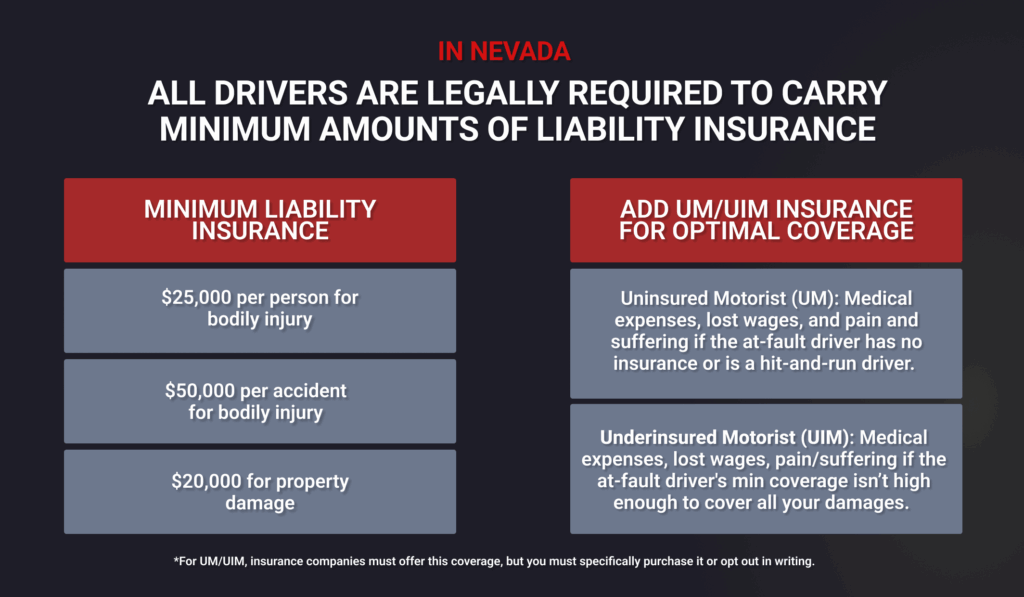
Nevada requires drivers to carry minimum liability coverage — $25,000 per person for bodily injury. That amount is inadequate for serious injuries. A single ER visit, imaging, and a short hospitalization can consume that limit before surgery or rehabilitation is even considered.
When the at-fault driver carries only minimum coverage and your damages exceed it, a lawsuit against them personally may be theoretically available but practically limited by their ability to pay. Your own uninsured and underinsured motorist coverage becomes the critical resource in this situation.
UM/UIM coverage is your own policy’s protection against drivers who caused your injuries but can’t fully compensate them. It’s one of the most important coverages Nevada drivers carry and one of the most underused. Learn more about what uninsured motorist coverage actually does and how it interacts with a potential lawsuit against the at-fault driver.
Frequently Asked Questions
How long do I have to sue after a car accident in Nevada?
Two years from the date of the accident for personal injury claims under NRS 11.190. Three years for property damage claims. These deadlines are firm. Consult an attorney well before the window closes — building a strong case takes time and evidence degrades.
Can I sue if I was partly at fault for the crash?
Yes, as long as your fault is 50 percent or less. Your recovery is reduced by your percentage of fault but not eliminated. An attorney helps ensure that percentage is accurately assessed based on evidence rather than inflated by the insurer.
Do I have to sue to get fair compensation?
Not necessarily. Many cases resolve through negotiated settlements without litigation. But the credible ability to file a lawsuit — backed by an attorney who is prepared to do so — often produces better settlement outcomes than negotiating without that leverage.
What damages can I sue for in Nevada?
Economic damages including medical costs, lost wages, and future treatment needs. Non-economic damages including pain and suffering, emotional distress, and loss of enjoyment of life. Nevada does not cap non-economic damages for most motor vehicle accident cases, which is significant in serious injury claims.
What if the at-fault driver’s insurance denies my claim?
A denial is not the end. An attorney can challenge the denial, present additional evidence, and if necessary file a lawsuit that forces a formal adjudication of your claim. Insurance company decisions are not final legal determinations.

Your Right to Sue Is Real — Use It If You Need To
Can you sue after a motor vehicle accident in Nevada? Yes — and knowing that you can changes your position in every conversation with the other side’s insurance company. You are not dependent on their goodwill or their assessment of what your case is worth. Nevada law gives you an independent path to fair compensation, and that path remains open for two years from the date of your crash.
The motor vehicle accident attorneys at Howard Injury Law represent injured people throughout Las Vegas and Nevada. We handle both the insurance negotiation and the litigation — whichever path produces the best outcome for you. Glen Howard and our team are available around the clock. Start with a free case review and let’s talk through what happened and what your options look like.
You pay nothing unless we recover for you.