


A common experience people describe when seeking medical care after a vehicle accident in Las Vegas is getting out of the car and deciding you were okay. Maybe a little shaken, maybe a sore neck, but nothing that seemed urgent enough for a hospital visit. You exchanged information, talked to the officer, and drove home.
Three days later, you can barely turn your head.
That’s a costly common mistake people make in terms of both their health and their legal claim. The decision about when to seek medical care after a vehicle accident is not just a medical one. It has direct, documented consequences for what you can recover if someone else’s negligence caused your crash.
Here’s why that timing matters — and what happens to your body and your case when you wait.

Your Body After a Crash: Why You Can’t Trust How You Feel
The human stress response is remarkably effective at masking pain. When a collision happens, your body floods with adrenaline and cortisol. These hormones suppress pain signals, elevate heart rate, and sharpen focus — an evolutionary response designed to help you survive a threat, not accurately assess your injuries.
The result is that how you feel at the scene of a crash bears almost no relationship to whether you’ve been injured. Drivers who walk away from serious collisions feeling fine sometimes discover herniated discs, torn ligaments, or concussions within 24 to 72 hours. The injury existed from the moment of impact. The symptoms simply hadn’t broken through the adrenaline response yet.
This delayed presentation is not unusual or rare. It is the expected pattern for many of the most common motor vehicle accident injuries. Understanding what those injuries look like — and when they typically surface — helps you recognize when your body is telling you something important.
Injuries That Don’t Show Up Right Away
Whiplash and Soft Tissue Injuries
Whiplash is the most common injury from rear-end and lower-speed collisions. The rapid back-and-forth motion of the head during impact strains the muscles, tendons, and ligaments of the neck and upper back. In many cases, the person involved feels nothing at the scene beyond mild tension.
Within 24 to 72 hours, the inflammatory response sets in. Stiffness, pain with movement, headaches, and sometimes radiating pain into the shoulders and arms emerge as the soft tissue responds to the trauma. By the time symptoms are undeniable, several days have passed since the crash — creating exactly the documentation gap that insurance adjusters use to dispute the injury’s connection to the accident.
Concussion and Traumatic Brain Injury
Concussions don’t require a direct blow to the head. The sudden deceleration of a vehicle accident can cause the brain to move within the skull, producing injury without any visible contact. Many people with concussions experience no immediate loss of consciousness and feel essentially normal at the scene.
In the hours and days that follow, symptoms emerge: headache, difficulty concentrating, sensitivity to light and noise, sleep disruption, irritability, and memory problems. Because these symptoms are non-specific — they could reflect stress, poor sleep, or general discomfort — they are easy to dismiss and equally easy for an insurer to attribute to something other than the crash. A same-day medical evaluation that documents the mechanism of injury creates the connection before the delay becomes a problem.
Internal Injuries
Internal injuries are the most medically serious delayed-presentation injuries from vehicle accidents. Damage to the spleen, liver, kidneys, or internal bleeding from blunt force impact can develop or worsen over hours without obvious external symptoms. Initial signs are often subtle: mild abdominal discomfort, unusual fatigue, slight dizziness.
If you experience any abdominal pain, pain that worsens over time after a crash, significant dizziness, shortness of breath, or feel noticeably worse the day after the accident, go to an emergency room immediately. These symptoms can indicate a life-threatening condition that requires urgent evaluation rather than urgent care or a scheduled appointment.
Disc Injuries and Spinal Damage
The compressive forces of a vehicle collision can herniate or bulge spinal discs — particularly in the cervical and lumbar spine. Like soft tissue injuries, disc injuries frequently don’t produce their full symptom picture at the scene. Radiating pain, numbness or tingling in the arms or legs, and significant back pain often emerge in the days following the crash as inflammation develops around the affected disc.
Disc injuries documented close to the date of a crash are much easier to connect causally to that crash than disc injuries first documented weeks later. An MRI or CT scan ordered during a prompt medical evaluation creates that contemporaneous record.

ER or Urgent Care After an Accident
Not every post-accident medical visit needs to be an emergency room visit. The right setting depends on your symptoms.
Go to the Emergency Room if You Have Any of These
Call 911 or go directly to an ER for: loss of consciousness at any point, significant head trauma, severe neck or back pain, chest pain or difficulty breathing, abdominal pain or tenderness, obvious bone fractures or deformity, uncontrolled bleeding, sudden vision changes, seizures, or symptoms that are getting rapidly worse.
Dignity Health, University Medical Center, and Sunrise Hospital are among the Las Vegas-area emergency facilities equipped to handle serious trauma from vehicle accidents. If you’re unsure whether your symptoms warrant an ER, default to yes. The cost of an unnecessary ER visit is manageable. The cost of missing a serious injury is not.
Urgent Care Is Appropriate for Lower-Severity Symptoms
If you have no symptoms that suggest internal injury, head trauma, or spinal emergency — but you want a same-day evaluation and documentation of the crash and any discomfort — urgent care is an appropriate option. Urgent care facilities can evaluate soft tissue injuries, order X-rays for suspected fractures, document your visit and symptom presentation, and refer you to specialists for follow-up.
The critical point is that urgent care on the day of the crash is always better than waiting to see your primary care doctor next week. The gap between the crash date and your first medical visit is one of the first things an insurance adjuster looks at when evaluating your claim.

Why Timing Directly Affects Your Claim
Here’s where the medical decision and the legal reality intersect most directly.
Insurance companies evaluate injury claims by looking for a clear, documented, unbroken chain from the crash to your injuries to your treatment. Every gap in that chain is an opportunity for the adjuster to insert an alternative explanation. A three-day gap between the crash and your first doctor visit becomes: the injuries weren’t serious enough to seek care. A two-week gap becomes: something else may have caused this. A month becomes: there’s no established connection to the accident at all.
None of those arguments are necessarily accurate. But they don’t need to be accurate to affect your settlement. They need to be plausible enough to justify a reduced offer, and a documentation gap makes them plausible.
A same-day medical visit eliminates the gap entirely. The record shows: crash on this date, medical evaluation on this date, injuries documented and causally attributed to the collision. That chain is difficult to break regardless of what the adjuster argues.
This timing issue is also why understanding what the insurance adjuster actually does with your claim before you interact with them matters so much. Their evaluation of your medical documentation begins the moment your claim is opened.
What to Tell the Doctor
When you go to the doctor after a vehicle accident, be complete and specific about what happened and every symptom you’re experiencing — even ones that seem minor.
Tell them the mechanism of the crash: rear-end collision, T-bone, head-on. Let them know the approximate speed, the area of your body that has any discomfort, stiffness, pain, or unusual sensation, however mild. Tell them about any headache, dizziness, nausea, or cognitive fogginess. Tell them you were in a motor vehicle accident and are seeking evaluation specifically in connection with that event.
Physicians document what you report. Symptoms you don’t mention don’t make it into the record. Two months later when your neck injury is significant and documented, the question will be whether that injury was documented at your first visit — or whether it appeared later, which looks different to an insurer.
Don’t downplay your symptoms because you don’t want to seem dramatic. Don’t minimize discomfort because you’re not sure it’s related. Report everything and let the physician assess its significance.
Continuing Care After the Initial Visit
The initial evaluation is the beginning, not the end. Follow through on every referral, every follow-up appointment, and every treatment recommendation your doctors provide. Gaps in ongoing treatment — periods where you stopped seeking care because you felt slightly better — create the same documentation problems as the initial delay.
Consistent treatment tells a consistent story: you were injured in this crash, you sought care, you followed through with treatment, and your injuries had an ongoing impact on your life. That story is worth more in a settlement than a fragmented one with unexplained gaps.
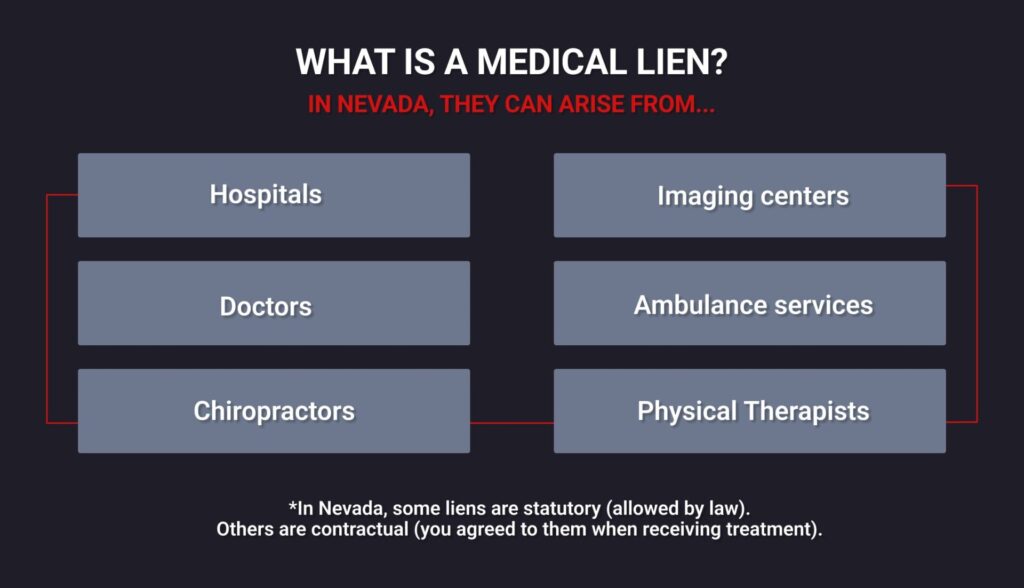
If cost is a barrier to consistent medical treatment after a crash in Las Vegas, there are options. Many medical providers work on a medical lien basis — meaning they treat you now and are paid from your settlement. Understanding how medical liens work in personal injury cases and what to do if you can’t afford treatment after an accident in Las Vegas can remove the financial barrier that causes some people to delay or discontinue care.
How Medical Documentation Connects to Maximum Medical Improvement
Your treatment continues until you reach what Nevada personal injury law calls maximum medical improvement — the point at which your condition has stabilized and further significant recovery is unlikely. That milestone matters enormously for your claim because it defines the endpoint of your documented injury and establishes whether any permanent impairment exists.
Settling a claim before reaching maximum medical improvement is one of the most common ways injured people recover less than their case is worth. If you settle while still in active treatment, you can’t go back for additional compensation if your condition worsens or requires additional procedures. Understanding what maximum medical improvement means for your claim helps you time your settlement negotiations correctly.
Frequently Asked Questions
How soon after an accident should I see a doctor in Nevada?
The same day — ideally within hours of the crash. At the very latest, within 24 hours. Every day of delay creates a documentation gap that insurance adjusters use to dispute the connection between your injuries and the accident.
What if I felt fine at the scene but now have pain two days later?
See a doctor immediately and tell them you were in a vehicle accident on the crash date. Same-day documentation is no longer possible, but prompt care still creates a record. An attorney can help contextualize the delay and explain the medical basis for delayed symptom presentation to the insurance company.
Does the type of doctor matter for my claim?
Any licensed medical provider who evaluates and documents your injuries creates a valid medical record. Emergency physicians, urgent care providers, primary care doctors, chiropractors, and specialists all contribute to your treatment record. What matters is that someone evaluated you, documented your symptoms, and connected those symptoms to the accident.
Can I still file a claim if I waited weeks to see a doctor?
Yes — Nevada’s statute of limitations gives you two years from the date of the crash to file a personal injury claim. But a delay in medical care weakens the documentation chain and gives insurers more room to dispute your injuries. An attorney can help assess how a delayed evaluation affects your specific claim and what additional documentation may help. Read more about whether you can still file a claim if the accident was weeks ago.
What if I don’t have health insurance to pay for medical care?
Medical liens allow treatment providers to treat you now and be paid from your settlement later. Many personal injury attorneys in Las Vegas work with providers who offer this arrangement. What to do if you can’t afford medical treatment after an accident in Las Vegas covers this in detail.

Your Health and Your Claim Both Start With One Visit
When should you seek medical care after a vehicle accident? Today. Not tomorrow, not after the weekend, not once you see how you feel in a few days. The same day — because your body’s ability to mask injury is real, because delayed symptoms are medically expected and legally predictable, and because the documentation chain that protects your claim starts the moment you walk through a medical provider’s door.
The motor vehicle accident attorneys at Howard Injury Law represent injured people throughout Las Vegas and Nevada. We work alongside your medical treatment to build a claim that accurately reflects what you’ve been through and what you’re owed. Glen Howard and our team are available 24 hours a day. Start with a free case review — no obligation, no fees unless we recover for you.
Don’t wait on either front.