

If you can’t afford medical treatment after an accident in Las Vegas, you’re not out of options. Nevada has specific legal and financial pathways designed for exactly this situation — and using them correctly doesn’t just get you the care you need, it protects your personal injury claim at the same time.
We understand after an accident, you’re hurt. And the first thought that stopped you from going to the doctor wasn’t the pain — it was the cost. No insurance. No savings. A stack of bills already sitting on the counter. The idea of adding an ER visit on top of everything else feels impossible.
That’s what we’re here for, to walk you through every realistic option available to you right now, in order of how fast you can access them.

Can a Hospital Turn You Away Without Insurance or Money?
No. Under the federal Emergency Medical Treatment and Labor Act — commonly called EMTALA — every hospital emergency room in the United States is required to provide a medical screening examination and stabilizing treatment to anyone who arrives, regardless of their ability to pay, insurance status, or immigration status.
Every major Las Vegas hospital — University Medical Center, Sunrise Hospital, Valley Hospital Medical Center, MountainView Hospital — is bound by this law. If you need emergency care after an accident, go. The bill comes later. The treatment cannot be withheld.
This matters because one of the most common and damaging mistakes injured accident victims make is skipping the emergency room because they can’t afford it. That decision doesn’t just affect your health — it creates a gap in your medical record that insurance companies use to argue your injuries weren’t serious. The ER visit you avoid today becomes the evidence hole that reduces your settlement tomorrow.
When you can’t afford medical treatment after an accident, the emergency room is always available to you. What happens to the bill afterward is where the solutions below come in.
Medical Liens — Treatment Now, Payment From Your Settlement Later
The medical lien is the primary tool that allows accident injury patients in Nevada to access comprehensive medical care without paying anything upfront. Understanding how it works is the most important financial concept for any uninsured or cash-limited accident victim in Las Vegas.
How a Medical Lien Works
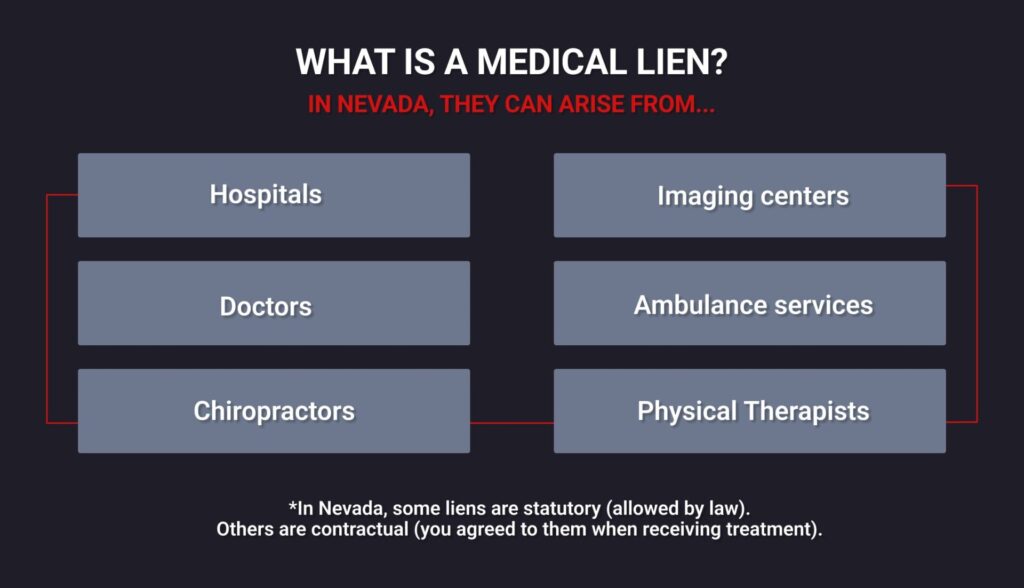
A medical lien — sometimes called a Letter of Protection — is a written agreement between you and a healthcare provider. The provider agrees to treat you now and defer all payment until your personal injury case resolves. In exchange, they place a legal claim on your settlement: they get paid directly from the recovery before you receive your net share.
You owe nothing until your case settles. You don’t make monthly payments. You don’t need to qualify for financing. The provider is extending credit against the anticipated value of your claim — and getting paid from the at-fault party’s insurance, not from your pocket.
Medical liens are standard practice in Nevada personal injury cases. Orthopedic specialists, neurologists, pain management clinics, MRI and imaging centers, chiropractors, and physical therapy practices in Las Vegas regularly treat accident patients on lien. Your personal injury attorney coordinates this — connecting you with appropriate providers for your specific injury type who are willing to work on lien.
What Happens to the Lien at Settlement
At settlement, your attorney receives the gross recovery. The contingency fee is deducted, case costs are reimbursed, and all outstanding medical liens are paid — often after your attorney negotiates them down. The remaining net amount goes to you.
Lien negotiation is a normal part of closing a personal injury case. Experienced attorneys routinely reduce lien amounts by 20 to 50 percent or more, which directly increases what you take home. The goal is to maximize net recovery — not just gross settlement.
For a complete breakdown of how this process works from treatment through settlement, read our guide on how medical liens work in Nevada personal injury cases. And for a full picture of how medical bills get paid after a settlement, see our guide on how medical bills and liens are paid after a Nevada settlement.
MedPay — The Coverage You May Already Have
If you carry any auto insurance at all, the first thing you should do after an accident is check your policy for Medical Payments coverage — called MedPay. Many Nevada drivers have it without knowing.
MedPay is an optional add-on to Nevada auto insurance policies. It covers medical expenses for you and your passengers regardless of who caused the accident. It doesn’t require a fault determination, it doesn’t require a settled lawsuit — it activates as soon as you file a claim and submit your medical bills.
Coverage limits typically range from $1,000 to $10,000 per person per accident. That’s not enough to cover a serious injury’s full treatment costs — but it can cover your ER visit, initial imaging, and first few specialist appointments while your personal injury claim is still in process.
To check whether you have MedPay, look at your auto insurance declarations page — the summary document that lists every coverage type and limit. MedPay appears as “Medical Payments” with a per-person dollar amount. If you can’t locate your declarations page, call your insurer directly and ask: “Do I have Medical Payments coverage on my current policy?”
If you do, activate it immediately by reporting the accident and your injuries to your insurer. Don’t wait for your personal injury case to resolve. MedPay is a separate benefit you’ve already paid for through your premiums.
Your Auto Insurance — Liability Coverage and PIP
If the at-fault driver has liability coverage — which Nevada law requires at minimum $25,000 per person — their insurer is responsible for your medical expenses, lost wages, and other damages up to their policy limits. This applies regardless of your own insurance status.
Filing a claim against the at-fault driver’s insurer is often the first formal step in a personal injury case. That claim doesn’t require you to pay anything. It requires documentation — of the accident, of your injuries, and of your treatment — which is exactly why getting medical care immediately and consistently matters so much.
The challenge with relying solely on the at-fault driver’s liability coverage is that it pays at settlement, not upfront. The medical lien system bridges that gap — letting you access care now against the anticipated recovery from that coverage later.
Nevada Medicaid — Check Your Eligibility Today
Nevada expanded Medicaid under the Affordable Care Act to cover adults earning up to 138 percent of the federal poverty level. For a single adult in 2026, that threshold is approximately $20,600 in annual income. For a household of two, it’s approximately $27,900.
If your income falls within those ranges, you may qualify for Medicaid coverage that applies immediately to accident-related medical treatment. Applications are processed through Nevada Health Link. Coverage can be retroactive to the date of your application and in some cases to the date of your accident — meaning treatment already received may be covered.
If your accident left you unable to work, your reduced income during recovery may now qualify you for Medicaid coverage that wasn’t available before. This is worth checking specifically during the recovery period — not just based on your normal annual income.
Emergency Medicaid
Emergency Medicaid provides coverage for life-threatening medical conditions regardless of immigration status or income level. If you’re not eligible for standard Medicaid, Emergency Medicaid may still cover acute emergency treatment from your accident.
Crime Victim Compensation — If a Crime Was Involved
If your accident was caused by a DUI driver or any other criminal act, Nevada’s Crime Victim Compensation Program provides financial assistance for medical expenses, mental health treatment, and lost wages to victims of violent crimes. This is a separate program from personal injury law — it provides direct financial assistance regardless of whether the at-fault party is insured or has assets.
Applications are filed through the Nevada Office for Victims of Crime. An attorney can help you navigate both the compensation program and your personal injury claim simultaneously.
Community Resources in Las Vegas
When you can’t afford medical treatment after an accident and need immediate care options beyond the ER, Las Vegas has specific local resources.
Nevada 211 is a free resource connection service available by phone, text, or online at 211.org. Dial 211 to reach a navigator who can identify free and low-cost medical clinics, prescription assistance programs, and financial assistance programs specific to your zip code. This is one of the most underutilized resources in Clark County for people navigating unexpected medical costs.
Nevada Health Centers operates federally qualified health centers across Clark County providing care on a sliding fee scale based on income. The sliding scale means you pay only what you can afford — and for the lowest income brackets, care is effectively free.
University Medical Center’s Financial Assistance Program offers charity care and payment plans for qualifying patients. If you received care at UMC after your accident and cannot pay, apply for their financial assistance program before the account goes to collections. Approval can significantly reduce or eliminate the balance.
Prescription Assistance Programs — if your injury requires ongoing medication, pharmaceutical manufacturers’ patient assistance programs and services like NeedyMeds.org provide free or reduced-cost prescription drugs for qualifying patients.
If you have more questions, check out our free community helpline for our Las Vegas community:

How Lost Wages Factor In
When you can’t afford medical treatment after an accident, the financial pressure is often compounded by not being able to work while you recover. Lost wages are a fully recoverable category of damages in Nevada personal injury cases — but they need to be documented properly.
Your employer needs to confirm in writing the time you missed and your regular compensation rate. Pay stubs, W-2s, or 1099s establish your earnings history. Self-employed individuals document lost income through tax returns and client records.
If your injury permanently or long-term affects your ability to work at the same capacity, lost earning capacity extends beyond the wages you’ve already missed — it covers the projected future income you won’t be able to earn. This calculation typically requires a vocational rehabilitation expert and in serious injury cases can represent a significant portion of the total damages recovery.
Your attorney manages the documentation of both wage loss and earning capacity as part of building your full damages picture. These aren’t optional add-ons — they’re core categories of what you’re entitled to recover.
The Most Important Step — Contact an Attorney Before Making Financial Decisions
If you can’t afford medical treatment after an accident, the single most effective thing you can do right now is call a personal injury attorney before making any financial decisions about your care.
Here’s why: the moment you retain Howard Injury Law, we connect you with appropriate medical providers who work on lien for your specific injury type — typically within 24 to 48 hours. We identify whether MedPay or other coverage is available and activate it immediately. We preserve the evidence your case depends on. And we ensure that the treatment you receive is documented in the way that maximizes both your health outcome and your legal recovery.
Trying to navigate lien providers, insurance coverage, and Medicaid eligibility without legal guidance wastes time and often results in treating with providers who aren’t experienced with personal injury documentation. The result is care that helps your health but doesn’t build your case.
There is no upfront cost to hiring Howard Injury Law. Personal injury attorneys in Nevada work on contingency — our fee is a percentage of your recovery, paid at settlement. If your case doesn’t produce a recovery, you owe no fee. For a full explanation of how this works, read our guide on how contingency fees work in Nevada.
Frequently Asked Questions
Can a hospital sue me for unpaid bills from an accident?
Yes — medical providers can pursue collection on unpaid bills. However, in a represented personal injury case, medical bills are paid from the settlement before you receive your net recovery. The lien process is specifically designed to prevent this scenario by giving providers a secured path to payment through your case rather than through collection action against you personally.
What if my injuries are minor and I’m not sure a lawsuit is worth it?
The cost of treatment — even for injuries that seem minor — adds up quickly. An urgent care visit, two MRIs, and six weeks of physical therapy can exceed $15,000. Before deciding a claim isn’t worth pursuing, get a free legal assessment. You may be entitled to recover significantly more than your medical bills alone. Read our guide on whether your injury is too minor for a personal injury claim for a full breakdown.
Can I negotiate my medical bills directly with the hospital?
Yes. Most hospitals have financial assistance programs and will negotiate balances — particularly for uninsured patients. However, in a personal injury case, your attorney negotiates medical liens as part of the settlement process, typically achieving larger reductions than individual patients can negotiate on their own. Attempting to negotiate bills independently before your case settles can sometimes complicate the lien process — talk to your attorney first.
How long before I see any money from my case?
Personal injury cases in Nevada typically resolve in three to twelve months for cases that settle before litigation. Your medical treatment should reach maximum medical improvement before settlement is finalized — meaning the case shouldn’t close until your treating physician has determined your condition has stabilized and full treatment costs are known. Read our guide on how long personal injury cases take in Nevada for a detailed timeline breakdown.
Treatment Is Available. Your Recovery Comes First.
Not being able to afford medical treatment after an accident in Las Vegas is a real obstacle — but it is not an insurmountable one. The medical lien system, MedPay, Medicaid, Nevada 211, and community health resources all provide pathways to care without upfront payment.
The key is acting now. Every day without treatment is a day the gap in your medical record widens — and a day the evidence your case depends on gets harder to recover.
Howard Injury Law is available 24/7. Call (702) 331-5722 or contact us here. Free consultation, no fees unless we win. Tell us what happened — we’ll handle everything from here.