


If you’ve been searching for a personal injury attorney in Las Vegas and come across the phrase “80/20 rule for lawyers” — you’re probably wondering what it actually means and whether it affects you as a client.
The honest answer is yes, it does — in ways that most firms won’t explain directly. Understanding the 80/20 rule for lawyers helps you evaluate how a firm operates, whether your case is likely to get the attention it deserves, and what separates firms that treat every client as a priority from ones where your file competes with hundreds of others for an attorney’s time.
Here’s what the 80/20 rule is, how it applies to personal injury law firms in Las Vegas, and what it tells you about the firm you’re evaluating.

The 80/20 Rule — The Basic Principle
The 80/20 rule — formally called the Pareto Principle — is an observation about distribution patterns that shows up consistently across business, economics, and professional services. The core idea is that roughly 80% of outcomes come from 20% of inputs.
In a business context it means 20% of customers typically generate 80% of revenue. 20% of products drive 80% of sales. 20% of effort produces 80% of results.
In law firms, the 80/20 rule plays out in several specific ways — some of which directly affect you as a client.
How the 80/20 Rule Applies to Law Firm Revenue
At most personal injury firms, a small percentage of cases generate the majority of the firm’s revenue. High-value cases — serious injuries, clear liability, significant insurance coverage — produce large contingency fees. Lower-value cases — soft tissue injuries, modest treatment costs, limited coverage — produce smaller fees.
This creates a structural pressure that shapes how firms allocate attorney time and resources. A case likely to produce a $500,000 settlement gets different attention than one likely to produce $15,000 — even when the client’s experience of pain, disruption, and loss is equally real.
What This Means for Case Selection
Firms that understand and apply the 80/20 rule selectively take cases based on value potential. They focus their capacity on the 20% of cases that will drive 80% of their outcomes. This isn’t inherently wrong — it’s rational resource allocation.
What it means for you as a client is that case selection matters. When Howard Injury Law agrees to take your case on contingency, we’ve assessed it as one we believe has merit and value worth fighting for. That assessment reflects genuine evaluation — not a policy of accepting everything that walks in.
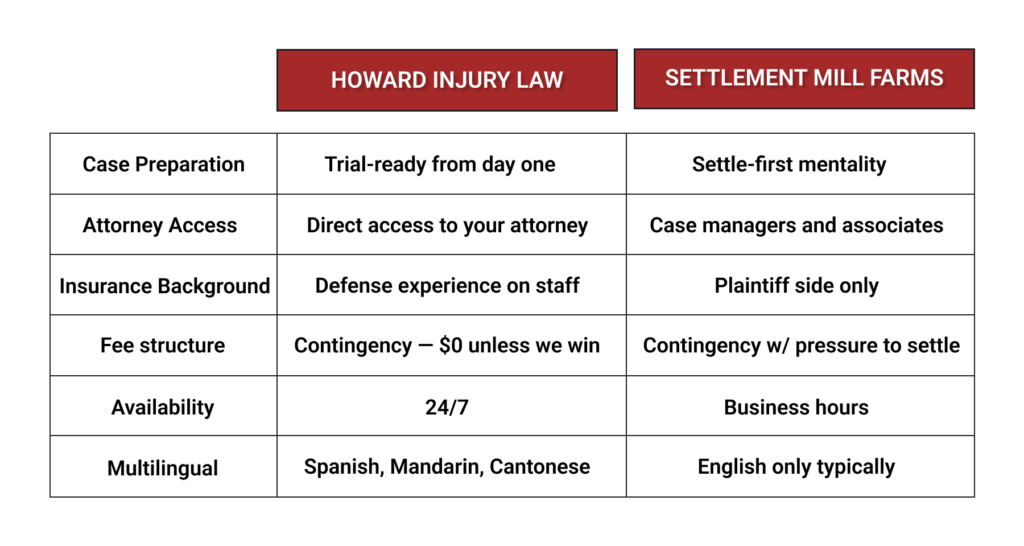
The flip side is that a firm accepting hundreds of cases without selectivity is taking the full distribution — including the majority of lower-value cases that, under the 80/20 principle, generate a small fraction of revenue. Those cases don’t get the same attention as the ones driving revenue. They get processed. That’s the settlement mill model described in our guide on trial lawyers vs settlement mills — what’s the difference.
The 80/20 Rule and Attorney Time
The second application of the 80/20 rule in law firms is about time allocation. Research and practical observation consistently show that a small percentage of attorney activities drive the majority of case outcomes.
The work that actually moves a case — thorough evidence preservation, comprehensive medical documentation, expert witness preparation, strong demand packages, skilled negotiation — represents a fraction of total case activity. Administrative work, routine correspondence, status updates, and file management take up significant time without directly driving outcomes.
What This Means for Your Case
A well-run personal injury firm structures its operations so that attorney time flows toward the high-impact 20% of activities — while support staff handles the administrative 80%. Case managers coordinate records and logistics. The attorney focuses on strategy, negotiation, and litigation preparation.
This delegation model, done correctly, actually benefits clients. It means the attorney’s time and judgment are concentrated on the work that matters most for your case — not consumed by administrative tasks that don’t require legal expertise.
Done incorrectly — when case managers are handling work that actually requires legal judgment — the 80/20 principle works against clients. The attorney’s involvement drops below the threshold where they genuinely understand and can advocate for your case.
At Howard Injury Law, Attorney Glen Howard leads every case. Our support team handles coordination and logistics — but the legal work, the strategy, and the decisions happen at the attorney level. For more on why that distinction matters for outcomes, read our guide on why direct access to your attorney matters.
The 80/20 Rule and the “Problem Client” Myth
One application of the 80/20 rule in legal practice management literature focuses on the idea that 20% of clients cause 80% of a firm’s administrative headaches. The implication — often discussed in law firm business coaching — is that firms should identify and avoid these clients.
This framing is worth examining critically from a client perspective.
Who Gets Labeled a “Problem Client”?
In personal injury practice, the clients most likely to generate administrative friction are often the ones with the most complex or serious cases — catastrophic injuries with multiple medical providers, disputed liability situations, cases involving government entities or complex insurance structures, clients who ask detailed questions and want thorough explanations.
These clients require more time and more communication. Under a pure efficiency lens, they look like the “difficult 20%.” Under a quality representation lens, they’re the clients whose cases most need thorough, engaged advocacy.
A firm that filters for administrative convenience rather than client need is not a firm oriented toward the best outcomes for injured people. The clients who need the most attention should get it — not be flagged as problematic.
What Good Client Management Actually Looks Like
The legitimate application of the 80/20 principle to client management is about firm capacity, not client filtering. A firm that takes an appropriate number of cases for its attorney capacity can give every client meaningful attention. A firm that takes three times more cases than it can handle well is going to underserve most of its clients regardless of how it tries to prioritize.
When you evaluate a personal injury firm in Las Vegas, case volume relative to attorney capacity is one of the most important things to assess. For guidance on how to evaluate this directly, read our guide on how to compare law firms.
The 80/20 Rule and Case Preparation
Here’s the application of the 80/20 rule that most directly affects what your personal injury case is worth.
In personal injury litigation, the quality of case preparation determines the quality of outcomes. And the preparation that actually matters — the evidence gathering, the expert analysis, the medical documentation, the damages calculation — is a concentrated set of activities that drive the majority of case value.
Preparation as the 20%
A thoroughly prepared personal injury case is built around a small number of high-impact elements. Strong liability documentation that clearly establishes the other party’s negligence. Comprehensive medical records that fully capture the nature, extent, and future implications of the injury. A damages analysis that accounts for all economic losses and presents the non-economic losses compellingly. Expert witnesses who can explain technical aspects of the case to a jury.
These elements represent the 20% of case work that drives 80% of settlement value. Firms that invest in this preparation produce better outcomes. Firms that cut corners on this preparation — accepting early offers before the evidence picture is complete, settling before maximum medical improvement is reached, skipping expert involvement to reduce costs — undermine the very work that produces case value.
At Howard Injury Law, we prepare every case as if it’s going to trial. That means the high-impact 20% of preparation work gets done completely — not abbreviated in the interest of closing files quickly.
Why Trial Readiness Is the Most Important 20%
Of all the preparation work in a personal injury case, trial readiness is the single element that most influences settlement value. Insurance companies know which firms will actually go to trial and which ones won’t. That knowledge shapes every offer they make.
A firm that is genuinely trial-ready — that has the preparation, the experience, and the demonstrated history of following through — operates with leverage that settlement-focused firms simply don’t have. The threat of trial only works when the insurer believes it’s real. For more on how this dynamic works and why it matters for your recovery, read our guide on best trial lawyers Las Vegas.
What the 80/20 Rule Means When You’re Hiring a Lawyer in Las Vegas
Knowing how the 80/20 principle operates in law firms gives you a useful framework for evaluating any firm you’re considering.
Is Your Case in the Priority 20%?
Ask yourself honestly: does this firm view my case as one of their priority matters, or am I likely to be part of the volume they process? The answer depends on the firm’s case selection model, their capacity, and how they communicate with clients.
A firm that took your case selectively — that evaluated it carefully and committed to it because they believe it has value — is a firm where your case is likely to get serious attention. A firm that accepts every case regardless of merit is a firm where your case competes with everyone else’s for the attention available.
Is Attorney Time Allocated to the Right Activities?
Ask who handles what in your case. If attorney time goes to legal strategy, evidence development, expert coordination, and negotiation — and support staff handles coordination and logistics — that’s correct allocation. If the attorney’s involvement is primarily administrative while staff makes substantive case decisions, that’s inverted allocation that doesn’t serve you.
Is Preparation Thorough or Abbreviated?
Ask what case preparation looks like for a case like yours. Ask how the firm approaches expert witnesses, medical documentation, and damages analysis. Ask what happens if the insurer’s offer doesn’t reflect full case value.
The answers tell you whether the firm invests in the high-impact preparation that drives outcomes — or takes the efficient path that closes cases fast at the expense of value.

Frequently Asked Questions
Does the 80/20 rule mean lawyers only focus on big cases?
Not necessarily — but it does mean resource allocation follows value signals. A well-run firm allocates attorney time to the work that most affects outcomes across all cases, not just large ones. The question for any client is whether their case is getting attorney-level attention on the activities that matter most.
How does the 80/20 rule affect what my case settles for?
Indirectly but significantly. A firm that applies the 80/20 principle correctly — concentrating attorney effort on high-impact preparation — produces stronger demand packages and better negotiation positions. A firm that dilutes attorney involvement across too many cases produces weaker preparation and lower settlement values across the board.
Should I ask a potential attorney about their case volume?
Yes — directly. How many active cases does the firm currently have, and what is the attorney-to-case ratio? A firm with one attorney carrying 400 open files cannot give each one meaningful attention. A firm with proportionate capacity for its volume can. For specific questions to ask before signing, read our guide on questions to ask during a personal injury consultation.
What is the most important thing I can do to be in the priority 20%?
Document everything thoroughly from day one. Consistent medical treatment, organized records, and clear communication with your attorney about your symptoms and limitations give your case the strongest possible foundation. A well-documented case is easier to build to full value — and an attorney who has complete information makes better decisions on your behalf.
The 80/20 Rule Works For You When the Right Firm Applies It
The 80/20 rule for lawyers isn’t just an internal business concept. It’s a lens for understanding how a firm allocates its most valuable resource — attorney time and judgment — and whether that allocation serves clients or just firm efficiency metrics.
The right application of the principle puts concentrated attorney effort into the preparation that drives case value. The wrong application turns clients into a volume problem to be processed as efficiently as possible.
Howard Injury Law takes cases selectively, prepares them thoroughly, and puts attorney-level attention on the work that matters. Free consultations 24/7. Call (702) 331-5722 or contact us here.