


What’s the difference between a trial lawyer and a settlement mill? They all look the same. They all sound the same. But they are not the same.
When you’re injured. You need a lawyer. You start searching, and within minutes you’re looking at billboards, TV commercials, bus wraps, and websites promising fast settlements, maximum compensation, and millions recovered.
Understanding trial lawyers vs settlement mills isn’t legal trivia. It’s the most important research you can do before you sign a retainer agreement. It could be the difference between recovering what your case is actually worth and walking away with a fraction of it.
Here’s exactly what separates them and us at Howard Injury Law, how to spot the difference, and what it means for your case in Las Vegas.

What Is a Settlement Mill?
A settlement mill is a high-volume personal injury law firm built around one goal: processing as many cases as possible, as quickly as possible. The business model prioritizes throughput over outcomes. Volume over value.
These firms — often the ones with the biggest advertising budgets, the most billboards on I-15, and the catchiest phone numbers — operate like an assembly line. Cases come in, get assigned to a paralegal or case manager, a demand letter goes out to the insurer, the first reasonable offer gets accepted, and the file gets closed. Then the next case comes in.
How Settlement Mills Make Money
Settlement mills make money on margin and volume. A firm handling 500 cases per year at an average settlement of $15,000 generates more revenue than a firm handling 50 cases per year at an average settlement of $80,000 — even if the per-case recovery is dramatically lower. The math works for the firm. It rarely works for the client.
The contingency fee on a quick, undervalued settlement is still a fee. The client gets less. The firm moves on.
What the Client Experience Looks Like at a Settlement Mill
If you’ve ever called a large personal injury firm and been immediately transferred to an intake specialist, then handed to a case manager, and then struggled to get the actual attorney on the phone — you’ve experienced the settlement mill model.
Clients at high-volume firms frequently go weeks or months without speaking to the attorney whose name is on the door. Their case is managed by paralegals and staff who handle dozens of files simultaneously. The attorney signs documents. The staff runs the case.
This matters not just because it’s frustrating — it matters because the person building your file directly affects what your case is worth. A case managed by an overloaded paralegal gets less investigation, less documentation, and less preparation than a case managed by an experienced attorney who knows how insurance companies think.
What Is a Trial Lawyer?
A trial lawyer is an attorney who genuinely prepares every case for trial — and who insurance companies know will actually take a case to a jury if the settlement offer doesn’t reflect the case’s true value.
The distinction sounds simple. The implications are significant.
Why Trial Preparation Changes the Settlement Outcome
Insurance companies aren’t afraid of attorneys. They’re afraid of specific attorneys — the ones who have walked into courtrooms, tried cases to verdict, and won. When an insurer evaluates a claim, one of the factors their internal system weighs is who is on the other side. A firm known for accepting early settlements gets different offers than a firm known for going to trial.
This is not a theory. It’s how insurance defense operates. The threat of trial is only credible when the attorney across the table has demonstrated they’ll follow through. A settlement mill that hasn’t filed a lawsuit in three years has no leverage at the negotiating table. A trial firm that just won a verdict last month has all of it.
When Howard Injury Law prepares a case, we build it as if it’s going to a jury. Every piece of evidence, every expert, every medical record is assembled with trial in mind. That preparation is visible to the insurer. It changes what they offer.
How Trial Lawyers Handle the Client Relationship
At a genuinely trial-focused firm, you work directly with your attorney — not a case manager, not a rotating team of paralegals. You have your attorney’s direct line. When your case has a development, the attorney calls you. When you have a question, you get an answer from the person who is actually handling your matter.
This direct access isn’t just a quality-of-life difference. It’s a case quality difference. An experienced attorney who knows your case inside and out — your injury timeline, your treatment history, your financial losses, your life before and after the accident — builds a stronger demand package, negotiates from a position of genuine knowledge, and presents a more compelling case if it goes to trial.

Trial Lawyers vs Settlement Mills — The Core Differences
Here’s where trial lawyers vs settlement mills diverge in ways that directly affect your recovery.
Case Preparation
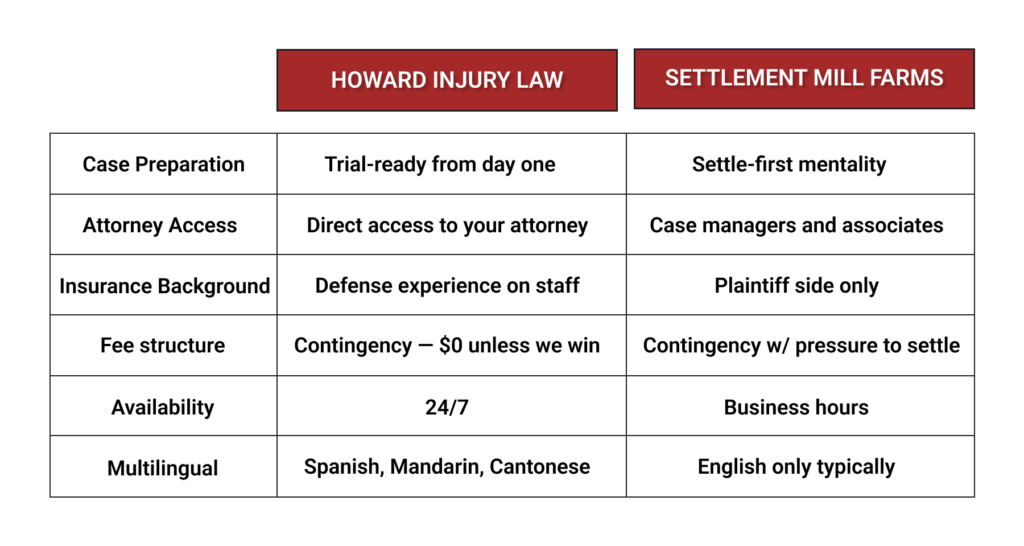
Settlement mills prepare cases for settlement. They gather enough documentation to support a demand letter and a negotiation. The goal is a number the insurer will accept.
Trial lawyers prepare cases for trial and accept settlements when the number reflects the full value of the case. The documentation is more thorough, the expert involvement is deeper, and the liability picture is built more aggressively — because it has to hold up in front of a jury, not just satisfy an adjuster.
Willingness to File a Lawsuit
Most settlement mills rarely file lawsuits. Filing a lawsuit means more work, more time, more expense — and those costs eat into the firm’s volume model. The path of least resistance is always to settle.
A trial firm files lawsuits when the insurer’s offer doesn’t reflect case value. The filing itself — the act of initiating litigation — often produces a recalibration from the insurer. Suddenly the case is being treated differently. A higher authority gets involved. Offers improve.
Who Handles Your Case
At a settlement mill: paralegals, case managers, and intake staff. At a trial firm: your attorney.
That difference compounds across every stage of your case — investigation, documentation, negotiation, and if necessary, litigation.
The Insurance Defense Advantage
Howard Injury Law’s attorneys bring something to this comparison that even most trial firms don’t have: direct insurance defense experience. Our team has worked on the defense side of personal injury cases. We know how insurers evaluate claims, what they look for in a file, where their arguments are strong, and where they’re weak.
That inside knowledge shapes how we build every case from the first appointment. We know what the other side is going to argue before they argue it — because we’ve made those arguments ourselves. That’s not a marketing line. It’s a structural advantage that shows up in outcomes.
For a deeper look at what separates Howard Injury Law from other Las Vegas personal injury firms, read our guide on why Las Vegas injury victims choose Howard Injury Law.
Red Flags That You’re Talking to a Settlement Mill
When you’re evaluating personal injury lawyers in Las Vegas, these specific signals indicate you’re dealing with a volume-based settlement operation.
You Never Speak to an Actual Attorney
If your initial consultation or intake call is handled entirely by a non-attorney — a “case evaluator,” intake specialist, or legal assistant — and you can’t get the actual attorney on the phone before signing anything, that’s a significant red flag. The attorney should be accessible from the first conversation.
The Advertising Promises Speed
“Fast settlement.” “Quick check.” “Get your money now.” These phrases signal a business model built around settlement speed, not settlement value. The fastest settlement is almost never the best settlement. An insurer’s early offer is almost always a test to see if you’ll take less than your case is worth.
You’re Being Pressured to Settle Before Treatment Is Complete
Any attorney who recommends accepting a settlement offer before you’ve reached maximum medical improvement — the point at which your treating physician determines your condition has stabilized — is prioritizing their fee over your full recovery. Your future medical costs aren’t known until your treatment is complete. Settling before that point means settling blind.
Your Case Has a Team — But Your Attorney Leads It
At settlement mills, cases get handed to a case manager and the attorney largely disappears from the picture. You might sign a retainer with a well-known name on the door and never speak to that person again.
At Howard Injury Law, your attorney leads your case from the first call to the final settlement. Our case managers work alongside your attorney — coordinating records, managing timelines, and keeping communication moving — but the legal strategy, the negotiations, and the decisions are always attorney-driven. You have your attorney’s direct line and you use it.
The question to ask any firm isn’t whether they have case managers — most good firms do. The question is whether the attorney is genuinely leading your case or whether the case manager is running it with the attorney’s name on the letterhead.
What to Ask Any Las Vegas Personal Injury Lawyer Before You Sign
These questions cut through marketing language and reveal how a firm actually operates.
Has the attorney personally tried personal injury cases to verdict in Nevada? Not the firm — the attorney who will be handling your file.
Who will I communicate with day-to-day? If the answer involves case managers, paralegals, or “the team” rather than the attorney, ask directly: when will I speak to my attorney, and how often?
How many cases does this firm have open right now? A firm carrying 400 active files cannot give 400 cases the same attention as a firm carrying 60.
What happens if the insurance company’s offer is too low? The answer should be clear: we file a lawsuit and prepare for trial. If the answer involves language about “continuing to negotiate,” ask specifically whether the firm has filed suit against that insurer before.
Do you have experience on the insurance defense side? This question separates firms that have fought insurance companies from firms that understand how insurance companies think. There’s a meaningful difference.
When relocating to Las Vegas in 2003, Mr. Howard worked for a multi-state insurance defense firm. He handled a variety of client matters, including drafting/revising contractions, commercial/residential real estate transactions, business formations, trademark registration, and litigation.
Why This Matters Specifically in Las Vegas
Las Vegas has more personal injury law firm advertising per capita than almost any other city in the country. The billboards, the bus wraps, the late-night TV spots — the sheer volume of legal advertising in Clark County is a signal about the market, not about the quality of representation.
The density of settlement mills in Las Vegas is directly related to the volume of accidents the city generates — tourist traffic, rideshare congestion, 24-hour road activity, and one of the highest uninsured driver rates in the country. High accident volume creates high demand for legal services. High demand attracts volume operators.
Knowing the difference between trial lawyers vs settlement mills in Las Vegas isn’t just useful — it’s essential. The firm you choose determines what your case is worth. Not the accident, not the insurance policy limits, not the severity of your injury alone. The representation.
Frequently Asked Questions
Do I need a trial lawyer if my case is likely to settle?
The vast majority of personal injury cases settle before trial — but how your case is prepared determines what the settlement offer looks like. Cases prepared for trial settle for more than cases prepared for settlement. The preparation is the leverage.
How do I know if a firm has actually tried cases to verdict?
Ask directly and specifically. Ask for the attorney’s trial history — not the firm’s marketing materials. A trial-experienced attorney can tell you about specific cases they’ve tried, the jurisdictions, and the outcomes. Vague answers about the firm’s general experience are not the same thing.
Is a settlement mill always a bad choice?
For minor property damage claims with no injuries, a high-volume firm’s efficiency may be fine. For any case involving injuries — especially soft tissue injuries, spinal injuries, TBI, or permanent disability — the quality of representation directly affects the outcome. Those cases need trial-ready preparation.
Does Howard Injury Law go to trial?
Yes. Howard Injury Law prepares every case for trial from day one. That preparation is what produces better settlement offers — and when an insurer refuses to offer fair value, we follow through. For more on how we approach cases, read about how we win personal injury cases in Las Vegas.
What does “no fees unless we win” actually mean?
It means Howard Injury Law’s fee is a percentage of your recovery — paid only when your case resolves in your favor. If your case doesn’t produce compensation, you owe no attorney fee. For a full explanation of how contingency fees work in Nevada, read our guide on what a contingency fee is and how it works.
The Difference Is Your Recovery
The difference between trial lawyers vs settlement mills in Las Vegas isn’t just a philosophical distinction about legal culture. It shows up in the number on your settlement check.
A settlement mill takes the first workable offer and closes the file. A trial lawyer builds the case to its full value and doesn’t close until the offer reflects it.
You were injured through someone else’s negligence. You deserve representation that fights for what your case is actually worth — not what’s fastest for the firm.
Howard Injury Law is available 24 hours a day, seven days a week. Free consultation, no fees unless we win. Call (702) 331-5722 or contact us here.