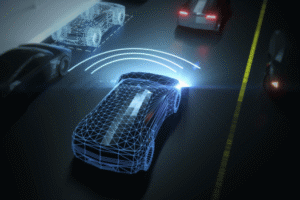


Robotaxis went from novelty to everyday traffic on the Las Vegas Strip in about a year. Zoox now picks up paying riders near the casinos, Waymo just opened to the public across a 24-square-mile zone, and Tesla and Uber have Nevada’s approval to follow. So a lot of Las Vegas residents and visitors are asking a fair question: are self-driving cars safe — and what happens if one of them causes a crash that hurts you?
The short answer is that the technology is promising and improving fast, but it isn’t flawless. And if a driverless car injures you in Nevada, you still have a real claim — the tricky part is figuring out who to pursue when there’s no driver behind the wheel.
Self-driving cars are already on Las Vegas roads
Las Vegas has quietly become one of the busiest robotaxi markets in the country. Two companies now carry paying passengers here, with more on the way.
Zoox, owned by Amazon, launched free public rides in September 2025 and began charging fares in August 2026. Its boxy, steering-wheel-free vehicles run the Resort Corridor, the Las Vegas Convention Center, Sphere, T-Mobile Arena, and — as of September 2026 — Harry Reid International Airport.
Waymo, owned by Alphabet (Google’s parent), opened public paid service in Las Vegas on September 14, 2026. Its Ojai minivans cover roughly 24 square miles, from Boulder Junction up Las Vegas Boulevard to Sahara Avenue, out to Allegiant Stadium and parts of Spring Valley.
They won’t be the last. In August 2026, the Nevada Transportation Authority also cleared Tesla’s Robotaxi and Aviari, an Uber subsidiary, to charge for driverless rides in Clark County. If you drive the Strip, you’re now sharing the road with cars that have no one in the front seat.
Are self-driving cars actually safe? What the data shows
The case for robotaxis is straightforward. A self-driving car never drives drunk, never texts, never gets drowsy after a double shift, and never speeds to make a light. Those human behaviors cause a huge share of the crashes we see across Nevada, so removing the human is supposed to remove the risk.
The companies lean hard on that argument. Waymo points to more than 100 million autonomous miles and its own safety studies reporting far fewer injury crashes than human drivers over the same distance. Independent researchers who’ve reviewed the early numbers generally agree these vehicles are involved in fewer serious collisions than the average human driver — though the data is still young, and most of the strongest figures come from the companies themselves.
Taken at face value, that’s encouraging. But “safer on average” is not the same as “safe every time,” and the recall record makes that clear.
The other side: robotaxi recalls and Las Vegas incidents
Self-driving systems are software, and software has bugs. When a robotaxi behaves unexpectedly, the fix is usually a recall — and Zoox alone has issued several.
In 2024, federal safety regulators opened an investigation after two motorcyclists rear-ended Zoox vehicles that braked suddenly, causing minor injuries. That led to a software recall in early 2025. Then, in April 2025, an empty Zoox robotaxi in Las Vegas collided with a passenger car. No one was hurt, but Zoox paused its driverless operations and recalled the software behind the crash. Later that year came recalls for failing to properly track a person next to the vehicle and for stopping in oncoming lanes near intersections. In June 2026, Zoox recalled software again after a robotaxi struggled to handle heavy smoke at a fire scene — around the same time federal regulators warned autonomous companies to stop interfering with first responders.
Waymo has its own history. Its cars have blocked roadways and collided with other vehicles in San Francisco, and a 2024 collision with a utility pole prompted a recall of hundreds of vehicles. In its first days on Las Vegas roads, riders reported robotaxis making abrupt stops and hesitating in traffic as the systems learned the city.
And the industry hasn’t forgotten Cruise — a General Motors robotaxi service that shut down after one of its cars dragged a pedestrian in San Francisco in 2023. The lesson isn’t that these cars are dangerous by default. It’s that the technology is new, still being corrected in real time, and capable of causing a serious crash. When it does, someone is responsible.
Who is liable if a driverless car causes a crash in Las Vegas?
This is where a robotaxi crash stops looking like a normal car accident. In a typical wreck, you ask which driver was careless. In a driverless crash, there’s no driver — so the question becomes which company or system failed.
Depending on what happened, more than one party may be on the hook:
- The company operating the robotaxi (Zoox, Waymo) for how the vehicle was deployed, maintained, and supervised.
- The manufacturer or software developer, under product-liability law, if a defect in the sensors or automated driving system caused the crash. The recalls above show these defects are real, not hypothetical.
- Another human driver who contributed to the collision.
- A government entity, in rare cases, if a road or signal problem played a role.
Nevada was the first state to legalize autonomous vehicles, and they’re regulated here under a dedicated chapter of state law (NRS Chapter 482A), with the DMV overseeing operation. But that law is largely silent on who pays after a crash, so recovery falls back on ordinary negligence and product-liability principles — which is exactly why sorting out who’s liable in a rideshare crash or a driverless one takes real digging.
A few Nevada rules matter for your recovery. Under the state’s comparative-negligence rule, you can still recover compensation as long as you’re not more than half at fault, though your award is reduced by your share of the blame. Autonomous-vehicle providers are required to carry at least $1 million in coverage while they’re carrying passengers. And you generally have two years from the date of the crash to file a claim — less if a government entity is involved.
One more thing decides these cases: data. A self-driving car records enormous amounts of information — sensor logs, camera footage, and software decisions in the seconds before impact. That data is often the strongest proof of what went wrong, and it can be overwritten. Getting a self-driving car accident lawyer involved early, so preservation demands go out before the record disappears, can make or break a claim. Every crash is different, so treat this as general information and talk to a Nevada attorney about your specific situation.
What to do if a robotaxi hits you in Las Vegas
If a driverless car crashes into you, the basics still apply — with a few twists for the fact that no one was driving.
- Get medical care first. Some injuries don’t show up for a day or two.
- Call the police. A Las Vegas Metro report documents the scene and the vehicle.
- Photograph everything — the vehicle, its company markings, license plate, and any visible ID number, plus the scene and your injuries. Note plainly that there was no driver inside.
- Collect witness names and numbers. Robotaxi crashes draw attention.
- Don’t give the company’s insurer a recorded statement before you’ve spoken with a lawyer.
- Contact an attorney quickly so the vehicle’s data can be preserved.
For a fuller walkthrough, our guide on the steps to take after a rideshare crash on the Strip covers the same ground in detail, and you can read more about rideshare accidents in Las Vegas generally.
Frequently Asked Questions
Are self-driving cars safe in Las Vegas?
On balance, the early data is encouraging — robotaxis remove the drunk, distracted, and drowsy driving that causes so many Nevada crashes, and companies like Waymo report fewer injury collisions than human drivers over the same miles. But “safer on average” isn’t “perfect.” Zoox and Waymo have both issued recalls after their software behaved unexpectedly, including an April 2025 Zoox collision right here in Las Vegas. The honest answer is that these vehicles are promising and improving, but not flawless. Treat them like any other car sharing the Strip with you: usually fine, occasionally not — and fully capable of causing a serious crash.
Which robotaxis operate in Las Vegas — Zoox, Waymo, or others?
As of late 2026, two companies carry paying passengers in Las Vegas. Zoox, owned by Amazon, launched first, going public in September 2025 and charging fares by August 2026, with service on the Resort Corridor and at Harry Reid International Airport. Waymo, owned by Alphabet, opened public paid rides on September 14, 2026, across a roughly 24-square-mile zone covering the Strip, Allegiant Stadium, and parts of Spring Valley. The Nevada Transportation Authority has also approved Tesla’s Robotaxi and Uber’s Aviari service, so expect more driverless cars on Las Vegas roads soon.
Who’s responsible if a driverless car with no one inside hits me?
With no human driver, responsibility usually shifts to the company operating the robotaxi and, if a defect caused the crash, to the manufacturer or software developer under product-liability law. Another human driver or, rarely, a government road defect can also share the blame. Nevada’s comparative-negligence rule lets you recover as long as you’re not more than half at fault, and autonomous-vehicle operators must carry at least $1 million in coverage while carrying passengers. The vehicle’s own data logs are often the key evidence. Because these cases are complex and every situation is different, it’s worth having a Nevada attorney evaluate yours.
Can you sue Zoox or Waymo after a crash?
Potentially, yes. If a Zoox, Waymo, or other robotaxi injured you, your claim generally runs against the company operating the vehicle and, where a software or sensor defect is involved, the manufacturer or developer as well — under a mix of negligence and product-liability law. These aren’t simple cases. You’re dealing with well-funded companies, their insurers, and technical evidence buried in the vehicle’s data. Our rideshare and taxi accident FAQs explain how these claims work, and a lawyer who handles them can tell you quickly whether you have a case worth pursuing.

Hurt by a robotaxi, rideshare, or taxi in Las Vegas? Here’s your next move.
Getting hit by a car with no one driving is disorienting, and the companies behind these vehicles have deep pockets and experienced insurers ready to minimize what happened. You don’t have to go up against them alone — or guess at whether you even have a claim.
Attorney Glen Howard built his career on the insurance-defense side before switching to represent injured people, so he knows exactly how these companies and their insurers evaluate, delay, and shrink claims. That’s the perspective we bring to every autonomous-vehicle, rideshare, and taxi case: we move fast to preserve the vehicle’s data, identify every party that may share fault, and pursue the full coverage available.
If a driverless car, rideshare, or taxi has injured you, talk with a Las Vegas rideshare accident attorney before that data disappears. The consultation is free, and you owe no fee unless we win. Call (702) 331-5722 or reach out through our contact page to find out whether you have a case — it takes one conversation to know where you stand.