


If an insurance adjuster has already called you after your loved one’s fatal crash — sounding warm, asking a few “quick questions,” maybe floating a check — understand this: that person works for the at-fault driver’s insurance company, not for your family. Their job is to close your claim for as little as possible, and the days right after a fatal Las Vegas crash are when they have the most leverage over you.
You don’t have to play their game. Knowing how insurers fight wrongful death claims is the first step to protecting what your family is owed under Nevada law.
Why the insurance company treats a fatal crash as a number
Insurance companies are for-profit businesses. Every dollar they don’t pay on your claim is a dollar they keep. A fatal crash claim is high-value — it can involve years of lost income, funeral costs, and the immeasurable loss of a parent, spouse, or child — which means it gets the most aggressive handling, not the most generous.
That’s the mindset behind every tactic below. None of it is personal. All of it is designed to make your family’s loss look smaller on paper than it is in life.
The tactics insurers use to shrink a fatal crash claim
These are the moves plaintiff attorneys in Nevada see over and over. Recognizing them is how you stop them from working.
The fast, friendly lowball offer
An adjuster may reach out within days with a settlement offer that feels like a relief when bills are piling up. It’s almost always a fraction of the claim’s real value. The goal is to close the file before your family understands the full scope of the loss — future lost support, the value of companionship, the estate’s damages. Once you accept and sign a release, the claim is over. You can’t reopen it later when the true cost becomes clear.
The recorded statement request
“We just need to hear what happened in your own words.” That request sounds harmless. It isn’t. Insurers use recorded statements to find inconsistencies, pull emotional comments out of context, and build an argument that your loved one was partly to blame. You are grieving and exhausted — exactly the condition in which people say things that get twisted later. You are not required to give one.
Blaming your loved one for the crash
One of the most common tactics is shifting fault onto the person who died. Adjusters will suggest your loved one was speeding, distracted, or careless — because Nevada follows a modified comparative negligence rule. Under it, a victim’s recovery is reduced by their share of fault, and barred only if they’re found more than 50% at fault.
Here’s what the insurer won’t explain: partial blame only reduces recovery, it doesn’t erase it. And if your loved one was genuinely not at fault, comparative negligence shouldn’t cut your claim at all. Fault is a fight worth having, and it can be answered with accident reconstruction, witness testimony, and physical evidence — even if your loved one was accused of being partly at fault.
Overbroad medical-records requests
An insurer may ask you to sign a blanket authorization for your loved one’s entire medical history. They’re entitled to records related to the crash and the cause of death — not a lifetime of unrelated history they can mine for a “pre-existing condition” to blame. A broad release hands them ammunition. A narrow, appropriate one doesn’t.
Attacking the value of your family’s loss
When they can’t deny the death, insurers attack the damages. They question how close the family really was. They point to a decedent’s health history to argue they “wouldn’t have earned or lived as long anyway.” It’s cold, and it’s routine. The counter is documentation: the true nature of the relationship, financial contributions, and the real scope of what your family can actually recover shown through records and expert evaluation.
Surveillance and social media monitoring
In higher-value cases, insurers may monitor a grieving family’s social media or conduct surveillance, hoping to find a photo or post they can spin as inconsistent with your loss. Assume the other side is watching. Keep details of the crash and claim off social media entirely.
Delay
Silence is a strategy. An insurer that stalls is betting your family will get worn down and accept less — or, worse, miss the legal deadline to file. In Nevada, a wrongful death claim generally must be filed within two years of the date of death, though exceptions and tolling can apply. Time is not on the insurer’s side by accident. Knowing Nevada’s deadline to file a wrongful death claim takes that leverage away.
What the insurance company doesn’t want you to know about Nevada law
Nevada wrongful death law is more protective of families than the adjuster will let on — and understanding it changes how you respond.
Two separate claims exist, not one. Under NRS 41.085, the heirs can recover for their own losses — grief and sorrow, loss of companionship and support, and the decedent’s pain and suffering — while the estate, through its personal representative, recovers funeral and medical costs and other damages. An offer that ignores one of these two claims is undervaluing your case by design. If the insurer disputes who has the legal right to file, that’s a question Nevada’s succession law answers, not the adjuster.
There’s no general cap on ordinary wrongful death compensatory damages in Nevada. A quick, “generous”-sounding number is a ceiling the insurer picked, not one the law imposes.
And here’s the point that catches most families off guard: you generally cannot sue the at-fault driver’s insurance company for “bad faith.” Nevada’s bad-faith law, NRS 686A.310, gives that right to an insurer’s own policyholder — a first-party relationship. As a third party making a claim against the other driver’s carrier, Nevada courts have made clear you don’t have that direct claim against them.
So where does your leverage actually come from? Three places. First, building the liability and damages case so thoroughly that a refusal to pay fairly exposes the insurer’s own policyholder to a judgment beyond their policy limits — pressure the carrier feels sharply. Second, your own uninsured/underinsured motorist coverage, which is a first-party relationship where those bad-faith protections do apply if your carrier lowballs you — which matters because fatal crashes routinely exceed a driver’s policy limits and the at-fault driver may be uninsured or underinsured. Third, being genuinely prepared to file suit against the at-fault driver. Every case is different, and how these apply to yours is a conversation to have with a Nevada attorney — but the takeaway is simple: leverage is built, not granted.
Strategic response steps to protect your claim
You don’t need to have everything figured out. You need to avoid the few early mistakes that hand the insurer the win.
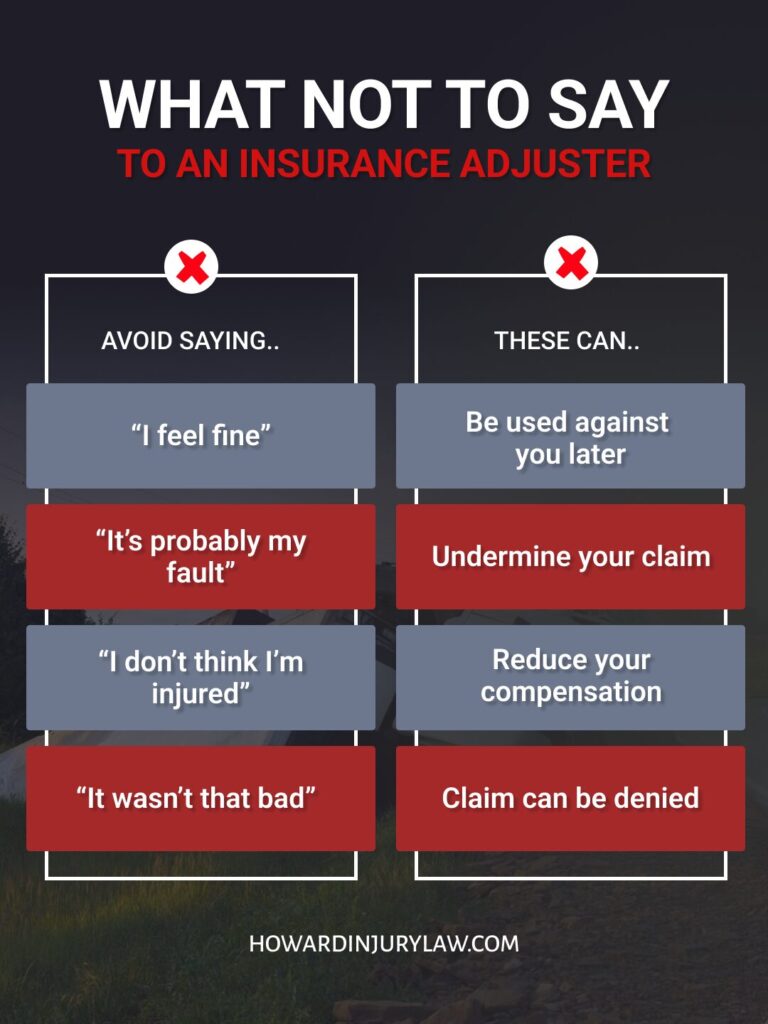
Don’t record or sign anything yet
No recorded statements. No settlement releases. No blanket medical authorizations. These are the documents that quietly cap your recovery before you know its value.
Limit what you say
You can be polite and still say very little. Confirm your identity, note that you’re represented or seeking representation, and decline to discuss fault or details. Anything beyond the basic facts can be used to shrink your claim.
Preserve evidence early
Fatal crash evidence disappears fast — vehicles get repaired or scrapped, skid marks fade, witnesses scatter, and camera footage gets overwritten. The evidence that proves a fatal crash case is easiest to secure in the first days, before the insurer’s version of events hardens.
Let one point of contact handle the adjuster
Once an attorney represents your family, the adjuster’s calls go to them. That single change ends the pressure calls, the “quick questions,” and the manufactured urgency — and it signals to the insurer that the easy discount is off the table.
Know your deadline
Nevada’s roughly two-year window from the date of death is firm, and missing it can end the claim entirely. Calendar it, and don’t let insurer delay run out your clock.
Is it worth it to sue after a fatal car accident?
For most families, the honest answer is yes — and here’s the nuance. The vast majority of wrongful death claims settle without a trial. But the families who recover full value are almost always the ones who were prepared to sue. A credible willingness to take the case to a Las Vegas jury is often the only thing that moves an insurer off a lowball number.
Cost isn’t the barrier families fear it is. A reputable Nevada wrongful death lawyer works on contingency — no upfront fees, no hourly bills, and no fee at all unless they recover for you. That means the analysis isn’t “can we afford a lawyer.” It’s “can we afford to face the insurance company’s playbook alone.” For a high-value claim, the answer is usually clear.
How a former insurance-defense attorney levels the field
At Howard Injury Law, founding attorney Glen Howard spent years on the other side of these claims as an insurance defense attorney. He knows this playbook because he used to run it — the lowball timing, the recorded-statement traps, the fault-shifting, the delay. That inside knowledge is exactly what your family needs on your side of the table now.
If an adjuster has already reached out about your loved one’s fatal crash and wrongful death claim, the most valuable thing you can do is talk to a lawyer before you record a statement, sign a release, or accept a check. As a Las Vegas motor vehicle accident firm, we handle the insurer so your family can grieve — and we don’t get paid unless we win.
Request a free, confidential consultation to find out what your family’s claim is really worth, and what to do before you speak to the insurance company again.
Frequently Asked Questions
What tactics do insurance companies use in a fatal crash wrongful death claim?
The most common are a fast lowball settlement offered before the family knows the claim’s value, requests for a recorded statement, and shifting blame onto the person who died to trigger Nevada’s comparative negligence rule. Insurers also request overly broad medical records to hunt for a “pre-existing condition,” question the closeness of the family to shrink non-economic damages, and delay in hopes the family gives up or misses the filing deadline. In higher-value cases, they may monitor social media or conduct surveillance. None of these tactics are illegal on their face — they work because grieving families don’t expect them.
Should I give the insurance company a recorded statement after a fatal crash?
No — not before speaking with a Nevada wrongful death attorney. Adjusters use recorded statements to find inconsistencies and pull emotional or unclear comments out of context, then use them to argue your loved one was partly at fault or that your damages are exaggerated. You are not legally required to give the at-fault driver’s insurer a recorded statement. You can decline politely and say you’ll be represented by an attorney. Once you have a lawyer, all communication runs through them, which removes the pressure and the risk of an offhand comment being used against your claim later.
What should I not tell the insurance company after a loved one’s fatal accident?
Don’t discuss fault, don’t speculate about how the crash happened, and don’t describe your loved one’s health, habits, or activities — all of it can be twisted to reduce your claim. Avoid giving a recorded statement, signing a blanket medical authorization, or accepting or even discussing a settlement figure. You can share basic facts (your name, that a claim exists, that you’re seeking counsel) and nothing more. When in doubt, say you’ll have your attorney follow up. A short conversation with a lawyer first is far safer than an unguarded one with an adjuster.
Can the insurance company blame my loved one for the crash in Nevada?
They can try. Nevada uses a modified comparative negligence rule: a victim’s recovery is reduced by their percentage of fault and barred only if they’re found more than 50% at fault. Insurers push blame onto the deceased precisely to shrink or defeat the claim. But partial fault only reduces recovery — it doesn’t eliminate it — and if your loved one wasn’t actually at fault, comparative negligence shouldn’t reduce your claim at all. Fault is provable with accident reconstruction, witnesses, physical evidence, and the police investigation. Don’t accept the insurer’s version as the final word.
Can I sue the at-fault driver’s insurance company for bad faith?
Generally, no — and this surprises most families. Nevada’s bad-faith statute, NRS 686A.310, gives a private right to sue an insurer for unfair claim handling to that insurer’s own policyholder, a first-party relationship. As a third party making a claim against the other driver’s carrier, Nevada courts have held you don’t have a direct bad-faith claim against them. Your leverage instead comes from building the case so strongly that refusing to pay fairly puts the insurer’s own policyholder at risk of a large judgment, from your own uninsured/underinsured motorist coverage (a first-party relationship where bad-faith rules do apply), and from readiness to file suit. An attorney can map which of these fits your situation.

Is it worth it to sue after a fatal car accident?
For most families with a legitimate high-value claim, yes. Most wrongful death cases settle without a trial, but the families who recover full value are typically the ones who were prepared to sue — a credible willingness to go to trial is often what forces an insurer off a lowball offer. Because Nevada wrongful death lawyers work on contingency, there are no upfront costs and no fee unless they win, so the practical question isn’t whether you can afford a lawyer. It’s whether you can afford to face the insurance company’s tactics without one. For a fatal crash claim, you usually can’t.