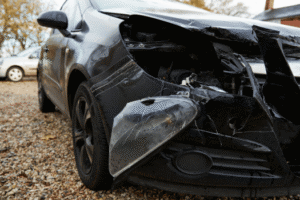


After a fatal crash, the one person who could say exactly what happened is the person you lost. That single, brutal fact is why evidence in a fatal crash wrongful death case carries more weight than in almost any other kind of claim — the proof has to speak for your loved one, because they no longer can.
The hard part is that this evidence doesn’t wait for a grieving family to be ready. Vehicles get scrapped. Camera footage records over itself in days. A car’s black box can be overwritten or lost when the wreck is repaired or salvaged. Understanding what evidence decides these cases — and how quickly it disappears — is how you protect the truth about what happened on I-15, Boulder Highway, or wherever your family’s life changed.
Why Evidence Carries a Fatal Crash Case More Than Any Other
In an ordinary injury claim, the injured person tells their own story. They describe the impact, point to their pain, sit for a deposition. A fatal crash claim has no such witness at its center. So the case is built almost entirely from physical proof, documents, and the accounts of others.
Nevada law also splits the recovery into two separate tracks, and each one has to be proven. Surviving family members bring a wrongful death claim for their own losses, while the estate brings a survival claim for what your loved one endured before passing. These are related but distinct, and we break down the difference between a wrongful death claim and a survival action in a separate guide. The point for now: evidence has to do double duty — proving what happened and proving the full scope of what your family lost.
Evidence That Proves What Happened
This is the liability side of the case: showing that another party’s negligence caused the crash. In Nevada, an at-fault state, the family has to establish the four building blocks of negligence — that the other driver owed a duty of care, breached it, caused the crash, and caused real harm. Every category of evidence below exists to prove one of those links.
The crash report and the scene
The responding officer’s report is the backbone of the file. It records the officer’s diagram of vehicle positions, statements taken at the scene, road and weather conditions, and any citations issued. Physical scene evidence — skid marks, debris fields, gouges in the pavement, the resting position of each vehicle — tells the story of speed and impact angle long after the road is cleared. Because a fatal crash triggers a full investigation, that record is unusually detailed. It’s also time-sensitive, which is why acting early matters more than families expect.
The vehicle’s black box (event data recorder)
Most modern vehicles carry an event data recorder — the automotive “black box.” In the seconds surrounding a crash, it can capture speed, throttle position, brake application, steering input, seatbelt use, and airbag deployment. In a fatal case where no one can describe the moment of impact, that data is often the closest thing to an eyewitness. It can confirm the other driver never braked, or was accelerating, in a way no memory could. But this data lives in a damaged vehicle that may be headed to a salvage yard — and once the vehicle is gone or repaired, the record can go with it.
Autopsy, medical, and toxicology records
An autopsy and the associated medical records establish the cause of death and connect it directly to the crash. Toxicology results matter on both sides: they can reveal whether the at-fault driver was impaired by alcohol or drugs, which strengthens the claim and can open the door to punitive damages. These records also document what your loved one suffered before passing — the evidence that supports the estate’s survival claim.
Digital and video evidence — phones, telematics, cameras
A fatal crash case increasingly turns on data no one used to think about. Cell phone records and app activity can show the other driver was texting or distracted. Commercial vehicles carry telematics and GPS logs. And in Las Vegas, cameras are everywhere — traffic signals, casinos and businesses along the Strip, doorbell cameras, and other drivers’ dashcams. This footage is often the single most powerful piece of evidence in a case, and it’s also the most fragile. Many systems overwrite in a matter of days.
Witnesses and accident reconstruction
Independent witnesses fill in what the physical evidence can’t. When the picture is disputed, an accident reconstruction expert uses the scene measurements, vehicle damage, and black box data to rebuild the crash frame by frame — essentially giving your loved one’s side of the story a voice. This is where a case with strong preserved evidence pulls decisively ahead of one where the proof was allowed to slip away.
Evidence That Proves the Full Value of Your Family’s Loss
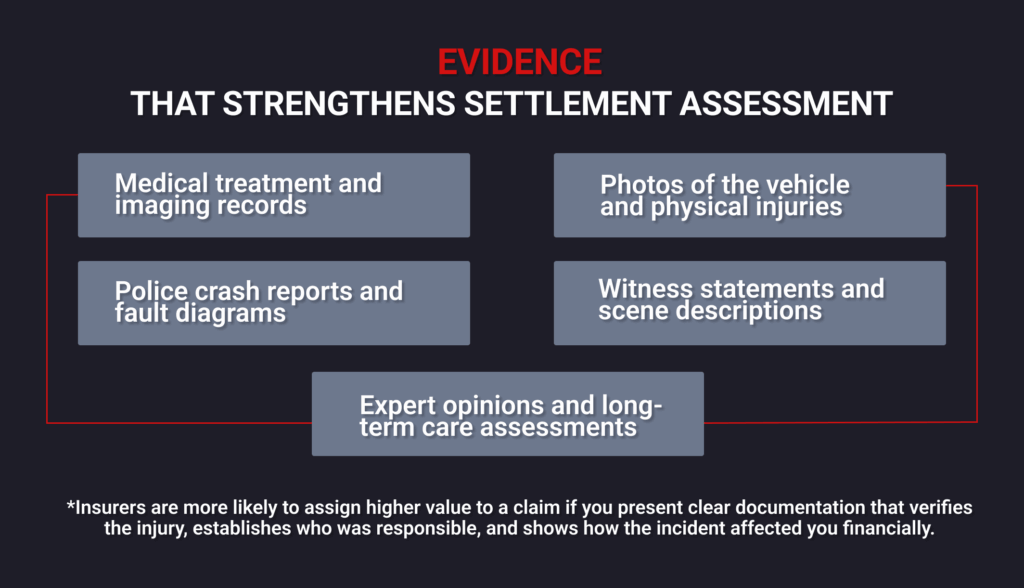
Proving fault is only half the case. The other half is proving what the loss is actually worth — and insurers fight this just as hard.
Economic losses are documented with records: the income and financial support your loved one provided, funeral and burial costs, medical bills from any treatment before death, and the value of services they contributed to the household. Non-economic losses — the loss of companionship, guidance, and support your family will carry for the rest of their lives — are harder to reduce to paper but no less real. We go deeper into what your family can recover in a dedicated guide. The through-line is the same as everywhere else in this case: the more thoroughly the loss is documented, the harder it is for an adjuster to minimize it.
Why This Evidence Disappears — and How It Gets Locked Down
Here is what surprises grieving families most. The deadline to bring a wrongful death claim in Nevada is generally two years from the date of death — but the evidence window is far shorter than that. Footage overwrites in days. Vehicles get released to salvage in weeks. Memories blur. The two-year clock is real, and you can read more about the deadline to file, but the fight to save evidence starts almost immediately.
The good news: your family doesn’t have to gather any of this alone. An attorney can move on day one to preserve it — sending formal preservation letters (sometimes called spoliation letters) to the insurer, the tow yard, and any business or agency holding footage, putting them on legal notice not to destroy or alter the vehicle, its black box, video, or records. From there, the lawyer subpoenas phone data, orders the crash and autopsy reports, and brings in reconstruction experts. If you’re wondering what to do right now, our guide to the first days after a fatal crash walks through the immediate steps.
Meanwhile, the insurance company already has a head start. Its investigators are working the file to minimize the payout — sometimes before the family has even planned a funeral.
The Insurance-Defense Advantage
This is where the right lawyer changes the outcome. Glen Howard built Howard Injury Law after years working as an insurance defense attorney — the side that used to fight claims like yours. He knows which pieces of evidence adjusters target first, how they argue a victim was partly to blame to shave down what they owe, and exactly what has to be locked down before they can. Knowing how fault is determined in a Nevada crash from the defense side is how you take a blame-shifting argument apart before it gains traction. Every fatal crash file at the firm is handled personally, not handed off to a rotating cast of paralegals.
Every case is different, and this is general information, not legal advice about your specific situation — but the principle holds across all of them: the strength of the evidence, and how fast it was preserved, tends to decide how a fatal crash claim ends.
Frequently Asked Questions
What are the four proofs of negligence in a wrongful death case?
To hold another party responsible, your family generally has to prove four things: duty (the other driver owed a legal obligation to drive safely), breach (they failed that obligation — speeding, running a light, driving impaired or distracted), causation (that failure directly caused the crash and the death), and damages (your family suffered real, measurable losses). Each element is proven with a different slice of evidence — the crash report and black box establish breach and causation, while medical, financial, and personal records establish damages. Miss one link, and the whole claim is vulnerable, which is why complete evidence matters so much in a fatal case.
What’s the average wrongful death payout in Nevada?
There’s no honest “average,” and any specific number you see online should make you skeptical. Wrongful death cases vary enormously based on the facts — the income and role your loved one held, the strength of the liability evidence, the degree of fault, and, critically, how much insurance coverage is actually available. A crash caused by a driver carrying only Nevada’s minimum policy can cap recovery no matter how strong the case, unless the evidence reveals additional responsible parties or coverage. That’s exactly why a thorough evidence-driven investigation, rather than a quick estimate, is what protects a family’s recovery. A lawyer can give you a realistic picture only after reviewing your specific case.
How long does a fatal car crash investigation take?
It varies. The official pieces — the completed police report, the autopsy and toxicology results, a black box download, and any accident reconstruction — can take anywhere from several weeks to many months, depending on the crash’s complexity and how many agencies are involved. Waiting on those reports does not mean waiting to protect your case, though. Evidence preservation should begin right away, long before the final reports are ready, because the most fragile evidence is gone within days. An attorney runs the preservation track and the investigation track at the same time so nothing critical is lost while the official record catches up.
What are common reasons a wrongful death claim gets dismissed?
A few recurring problems sink otherwise valid claims. The most common is missing the two-year filing deadline. Another is the wrong person bringing the claim — Nevada law limits who has standing to file, generally the estate’s personal representative or eligible heirs, so a claim filed by someone without standing can be thrown out. The third is insufficient evidence of causation: if the proof connecting the other party’s negligence to the death is thin or was never preserved, a court can dismiss the case. Notice the pattern — two of the three come down to acting early and preserving the record. That’s within your family’s control.

Talk to Someone Who Knows What the Other Side Will Try to Bury
Calling a lawyer while you’re still grieving can feel like too much, too soon. It isn’t. It’s how you make sure the truth about what happened to your loved one is preserved before the evidence — and the insurance company’s version of events — hardens into the record.
Howard Injury Law handles fatal car accident and wrongful death cases for families across Clark County, and works as your motor vehicle accident attorney in Las Vegas on a contingency basis — no fee unless we recover for your family. The free consultation costs nothing and puts no obligation on you. It will tell you whether there’s a case worth pursuing, and it lets us start protecting the evidence today, while it still exists.