


You did nothing wrong, and yet three weeks after the crash your car is still in the shop, the bills keep coming, and every adjuster you call blames a different driver. When multiple insurance companies fight over one crash, the injured person usually ends up stuck in the middle — watching companies argue while their own life stays on hold. If that’s where you are right now in Las Vegas, here’s what’s actually happening and how to get your claim moving.
Why Insurance Companies Point Fingers After a Multi-Car Crash
Nevada is an at-fault state. Whichever driver caused the crash is financially responsible, and that driver’s insurance company pays — up to the policy limits. So every carrier involved has one goal: make sure their driver isn’t the one holding the blame.
Add a second or third car and the finger-pointing multiplies. Now you have two, three, or four insurers, each with an adjuster whose job is to shift responsibility onto someone else’s policyholder. That’s not a glitch in the system. It’s the system working exactly as the companies designed it — protect their bottom line first, pay the injured person second.
The result is a standoff. Until the carriers agree on who holds primary fault, nobody wants to be the first to write a check. Meanwhile, you’re the one covering rental cars, copays, and missed paychecks.
How a Chain-Reaction Crash Turns Into an Insurance Standoff
Most multi-car pileups are chain reactions that start with a single act of negligence. One driver follows too closely, misjudges a stop, or looks down at a phone. That first impact pushes one car into the next, and the crash ripples down the line.
A few conditions make these chains far worse on Las Vegas roads:
- Inadequate stopping distances — tailgating on I-15 or the 215 Beltway leaves no room to react when traffic stops short.
- An unexpected hazard — debris, a stalled vehicle, or sudden brake lights on US-95 forcing a wall of drivers to slam their brakes at once.
- Low visibility — dust storms, hard afternoon sun glare, or nighttime construction zones near the Spaghetti Bowl.
The physics of a chain reaction are what make the insurance fight so ugly. When four cars are involved, each carrier argues about how much of the collision their driver caused versus the driver behind or ahead of them. A multi-vehicle accident claim rarely splits fault cleanly, and that ambiguity is exactly what the companies exploit to delay.
Why Your Payout Stalls While the Companies Argue
Here’s the part that frustrates injured people the most: the delay is often a strategy, not an accident.
Under Nevada’s comparative negligence rule, your compensation drops by whatever percentage of fault gets assigned to you — and if you’re found more than 50% at fault, you recover nothing. Every carrier in the crash has a financial reason to nudge blame in your direction or onto another driver, because every point of fault they push away is money they don’t pay. That’s why a straightforward crash can sit unresolved for months. This is the same dynamic behind any disputed liability car accident claim in Las Vegas — the more parties involved, the more room to argue.
While they argue, one clock keeps ticking that the insurers won’t remind you about. In Nevada, you generally have two years from the date of the crash to file a personal injury lawsuit. Ongoing settlement talks do not pause that deadline. Some adjusters are content to let negotiations drag precisely because a missed filing deadline ends your claim for good — no matter how strong it is. Their delay is not neutral. It works against you.
What “Arbitration” Between Insurers Actually Means for You
If the adjusters can’t agree on who owes what, they often send the dispute to inter-company arbitration — an independent arbiter who decides which insurer reimburses which.
The most important thing to understand: that arbitration is a fight between the insurance companies. It sorts out who pays whom behind the scenes. It does not decide the value of your injury claim, and its outcome does not bind you. You are not a party to it, and you shouldn’t let an adjuster imply that “we’re waiting on arbitration” means your hands are tied. Your claim for your injuries stands on its own, and you can pursue it while the carriers sort out their reimbursement between themselves.
That distinction matters, because insurers count on injured people assuming they have to wait for the whole mess to resolve before anyone helps them.
How to Protect Yourself While the Insurers Fight
You don’t have to sit still while the companies point fingers. A few moves protect your claim and get money moving now.
Don’t give recorded statements to the other drivers’ adjusters without advice. A friendly call asking you to “just walk through what happened” is designed to pull a quote they can twist into shared fault later. You’re not required to give one. Learn how to deal with an insurance adjuster before you say anything on the record.
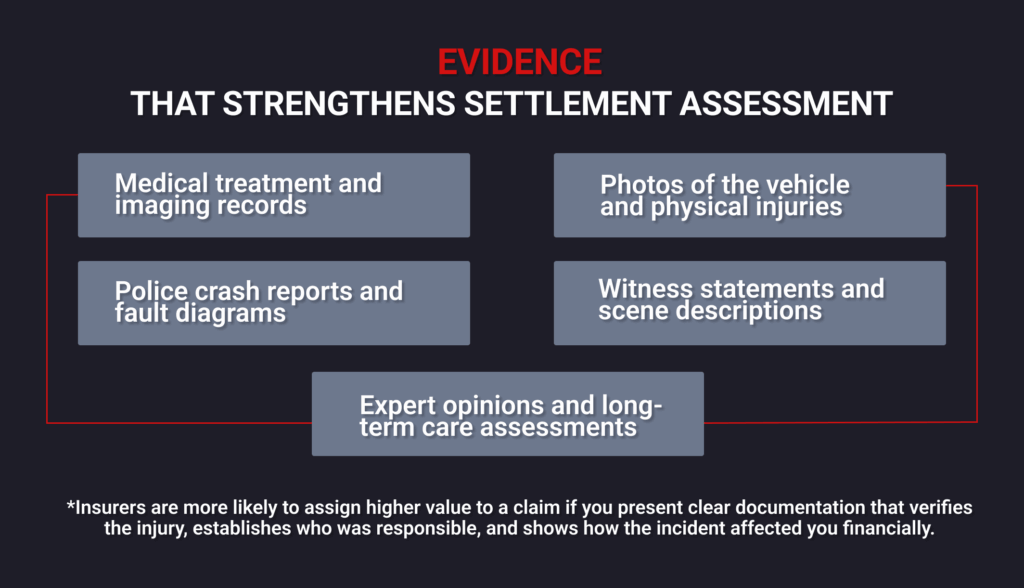
Document everything while it’s fresh. Photos of every vehicle and the scene, the police report number, and contact details for any witnesses can decide who a chain reaction gets pinned on. Knowing what evidence you need for a car accident injury claim is the difference between your version holding up and an adjuster’s version winning.
Use your own coverage to get moving. You don’t have to wait for the at-fault carrier to admit anything. Nevada insurers must offer uninsured/underinsured motorist coverage at your liability limits, and if you carry it — along with MedPay or collision — you can start repairs and treatment now. A Las Vegas attorney for uninsured motorist claims can tap that coverage while the fight over fault continues, and your own carrier gets reimbursed later if another driver is found responsible. The same goes for keeping treatment on track — here’s who pays your medical bills after an accident while liability is unsettled.
Watch the deadline. Don’t let months of “we’re still reviewing” quietly burn through your two-year window.
The reason a lawyer changes the outcome here is leverage. When the carriers know an attorney is documenting fault, preserving evidence, and prepared to file before the deadline, the incentive to stall disappears. The Car Accidents team at Howard Injury Law deals with this multi-carrier gridlock constantly.
Frequently Asked Questions
What happens when two insurance companies go to arbitration?
Their adjusters submit evidence to an independent arbiter who decides which insurer is responsible for reimbursing the other — for vehicle damage or payments one carrier already made. It’s a private process between the companies to settle their own dispute over fault percentages. It does not set the value of your injury claim, and you are not bound by the result. Your case for your medical bills, lost wages, and pain and suffering is separate and continues on its own track. If an adjuster tells you that you have to wait on their arbitration before your claim moves, that’s their timeline working in their favor, not a rule you have to accept.
What is double dipping in insurance?
Double dipping means trying to collect twice for the same loss — for example, having one repair paid by two different insurers, or keeping a medical payment from both a health plan and the at-fault driver’s carrier for the identical bill. In practice you generally can’t keep a double recovery, because subrogation rights and medical liens let the first payer claw back what it covered once the claim resolves. Adjusters also throw the term around to accuse injured people of overreaching, which can slow a legitimate claim. Coordinating multiple coverage sources correctly — so you’re fully paid without a clawback later — is one of the trickier parts of a multi-vehicle claim and a good reason to have a lawyer manage it.
What happens if two cars crash and have the same insurance?
The company assigns a separate adjuster to each driver and handles the claims independently, because the drivers’ interests conflict. You can still recover, and the insurer still owes each policyholder a good-faith investigation. That said, one company deciding fault between its own two customers creates an obvious tension, and it’s a situation where an independent evaluation of the evidence protects you. Don’t assume the shared insurer will land on a fair split on its own — the same finger-pointing and blame-shifting can happen inside a single company, just with two of its adjusters instead of two carriers.
Who is at fault in a multi-car collision in Nevada?
It depends on the evidence, and often more than one driver shares the blame. Nevada uses comparative negligence, so a jury or adjuster can assign each driver — and sometimes the injured person — a percentage of fault. In a chain reaction, fault frequently traces back to the driver who started it, but the middle cars can carry a share too, depending on speeds, following distances, and whether anyone had a chance to stop. Because your recovery shrinks as your assigned percentage climbs, how fault gets divided is the single biggest thing the insurers fight over — and the thing worth fighting back on.
Stop Being the Person Stuck in the Middle
You didn’t cause this standoff, and you shouldn’t have to fund your own recovery while insurers argue over who’s responsible. The fastest way to break the gridlock is to stop negotiating alone.
Glen Howard spent years as an insurance defense attorney — building the exact playbook these carriers now run to delay and shift blame. He knows how they decide who pays, where they stall, and what forces them to move. Howard Injury Law works on contingency, so there’s no fee unless we win, and your consultation is free.
If fault is being disputed and you were injured in the crash, that’s precisely the situation where having someone who knows the other side’s tactics changes what you walk away with. Call (702) 331-5722 or request a free case review — we’ll look at your crash, tell you honestly whether you have a case, and take the fight off your plate.
Every crash is different, and this article is general information, not legal advice about your specific claim. The best way to know where your case stands is a quick conversation with a Nevada attorney.