

You did everything right, a drunk driver hit you anyway, and now you’ve found out the worst part: they had no insurance, or they took off before police arrived. The panic is real — but an uninsured drunk driver is not the end of your claim, and neither is one who fled.
In Nevada, injured victims usually have more than one source of recovery. Your own coverage, the driver’s employer, and the driver personally can all be on the table. A Las Vegas drunk driving accident lawyer exists to find every one of those sources before you agree to eat a single bill.
Does a DUI Void the Driver’s Insurance?
No — not the coverage that matters to you. Liability insurance exists to pay the people a driver injures, and as a matter of public policy, a carrier generally cannot deny an innocent victim’s valid claim just because its insured was drunk.
You may have read about an “intentional acts” exclusion. That exclusion is about the insurer refusing to defend its own policyholder against claims of intentional wrongdoing — it does not erase your right to reach that liability coverage as the person who was hit.
One honest caveat: punitive damages in a DUI case usually come out of the driver’s own pocket, not the insurance company’s. That’s actually good news for you, and we’ll come back to why.
Who Else Can Pay When the Drunk Driver Can’t?
This is the question that keeps people up at night. When the at-fault driver is broke, uninsured, or gone, the money doesn’t just vanish — it shifts to other places. Here’s where it usually comes from.
Your Own UM/UIM Coverage
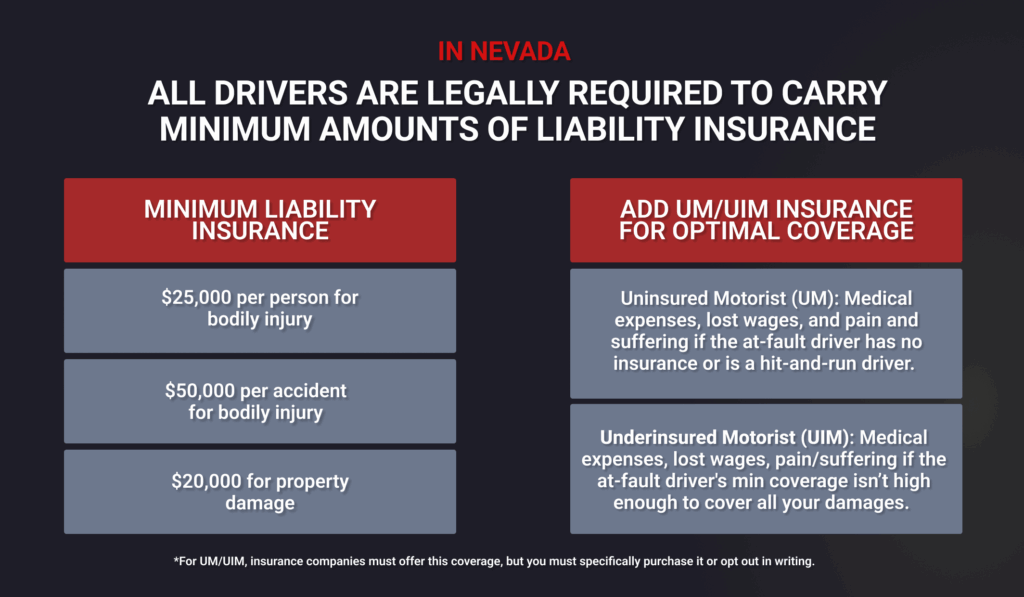
Uninsured and underinsured motorist coverage (UM/UIM) is a layer on your own auto policy that steps in when the other driver has no insurance, too little insurance, or fled the scene. It pays your damages as if the at-fault driver had proper coverage.
Nevada doesn’t require you to carry it, but every insurer has to offer it — and you can only turn it down in writing. Many Las Vegas drivers have this protection without realizing it. Because the mechanics of UM/UIM (stacking, limits, deadlines) get technical fast, they’re covered in depth in our guide to hit-and-run and uninsured driver claims. The takeaway here: check your policy before you assume there’s nothing to collect.
The Driver’s Employer (If They Were Working)
If the drunk driver was on the clock — making a delivery, driving a company vehicle, heading between job sites — their employer may share legal responsibility for the crash. Commercial policies typically carry far higher limits than a personal 25/50/20 policy, which can change everything about what your case is worth.
Whether an employer is on the hook depends on the specific facts, so this is worth having an attorney investigate early, before evidence disappears.
The Drunk Driver Personally — Uninsured Doesn’t Mean Untouchable
An uninsured driver is not automatically judgment-proof. A civil judgment can reach personal assets and, in many situations, future wages. And because Nevada allows punitive damages against drunk drivers — paid by the driver directly, not an insurer — an uninsured defendant can still owe you real money.
How collectible that is depends on the individual, and no lawyer can promise a number. But writing off a claim just because the driver “has nothing” is often a mistake.
What If the Drunk Driver Fled the Scene?
A driver who runs is usually a driver who knows they were drunk — and that works against them, not you. Fleeing is a separate crime in Nevada, and it reads to a jury as consciousness of guilt.
Fled drivers get identified more often than people expect: witness accounts, traffic and business cameras along corridors like the Strip and I-15, debris, and police investigation all help put a name to the car. Once identified, that driver faces the same civil liability as anyone who stayed. And if they’re genuinely never found, your UM coverage is designed to fill exactly that gap. The immediate steps that protect this kind of claim are laid out in what to do after being hit by a drunk driver.
Is It Worth Suing an Uninsured Drunk Driver?
Often, yes — for reasons that aren’t obvious at first. A personal judgment can be collected over time, punitive damages in a DUI case come straight from the driver, and the pressure of a lawsuit sometimes surfaces coverage or assets nobody knew about.
Just as important, a lot of real recovery in these cases never runs through the driver at all — it runs through your UM/UIM policy and any employer coverage. The right question isn’t “does this driver have money,” it’s “how many sources of recovery does my situation actually have.” That’s the analysis behind how much a drunk driving accident case is worth, and it’s rarely as simple as the person who hit you.
Is the Drunk Driver Always at Fault?
Usually the drunk driver is clearly at fault, and a DUI arrest or conviction is powerful evidence of it. But don’t assume the insurance company will just concede.
Nevada uses modified comparative negligence, which means a carrier can try to pin part of the blame on you to shrink what it pays — and if they push your share past 50%, it can bar recovery entirely. That’s exactly the tactic a good attorney shuts down early with the evidence that wins a DUI injury claim. Every crash is different, so treat this as general information, not a prediction about your specific case.
How a Las Vegas Drunk Driving Lawyer Finds Every Source of Recovery
Glen Howard spent years as an insurance defense attorney — the lawyer carriers hired to keep payouts small. He knows the exact scripts an adjuster uses to deny a DUI claim, delay it, or blame you for it, because he used to run that playbook. Now he runs it in reverse, for injured people.
That background matters most in the cases that look hopeless: the uninsured driver, the one who fled, the state-minimum policy that doesn’t cover the ER bill. Finding the employer policy, the UM coverage, and the punitive exposure is the work — and it’s the work carriers hope you’ll skip. Howard Injury Law handles these claims on contingency: no fee unless we win, so you’re not paying out of pocket to find out what your case is really worth. You can also see the full range of damages you can recover after a DUI crash in Nevada, or how punitive damages work in a Nevada DUI case.
Frequently Asked Questions
What happens to uninsured drivers in an accident?
In Nevada, an uninsured at-fault driver faces penalties for driving without coverage and remains personally responsible for the harm they caused. Driving without insurance is a misdemeanor here, but that’s a matter between the driver and the state — it doesn’t compensate you. What matters for your recovery is that the driver can still be pursued personally through a civil claim, and that your own uninsured motorist coverage may step in to pay your damages. An uninsured drunk driver often ends up owing money through a judgment or through punitive damages, even when there’s no insurance company writing the check.
Can I still get compensation if the drunk driver has no insurance?
Yes, in many cases. Your recovery can come from your own UM/UIM coverage, the driver’s employer if they were working at the time, and the driver personally through a civil judgment or punitive damages. The obvious source — the drunk driver’s liability insurance — is only one option, and it’s frequently not the biggest one. The real work is identifying every source that applies to your specific crash, which is why having a Las Vegas attorney investigate early tends to matter more in these cases than in a standard collision with a fully insured driver.
Does drunk driving void insurance?
Not the coverage that protects you. A driver’s liability insurance exists to pay the people they injure, and a carrier generally can’t refuse your valid claim simply because its insured was drunk. The “intentional acts” language you may have seen applies to the insurer defending its own policyholder against intentional-misconduct claims — it doesn’t cancel your right to the liability coverage as the injured party. The one piece that usually falls outside insurance is punitive damages, which in a Nevada DUI case are paid by the driver directly rather than the insurance company.
What if the drunk driver is never found?
If a fled drunk driver is genuinely never identified, your uninsured motorist (UM) coverage is built for exactly this situation — it treats the phantom or unidentified driver as if they carried liability insurance and pays your damages up to your limits. That’s one of the main reasons UM coverage is so valuable in Las Vegas, where hit-and-run crashes are common. Before assuming a fled driver can’t be found, though, it’s worth letting an attorney and investigators work the evidence — cameras, witnesses, and police reports identify more runners than most people expect.
How long do I have to file a claim after a DUI crash in Nevada?
Nevada’s deadline for most personal injury claims is generally two years from the date of the crash, and missing it can end your case before it starts. Uninsured motorist claims can carry their own separate notice requirements and deadlines under your policy, which are sometimes shorter than the two-year window. Because the timelines stack and the evidence in a fled-driver or uninsured case fades quickly, it’s smart to talk to a lawyer early rather than waiting. This is general information — your specific deadline depends on the facts, so confirm it with an attorney.

Talk to a Las Vegas Drunk Driving Accident Attorney
If you’ve been told the drunk driver who hurt you had no insurance or ran, don’t take that as the final word on your case — take it as the reason to have someone dig. The sources that pay in these situations are the ones adjusters don’t volunteer.
Request a free consultation with a Las Vegas drunk driving accident attorney, and Howard Injury Law will map every possible source of recovery for your crash — your coverage, the driver’s, and any employer’s. No fee unless we win. If you want to understand how these claims fit the bigger picture, start with our overview of motor vehicle accident claims in Las Vegas or reach out directly.