


If a drunk driver hurt you in Las Vegas, one question probably drowns out the rest: what is my case actually worth? Here’s the honest starting point — a drunk driving accident case is usually worth more than an ordinary crash, because Nevada law treats a drunk driver’s choice differently from an ordinary mistake.
No lawyer can hand you a dollar figure without knowing your injuries, your bills, and who the drunk driver is insured by. But you can understand exactly what drives the number, and why the impaired driver’s decision to get behind the wheel often works in your favor. That’s what this guide is for.
Why a Drunk Driving Case Is Worth More Than an Ordinary Crash
Two things separate a DUI case from a run-of-the-mill fender bender, and both push value up.
First, fault is usually far easier to prove. When a driver is charged with DUI, that’s powerful evidence of negligence per se — the law treats breaking a safety statute as negligence on its face. You’re rarely stuck arguing over who ran the light. The impairment does a lot of that work for you.
Second, the conduct is egregious. A drunk driver didn’t misjudge a gap — they made a choice that put every person on the road at risk. Juries in Clark County take that seriously, and so do insurance adjusters. That egregiousness is what opens the door to punitive damages, a category most ordinary crash victims never touch. More on that below, because it’s the single biggest reason DUI cases carry the leverage they do.
What Actually Determines Your DUI Case Value
Every Nevada injury claim is built from the same core parts. In a DUI case, the parts are the same — the numbers just tend to run higher.
Your economic damages
These are your hard, provable losses: ambulance and ER charges, surgeries, imaging, physical therapy, future medical care, lost wages, and reduced earning capacity if you can’t return to the same work. Economic damages are the foundation the rest of your claim is built on, so complete medical documentation matters enormously. A gap in treatment or an unpaid bill you forgot about is money left on the table.
Pain, suffering, and the multiplier
Your non-economic damages — physical pain, emotional trauma, loss of enjoyment of life — don’t come with receipts. Nevada attorneys and insurers estimate them, often by applying a multiplier to your economic losses. The more severe and lasting the injury, the higher the multiplier. Because a drunk driver’s conduct is so much worse than ordinary carelessness, DUI cases frequently justify a higher multiplier than a comparable sober-driver crash. If you want the mechanics, this walk-through of how the pain-and-suffering multiplier works breaks it down.
Here’s a simple illustration of the method — not an average, just the math. If your economic losses total $30,000 and a serious injury supports a multiplier of 3, your non-economic damages come in around $90,000, for a claim in the range of $120,000 before punitive damages enter the picture. Change the injury, and the whole equation changes.
Injury severity: the biggest lever
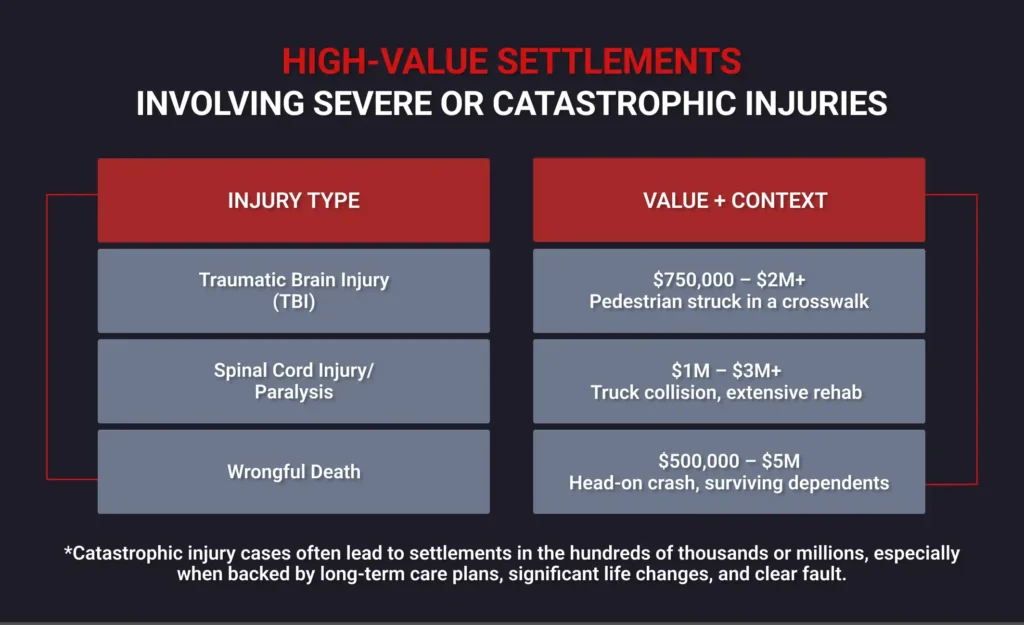
Nothing moves value more than how badly you were hurt. A soft-tissue neck strain and a traumatic brain injury are not in the same universe. Roughly speaking, cases climb as injuries get more severe and more permanent:
- Minor — soft-tissue injuries, sprains, short recovery.
- Moderate — fractures, injuries needing surgery or months of treatment.
- Severe — spinal cord damage, traumatic brain injury, permanent disability, disfigurement.
- Catastrophic or fatal — the highest-value cases, where a life is permanently altered or lost. If a drunk driver caused a death or life-changing injury, catastrophic and fatal DUI crashes follow their own rules and carry the heaviest exposure.
There is no fixed settlement amount for any of these tiers, and any site that promises one is guessing. Your number depends on your facts.
Punitive Damages: Nevada’s DUI Exception That Raises the Stakes
This is where drunk driving cases pull ahead.
In an ordinary Nevada injury case, punitive damages are hard to win and capped under NRS 42.005 — generally limited to three times your compensatory damages, or $300,000 if those damages fall below $100,000. Drunk driving is the exception. Under NRS 42.010, a victim injured by an impaired driver can pursue punitive damages, and the statute expressly says the NRS 42.005 caps do not apply. In plain terms: there is no ceiling on what a jury can award to punish a drunk driver.
Nevada also made these claims easier to bring. As of a 2023 change to the law, you no longer have to prove the driver knew they’d be driving later — only that they willfully drank and then caused injury behind the wheel.
That uncapped exposure is leverage, even in cases that settle. An insurer staring at unlimited punitive risk has a strong reason to pay policy limits rather than roll the dice with a Clark County jury. Punitive damages aren’t automatic — they have to be proven — but the mere fact that they’re on the table changes how the other side values your claim.
The Real Ceiling: Available Insurance and Policy Limits
Here’s the hard truth that surprises most victims: the practical limit on your recovery is often not the “value” of your case — it’s how much insurance exists to pay it.
Nevada’s minimum liability coverage is just 25/50/20 — $25,000 per person, $50,000 per crash, $20,000 property damage — under NRS 485.185. You can read the full Nevada minimum insurance requirements if you want the detail, but the point is this: if a drunk driver carried only the state minimum, a $25,000 policy can’t stretch to cover a $200,000 injury.
That’s where a good attorney goes hunting for more coverage. Your own uninsured/underinsured motorist (UM/UIM) coverage can step in. There may be an employer’s policy if the driver was working, an umbrella policy, or other liable parties. Finding every available source is often what separates a clipped recovery from a full one — this is exactly how high-value injury settlements get built past a low policy limit.
One common misconception, cleared up: in Nevada, the bar or casino that overserved the driver usually can’t be sued. State law gives businesses that serve alcohol to adults broad protection, so recovery almost always comes from the driver, their insurer, and the coverage sources above — not the venue.
How Nevada’s Fault and Deadline Rules Affect Your Payout
Two rules can change your final number, so know where you stand.
Comparative fault. Nevada uses modified comparative negligence under NRS 41.141. If you share part of the blame, your recovery drops by your percentage, and if you’re found more than 50% at fault you recover nothing. Here’s the reassuring part for DUI victims: if you were sober and lawfully on the road — driving through Spring Valley, stopped at a light on the Strip, walking with the signal — you typically carry no fault at all. Insurers still try to pin a percentage on you to shave their payout, which is precisely the tactic a lawyer is there to shut down.
The deadline. Under NRS 11.190, you generally have two years from the date of the crash to file a personal injury lawsuit in Nevada. Miss it, and even an airtight case is gone. Two years feels like plenty until you’re focused on healing — which is exactly why the clock is a reason to talk to someone early, not later.
Why Who Represents You Changes the Number
The same case is worth different amounts depending on who’s presenting it. That’s not a sales pitch — it’s how claims valuation works.
Insurance companies value drunk driving cases using their own software and their own playbook, and their first offer is designed to protect their bottom line, not yours. Howard Injury Law founder Glen Howard spent years as an insurance defense attorney before he switched sides. He knows exactly how carriers value — and quietly undervalue — a Las Vegas DUI case, and where the punitive-damages pressure points are that move an offer. That inside view is the difference between accepting the number an adjuster hands you and forcing the number your case is actually worth.
You also don’t pay out of pocket to find out. HIL works on contingency — no fee unless we win your case.
Frequently Asked Questions
How much is the average drunk driving settlement in Las Vegas?
There’s no honest “average,” and be wary of any site that quotes one. Two DUI crashes with identical facts can settle for wildly different amounts depending on injury severity, total medical costs, lost income, the available insurance, and whether punitive damages are in play. A minor soft-tissue case and a case involving spinal surgery aren’t remotely comparable, so averaging them tells you nothing about your claim. The only figure that matters is what your case is worth, and that comes from reviewing your specific injuries, bills, and the at-fault driver’s coverage. A free case review is the fastest way to get a realistic range instead of a made-up number.
Are punitive damages guaranteed in a Nevada DUI case?
No. While Nevada law (NRS 42.010) allows uncapped punitive damages against drunk drivers, they aren’t automatic. Your attorney has to prove the driver was impaired and pursue the claim properly. What matters for your recovery is that the possibility of uncapped punitive damages exists, and that possibility puts real pressure on the insurance company. Facing unlimited exposure at trial, insurers often move toward policy limits to settle rather than risk a Clark County jury deciding how much to punish a drunk driver. So even when punitive damages aren’t ultimately awarded, their availability tends to raise the value of a DUI claim.
What if the drunk driver only had minimum insurance?
A low policy limit doesn’t automatically cap your recovery. Nevada’s minimum is only 25/50/20, which rarely covers a serious injury — but that’s not the end of the search. Your own uninsured/underinsured motorist (UM/UIM) coverage can pay when the at-fault driver’s policy runs out. There may also be an employer’s insurance if the driver was on the job, an umbrella policy, or other liable parties. Identifying every available source of coverage is one of the most valuable things an attorney does, and it’s frequently what turns a case that looked “capped” at $25,000 into a full recovery.
Can I still recover if the drunk driver wasn’t convicted in Nevada?
Yes. Your civil injury claim is separate from the criminal DUI case, and it uses a lower standard of proof. A criminal conviction requires proof beyond a reasonable doubt; your civil case only requires showing it’s more likely than not that the driver’s impairment caused your injuries. Drivers are acquitted, cases get pleaded down, and charges are sometimes dropped for reasons that have nothing to do with your right to compensation. You do not need a conviction, or even pending charges, to pursue and win a civil claim against the person who hurt you.
How long do I have to file a DUI injury claim in Nevada?
Generally two years from the date of the crash, under NRS 11.190. If the crash caused a death, a related wrongful death claim also generally runs two years, measured from the date of death. There are narrow exceptions — the deadline can pause if an injury wasn’t reasonably discoverable right away, or for an injured minor — but you should never assume an exception applies to you. Evidence also fades fast: surveillance footage gets overwritten, witnesses move, and memories blur. The sooner a lawyer starts preserving proof, the stronger your case, so the practical deadline is often much earlier than two years.

Find Out What Your Drunk Driving Case Is Really Worth
You’ve been through enough without also being handed a lowball offer for a crash you didn’t cause. If a drunk driver hurt you or someone you love in Las Vegas, you deserve a straight answer about what your case could actually be worth — not a number designed to make the insurance company’s problem go away cheaply.
Start with a free case review. Tell us what happened, and we’ll give you an honest read on your case, what it may be worth, and the next step — no documents required, no pressure, no fee unless we win. When you’re ready to talk to a Las Vegas DUI accident attorney who knows how the insurance side thinks, call (702) 331-5722, 24/7.
Every case is different. This guide is general information about Nevada law, not legal advice about your specific situation — a quick conversation is the only way to know what your claim is worth.