


Yes, you can sue a driver who had no insurance. The harder question — the one you’re actually asking — is whether you’ll ever see a dollar of it. Suing someone who has nothing can mean winning a judgment you can’t collect, which is why the smartest move after a crash with an uninsured driver usually isn’t chasing that driver at all.
If you were hit by someone with no coverage in Las Vegas and you’re wondering whether it’s even worth the fight, here’s the honest breakdown of when suing pays off, when it doesn’t, and where the money usually really comes from.
Yes, you can sue an uninsured driver — but winning isn’t the same as getting paid
Nevada is an at-fault state, so the driver who caused your crash is legally responsible for your injuries and losses. That’s true whether they carried insurance or not. You have every right to file a lawsuit against an uninsured at-fault driver, and if you prove your case, a court can enter a judgment in your favor.
A judgment is a piece of paper that says you’re owed money. It is not a check. If the person who owes it has no insurance, no assets, and little income, that paper can be difficult to turn into an actual payment. So before you sink time and stress into suing the driver personally, the real question is collectability — can this person actually pay?
What “judgment-proof” means (and why it matters here)
A defendant is “judgment-proof” when they have nothing worth collecting. No equity, no savings, no steady wages a court can reach. Uninsured drivers frequently fall into this category — often the same financial situation that led them to skip insurance in the first place.
Nevada does give you tools to collect on a judgment: you can garnish wages, place liens, and pursue bank accounts. But those tools have limits. Nevada protects a chunk of a debtor’s wages and a large amount of home equity through exemptions, so garnishment against a low earner may trickle in slowly, if at all. Spending years squeezing a few dollars from someone with nothing is rarely worth it. That doesn’t mean you’re out of options — it means the best option is usually somewhere else.
The smarter path: your own uninsured motorist (UM/UIM) coverage
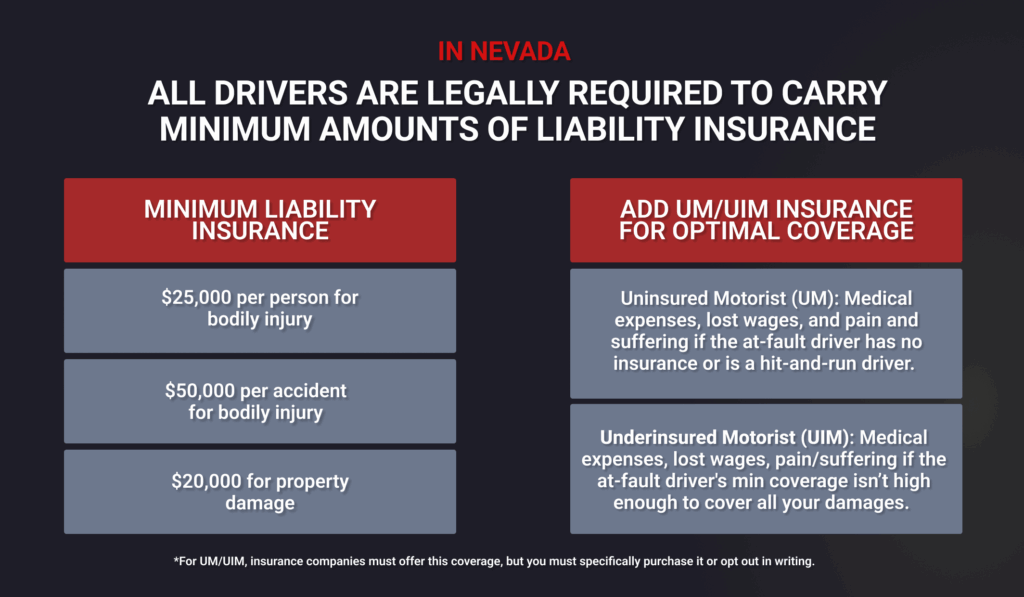
For most people, the real recovery after an uninsured-driver crash comes from their own policy, through uninsured/underinsured motorist coverage. UM/UIM steps in when the at-fault driver has no insurance, not enough insurance, or fled the scene, and it can pay for your medical bills, lost wages, and pain and suffering — the same categories you’d try to recover in a lawsuit, but from a company that can actually pay.
Here’s the part many Nevada drivers miss: while UM/UIM isn’t legally required, insurers must offer it, and you have to reject it in writing to go without it. If you never signed a rejection form, there’s a real chance you already carry it and don’t know it. Checking your own policy is often the single most valuable thing you can do after this kind of crash. Our overview of Nevada’s car insurance requirements explains how these limits and coverages fit together, and if UM applies to you, a Las Vegas uninsured motorist claim is usually the fastest route to real compensation.
When suing the driver personally IS worth it
Sometimes the at-fault driver has no insurance but does have something worth pursuing. Suing personally can make sense when the driver:
- Owns a home with real equity beyond Nevada’s homestead exemption;
- Has a stable, well-paying job that supports meaningful wage garnishment;
- Owns a business, valuable property, or other reachable assets; or
- Has strong future earning potential, since a Nevada judgment can be renewed and enforced for years.
In those situations, a judgment isn’t just paper — it’s leverage that can actually be collected over time. The only way to know which category your driver falls into is to investigate their finances, which is exactly the kind of legwork a car accident attorney handles before deciding whether a personal lawsuit is worth filing.
Other people who might actually be liable
The uninsured driver is often not the only one on the hook, and this is where thin cases turn into real recoveries. Depending on the facts, you may be able to pursue:
- The vehicle’s owner. If someone knowingly lent their car to an unfit or unlicensed driver, Nevada’s negligent entrustment doctrine can put the owner’s insurance in play.
- An employer. If the at-fault driver was working — making a delivery, driving for a company — the employer may be responsible, and a business carries far deeper coverage than an individual.
- Another at-fault driver. In a multi-car crash, a second negligent driver’s policy may cover part or all of your damages.
Finding these parties is the difference between a case worth pursuing and a dead end. Sorting out who is actually liable in a Nevada crash is one of the first things we do when the obvious defendant has no money.
Does it cost you anything to find out?
This is where “is it worth it” gets reframed. At Howard Injury Law, car accident cases run on contingency — no fee unless we win. That means the question isn’t whether you can afford to pursue recovery; it’s whether a real recovery exists to pursue. We do the investigating, and you owe nothing up front to find out.
Founder Glen Howard spent years as an insurance defense attorney, so he knows exactly how carriers evaluate UM claims and where the recoverable money tends to hide in a case that looks hopeless on the surface. When the at-fault driver has nothing, that experience is what turns a discouraging situation into a paid claim. If you’re weighing whether to give up, talk to a Las Vegas car accident lawyer first — the answer is often better than it looks.
Frequently Asked Questions
Can you sue someone with no insurance after a car accident in Nevada?
Yes. Nevada is an at-fault state, so an uninsured driver who caused your crash is personally responsible for your injuries and losses, and you can file a lawsuit against them. The catch is collectability: winning a judgment doesn’t guarantee payment if the driver has no assets or income. Before suing an uninsured driver personally, it’s worth investigating whether they can actually pay and whether a better source of recovery exists — usually your own uninsured motorist coverage or another liable party like the vehicle’s owner or the driver’s employer. An attorney can assess which path makes sense for your situation.
What happens if you win but the driver has no money?
You’d hold a judgment you may struggle to collect. Nevada lets you garnish wages, place liens, and pursue bank accounts, but exemptions protect a portion of the debtor’s income and home equity, so collecting from someone with little to their name can be slow and yield very little. A Nevada judgment can be renewed and enforced for years, which occasionally pays off if the person’s finances improve. Still, for most people the better move is to recover through uninsured motorist coverage or another responsible party rather than spending years chasing an empty pocket.
How do I get paid if the at-fault driver has no insurance?
The most common source is your own uninsured/underinsured motorist (UM/UIM) coverage, which pays for medical bills, lost wages, and pain and suffering when the at-fault driver can’t. In Nevada, insurers must offer UM/UIM, and you can only decline it in writing — so check your policy, because you may already have it. Beyond UM, recovery can come from the vehicle owner’s insurance through negligent entrustment, an employer if the driver was working, or another at-fault driver’s policy. A lawyer identifies every available source before you settle for less than your claim is worth.
Does my insurance go after the uninsured driver?
Often, yes. After paying your uninsured motorist claim, your insurance company may pursue the at-fault driver directly to recover what it paid out — a process called subrogation. That means you generally don’t have to chase the uninsured driver yourself; your carrier handles it. Your job is to recover fully under your own coverage, and your insurer takes on the collection fight afterward. This is one more reason UM/UIM coverage is usually a far smoother path than personally suing a driver who has no money.

Find out if your case is worth pursuing — free
Getting hit by someone with no insurance feels like a dead end, and plenty of people just eat the loss because chasing a broke driver sounds pointless. Often it is — but that’s the wrong target. The real money usually sits in your own UM coverage, an owner’s policy, or an employer’s insurance, and you can’t see it from where you’re standing.
That’s what a free consultation is for. Bring your police report, your insurance policy, and any medical bills, and our car accident team will tell you honestly whether there’s a recovery worth pursuing — and where it’s hiding. There’s no fee unless we win, so finding out costs you nothing. Call (702) 331-5722 or request your free consultation before you write off your claim. If you’re also dealing with a driver who had no coverage at all, our guide to legal help after a crash with no insurance is a good next read.
This article explains Nevada law in general terms and isn’t legal advice. Every case is different — talk with a licensed Nevada attorney about your specific situation.