


Understanding how insurance companies calculate your settlement offer in Las Vegas removes the mystery and gives you the knowledge to evaluate whether what they’re proposing reflects the real value of your claim.
After you receive a settlement offer from the insurance company and wonder — how did they come up with this number? Is it based on your actual losses? Is it fair? And why does it feel like they’re offering significantly less than what this accident has actually cost you? We’ll answer that for you when you submit a free case review with us at Howard Injury Law.

The Two Categories of Damages
Every personal injury settlement calculation starts with the same foundation — your documented damages. Insurance companies divide these into two categories, and how each gets calculated affects the final number significantly.
Economic Damages
Economic damages cover your actual, documented financial losses. These are the calculable costs the accident produced.
Medical expenses include every dollar you’ve spent — or will spend — on treatment related to your injuries. Emergency room visits, imaging studies, specialist appointments, physical therapy, injections, surgery if required, prescription costs, and any future treatment your condition requires all belong in this category. The key word is documented. What your medical records show and what your bills reflect drives this number, not what you report verbally.
Lost wages cover the income you couldn’t earn while your injuries prevented you from working. Documenting this requires confirmation from your employer of the time missed and your compensation rate. If your injury affects your ability to work going forward — reducing your capacity, preventing you from returning to your previous role, or eliminating earning potential permanently — lost earning capacity extends this category significantly beyond the immediate period of missed work.
Property damage covers your vehicle repairs or replacement and any other personal property damaged in the accident.
Non-Economic Damages
Non-economic damages cover real losses that don’t appear on a bill. Pain and suffering, emotional distress, loss of enjoyment of life, and loss of consortium if your spouse was affected are all non-economic damages.
These don’t have a receipt or an invoice. Calculating them requires a formula — and the formula the insurer uses directly affects how much they offer. Understanding that formula is the most important part of understanding how insurance companies calculate your settlement offer.
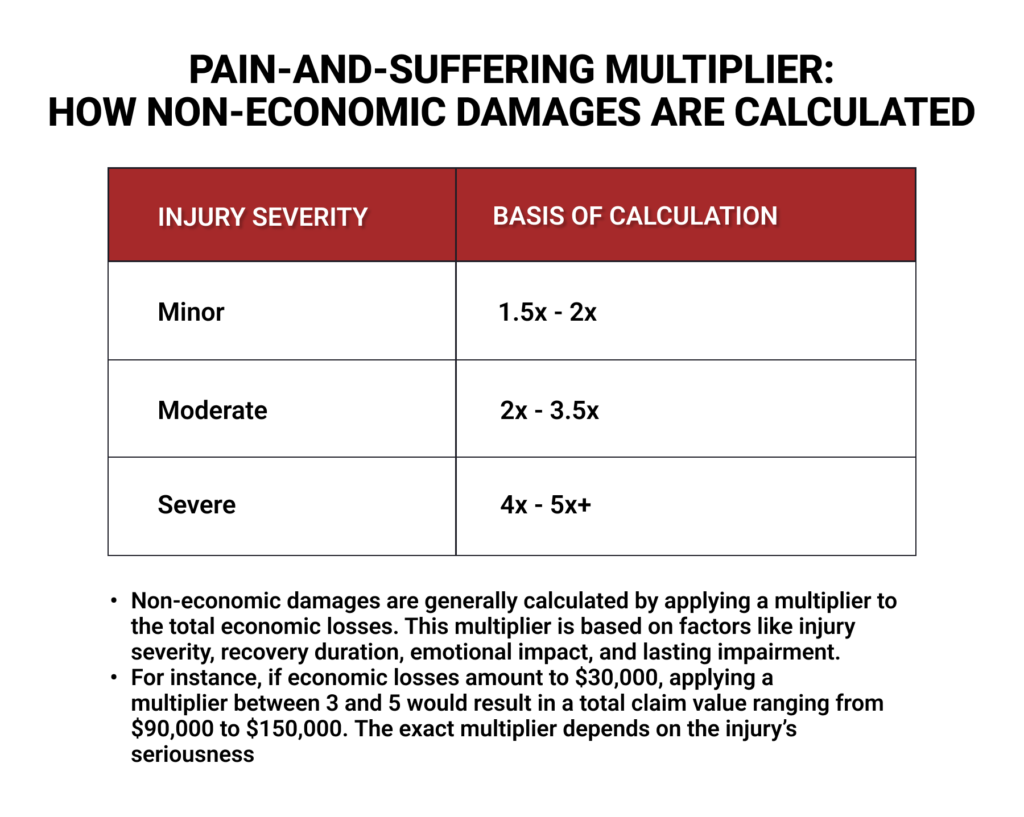
The Multiplier Method — How Pain and Suffering Gets Calculated
The most widely used formula for calculating non-economic damages in personal injury claims is the multiplier method. Your documented economic damages — primarily your medical expenses — serve as the base. The insurer multiplies that base by a number reflecting injury severity to produce the pain and suffering figure.
The multiplier typically ranges from 1.5 on the low end for minor, quickly resolved injuries to 5 or higher for serious, permanent, or catastrophic injuries. The total settlement offer combines the economic damages plus the multiplied pain and suffering figure.
A claim with $15,000 in medical expenses and a multiplier of 2 produces $30,000 in pain and suffering, for a total of $45,000 plus any lost wages. The same $15,000 in medical expenses with a multiplier of 4 produces $60,000 in pain and suffering, for a total of $75,000 plus wages.
That range between a 2 multiplier and a 4 multiplier on the same economic base represents a $30,000 difference. The multiplier the insurer chooses is not random — it reflects specific factors in your file, and understanding those factors shows you exactly where your case’s value gets built or eroded.
For a detailed breakdown of how Nevada applies the multiplier method in personal injury claims, read our guide on the multiplier method in Nevada personal injury claims.
What Drives the Multiplier Higher
The insurer assigns a higher multiplier when your injury documentation supports it. Factors that push the multiplier toward the higher end include significant injury severity, surgical intervention, permanent impairment or disability, documented impact on daily activities and quality of life, objective medical evidence supporting the claimed pain level, and consistent, uninterrupted treatment throughout recovery.
An injury that required surgery and produced permanent limitations justifies a higher multiplier than one that resolved with a few weeks of physical therapy. The documentation of your experience — how your injury affected your daily life, your work, your relationships, your sleep — builds the factual foundation for the multiplier conversation.
What Drives the Multiplier Lower
The insurer assigns a lower multiplier when your file gives them reasons to do so. Gaps in medical treatment are the most common factor that suppresses the multiplier. If you stopped treating for several weeks mid-recovery, the adjuster documents that gap as evidence the injury wasn’t severe enough to warrant consistent care.
Pre-existing conditions in your medical history, inconsistencies between your reported symptoms and your documented treatment, and the absence of objective medical evidence for subjective complaints like chronic pain all push the multiplier toward the lower end.
This is why how your case gets built from day one affects the settlement calculation directly. The documentation picture in your file is what the insurer uses to justify their multiplier selection.
The Per Diem Method — An Alternative Calculation
Some personal injury cases use the per diem method instead of the multiplier method. Under this approach, the claimant assigns a specific dollar value to each day of pain and suffering from the accident date through recovery.
The per diem rate often reflects the claimant’s daily earnings — the logic being that living with significant pain and limitation is worth at least as much as a day’s work. That daily rate multiplied by the number of days in recovery produces the pain and suffering figure.
The per diem method tends to work well for cases with clearly defined recovery periods and can produce higher figures than the multiplier method for long-duration recoveries with moderate medical expenses. Attorneys evaluate which method produces the stronger result for each specific case.
Insurance Software — The System Behind the Offer
Most large insurance companies use proprietary claims valuation software to calculate offer ranges. Colossus is the most widely known system — used by a significant portion of the major insurers operating in Nevada.
These systems take your documented damages as inputs and generate a value range for the claim. They weight specific factors heavily — documented medical treatment duration, injury classification, treatment type, and the presence or absence of certain documentation. The output is a range, and the adjuster typically opens negotiations at the lower end.
What the Software Rewards
Colossus and similar systems reward thorough, consistent documentation. Claims with complete medical records showing continuous treatment, clear injury classification, objective diagnostic evidence, and documented impact on daily function score higher in the system than claims with documentation gaps, unclear injury classification, or subjective complaints without supporting evidence.
Understanding what the software weights means understanding what documentation matters most. An attorney who knows how these systems evaluate claims — and specifically which inputs drive value higher — structures your case’s documentation to maximize the system’s output, not just to satisfy a general standard of thoroughness.
The Factors That Reduce the Offer
After the base calculation, specific factors reduce what the insurer offers. These reductions can be significant and are worth understanding specifically.
Comparative Fault
Nevada’s comparative fault rules under NRS 41.141 reduce your recovery by your percentage of fault. The adjuster actively looks for evidence assigning you a share of responsibility — because every percentage point of comparative fault reduces the insurer’s payment obligation proportionally.
An adjuster who assigns you 25% fault on a claim calculated at $80,000 reduces the offer to $60,000. The same claim with 0% fault assigned to you produces an $80,000 offer. Establishing and protecting a clean liability picture directly affects the final number.

Policy Limits
The at-fault driver’s policy limits cap what their insurer pays regardless of what your damages total. If your documented damages calculate to $150,000 but the at-fault driver carries Nevada’s minimum liability coverage of $25,000 per person, the insurer’s maximum exposure is $25,000.
Understanding coverage limits before building a demand shapes strategy. An attorney identifies all available coverage sources — umbrella policies, commercial coverage if a business vehicle was involved, your own UM/UIM coverage — to ensure the full damages picture gets addressed rather than accepting a limits-based settlement that leaves significant recovery uncaptured.
Pre-Existing Conditions
If your medical history includes prior treatment involving the same body part as your current injury, the insurer uses that history to argue your current condition predates the accident. Under Nevada law, a defendant takes their victim as they find them — an accident that aggravates a pre-existing condition is still fully compensable. But the insurer’s goal is to muddy the causation picture sufficiently to justify a reduced offer.
The counter to this argument requires clear medical documentation showing your condition changed as a result of the accident — a comparison of your pre-accident and post-accident functional status supported by treating provider records.
How Representation Changes the Calculation
The adjuster’s evaluation of your claim changes when an attorney represents you — and specifically when that attorney has demonstrated willingness to litigate.
Insurance companies track which attorneys regularly file lawsuits and which ones settle every case. An attorney with a verified trial record changes the insurer’s risk calculation. Litigation costs money, takes time, and exposes the insurer to jury verdicts that can exceed their internal valuation significantly. The threat of litigation is only credible when the attorney has demonstrated they’ll follow through.
Glen Howard’s insurance defense background means we understand how insurers build their internal valuations — because we’ve built them from the other side. We structure every demand to address the factors that drive the insurer’s calculation, counter the reduction arguments before they’re raised, and enter every negotiation with the documentation that supports the full value of your claim.
For more on how trial preparation affects what an insurer offers before any lawsuit is filed, read our guide on elite trial strength and what it means for your personal injury case.
What to Do When the Offer Comes
When you receive a settlement offer, you have three responses available — accept it, reject it and counter, or let it expire and file suit.
Accepting the first offer before your treatment is complete, before your future medical costs are known, and before a documented demand has been submitted almost always means accepting less than your claim is worth. The first offer reflects the insurer’s lowest defensible position — not the full value of what their calculation produces.
Before responding to any offer, get an independent assessment of what your claim is actually worth. Howard Injury Law provides this assessment at no cost through a free case review — reviewing your documented damages, evaluating the liability picture, and giving you a realistic picture of your claim’s full value before you make any decisions.
For more on why first offers consistently undervalue claims and what signing a release actually means, read our guide on should I accept the first settlement offer from insurance.

Frequently Asked Questions
Does the insurer’s calculation reflect what a jury would award?
Not necessarily — and that gap is part of what produces negotiating leverage. Jury verdicts in Clark County can significantly exceed an insurer’s internal valuation, particularly for serious injuries with well-documented damages. The insurer’s calculation reflects their risk management perspective. A jury’s award reflects twelve people’s assessment of what your injury actually cost you.
What if my medical treatment isn’t complete when the insurer makes an offer?
Don’t settle before reaching maximum medical improvement — the point at which your treating physician determines your condition has stabilized. Settling before MMI means settling before your future medical costs are known. The offer the insurer makes before MMI reflects incomplete damages information. For more on this, read our guide on what does the insurance adjuster actually do with your claim.
Can I negotiate the multiplier directly?
Not explicitly — the multiplier isn’t a line item you negotiate directly with the adjuster. You influence it through the quality and completeness of your documentation and through the strength of your representation. An attorney who builds a thorough damages picture and presents it with a credible litigation posture influences the multiplier the insurer applies indirectly but effectively.
What if the at-fault driver’s insurance coverage isn’t enough to cover my damages?
Your own UM/UIM coverage may provide additional recovery when the at-fault driver’s policy limits are insufficient. Other coverage sources — umbrella policies, commercial coverage, premises liability — may also apply depending on how the accident occurred. An attorney identifies all available coverage sources before determining the full recovery picture.
Know the Formula Before You Respond
How insurance companies calculate your settlement offer follows a specific logic — documented economic damages plus calculated non-economic damages, reduced by fault allocation, policy limits, and documentation gaps. Knowing that logic tells you exactly where your claim’s value gets built and where it gets eroded.
Getting an independent assessment before responding to any offer gives you the information the insurer is counting on you not having. Start your free case review at Howard Injury Law today. Available 24/7. No fees unless we win. Call (702) 331-5722 or contact us here.