


If you’re wondering whether you can still sue for injuries if you don’t have health insurance in Nevada, the answer is yes. Your right to pursue compensation from the party who caused your injury has nothing to do with whether you carry a health insurance card. Nevada law doesn’t require you to have health insurance to file a personal injury claim, access an attorney, or recover damages.
What does change without health insurance is how you access medical care and how your case gets built. Both of those challenges have real, workable solutions — and this guide walks through exactly what they are.

Your Legal Right to Sue Is Independent of Your Insurance Status
Can you sue for injuries if you don’t have health insurance? In Nevada, yes — without qualification. The legal right to seek compensation from a negligent party exists independently of your personal insurance situation.
Personal injury law in Nevada is built around one question: did someone else’s negligence cause your injury? If yes, that party is liable for your damages. The law doesn’t ask whether you had health insurance at the time. It asks what losses you suffered and who caused them.
Your health insurance — or lack of it — is largely irrelevant to the at-fault party’s liability. What it affects is the practical path to treatment and documentation, not your fundamental right to recover.
What Nevada Law Doesn’t Require
Nevada has no “no pay, no play” statute for personal injury lawsuits. Some states restrict uninsured drivers from recovering certain damages after accidents — Nevada is not one of them. An uninsured Nevada resident injured through another party’s negligence retains the full right to sue and recover all applicable categories of damages.
This is meaningfully different from states like California and Michigan that limit uninsured plaintiffs’ recovery. If you’ve heard that being uninsured affects your right to sue, that may be true in other states — it’s not the rule in Nevada.
How to Get Medical Treatment Without Health Insurance After an Accident
This is the most pressing practical concern for most uninsured accident victims in Las Vegas. The injury is real. The pain is real. And the thought of an emergency room bill without insurance feels impossible.
Here’s what’s actually available to you.
Medical Liens — The Primary Solution
A medical lien is an agreement between you and a healthcare provider where the provider treats you now and receives payment later, directly from your personal injury settlement. You owe nothing upfront. The provider places a legal claim on your recovery — they get paid when your case resolves, not before.
Medical liens are standard practice in Nevada personal injury cases. Emergency clinics, orthopedic specialists, neurologists, pain management providers, MRI and imaging centers, and physical therapy practices regularly treat accident injury patients on lien in Las Vegas. This is not an unusual arrangement — it’s built into how the Nevada personal injury ecosystem operates.
Your attorney coordinates this process. When you retain Howard Injury Law, we connect you with appropriate providers for your injury type who work on lien. You get the care you need, your treatment is documented properly for your claim, and the lien is paid from your settlement at close. For a complete explanation of how this process works, read our guide on how medical liens work in Nevada personal injury cases.
Can You Go to the ER Without Insurance in Las Vegas?
Yes. Under the federal Emergency Medical Treatment and Labor Act, emergency rooms are required to treat patients regardless of their insurance status or ability to pay. Every hospital emergency room in Las Vegas — including those at University Medical Center, Sunrise Hospital, and Valley Hospital — must provide stabilizing treatment regardless of coverage.
The ER bill that follows is real and can be significant. But it doesn’t prevent you from getting emergency care, and in a personal injury case, that bill becomes part of your documented medical damages — recoverable from the at-fault party.
MedPay — Coverage You May Not Know You Have
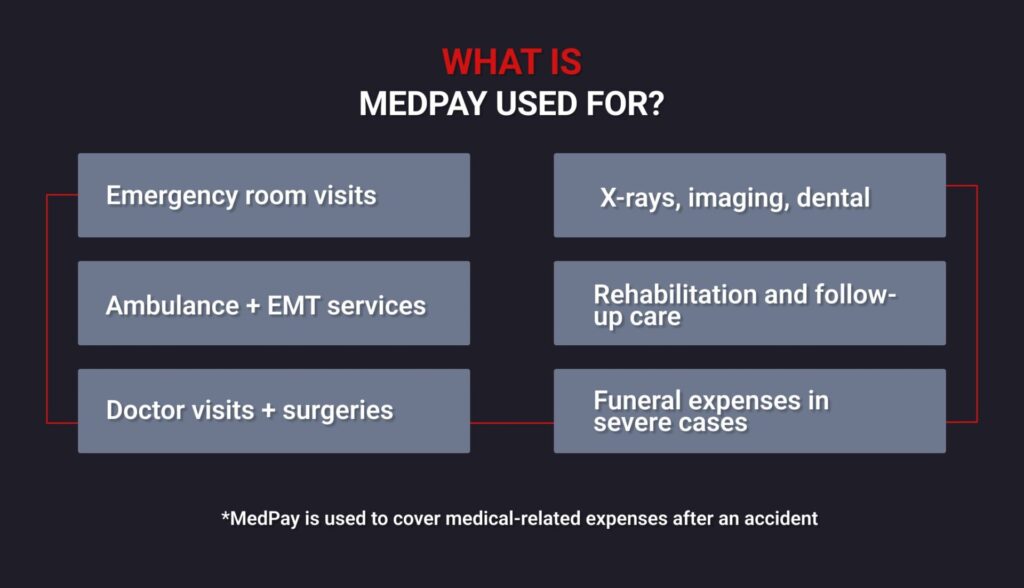
If you carry any auto insurance at all, check your policy for Medical Payments coverage, commonly called MedPay. MedPay is an optional add-on that covers medical expenses for you and passengers in your vehicle regardless of fault — no liability determination required, no waiting for settlement.
MedPay activates immediately and can cover your ER visit, follow-up appointments, and early specialist care while your personal injury claim is still in process. Coverage amounts vary — typically $1,000 to $10,000 per person. Many Nevada drivers carry MedPay without knowing it. Pull out your declarations page or call your insurer and ask directly.
Nevada Medicaid — Check Your Eligibility
Nevada expanded Medicaid under the ACA, extending eligibility to adults earning up to 138% of the federal poverty level. If your income qualifies, Medicaid covers accident-related treatment the same as any other medical situation.
Applications are processed through Nevada Health Link. If your accident left you unable to work, your reduced income may now qualify you for coverage that wasn’t previously available. Medicaid coverage can be retroactive — meaning it may apply to treatment already received.
What Damages Can You Recover as an Uninsured Injury Victim?
Can you sue for injuries if you don’t have health insurance and still recover full damages? Yes. Here’s what’s available.
Economic Damages
Economic damages cover your actual financial losses — the documented, calculable costs of the accident.
Medical expenses are the largest category for most injury claims. This includes every treatment cost from the date of the accident through your full recovery — ER visits, imaging, specialist appointments, physical therapy, injections, surgery if required, and any future medical costs your injury will produce. If you treated on a medical lien, the billed amount is your documented medical expense — fully recoverable from the at-fault party.
Lost wages cover income you couldn’t earn while you were injured and unable to work. If your injury affected your ability to perform your job — or prevented you from working entirely — that wage loss is a recoverable economic damage. Documentation requires employer confirmation of your time missed and your earnings history.
Lost earning capacity is a separate category from lost wages. If your injury permanently or long-term affects your ability to work at the same level or in the same field, the projected future earnings you’ve lost are recoverable. This is particularly relevant in serious injury cases — spinal injuries, traumatic brain injuries, and injuries producing permanent physical limitations.
Property damage covers the cost of repairing or replacing your vehicle and any other personal property damaged in the accident.
Non-Economic Damages
Non-economic damages cover the real losses that don’t appear on a bill. Pain and suffering — both physical and emotional — is recoverable under Nevada law. Loss of enjoyment of life, emotional distress, loss of consortium if the injury affected your relationship with a spouse, and disfigurement are all compensable.
Nevada does not cap non-economic damages in most personal injury cases, which is significant in serious injury situations where the non-economic losses can be substantial. The multiplier method used in Nevada personal injury claims applies to these damages — your documented medical expenses serve as a baseline, multiplied by a factor reflecting injury severity to produce the pain and suffering calculation.

One Consideration — Comparative Fault
Nevada’s modified comparative fault rule under NRS 41.141 applies regardless of your insurance status. If you were partially at fault for the accident, your recovery is reduced by your percentage of fault — and eliminated entirely if your fault exceeds 50%. This applies to every Nevada personal injury case, uninsured or not.
Insurance companies representing the at-fault driver will look for any basis to assign fault to you. Having legal representation from the outset — someone who understands how that argument gets built and how to counter it — directly affects your net recovery.
Can You Afford a Personal Injury Lawyer Without Health Insurance?
This question gets asked alongside “can I sue for injuries if I don’t have health insurance” — and the answer to both is the same: yes.
Contingency Fees — How Personal Injury Attorneys Get Paid
Personal injury attorneys in Nevada work on contingency. That means you pay nothing upfront, and no attorney fee is owed if your case doesn’t produce a recovery. If your case does resolve in your favor, the attorney’s fee is a percentage of the recovery — paid at settlement, not before.
This structure exists specifically to give injured people — including those without insurance, without savings, and without the financial ability to pay an attorney by the hour — access to legal representation. Your ability to hire an attorney has nothing to do with what’s in your bank account. It depends on whether your case has merit.
When Howard Injury Law agrees to represent you on contingency, we’re making a professional judgment that your case has value worth pursuing. That evaluation — the review of your facts, the liability assessment, the damages analysis — happens at the free consultation before you make any commitment. For a full explanation of how contingency fees work in Nevada, read our guide on what a contingency fee is and how it works.
Case Costs — How They’re Handled
Case costs — filing fees, medical record retrieval, expert witnesses, accident reconstruction — are separate from the attorney fee. At Howard Injury Law, we advance these costs throughout the case. They’re reimbursed from your settlement at close. You don’t need to fund the litigation of your own case out of pocket.
What Happens When the At-Fault Driver Has No Insurance
Nevada has one of the highest rates of uninsured drivers in the country. Being injured by an uninsured driver as an uninsured victim is one of the harder scenarios in Nevada personal injury law — but it’s not a dead end.
Your Own UM/UIM Coverage
If you carry any auto insurance with Uninsured Motorist coverage, that coverage activates when the at-fault driver has no insurance. UM coverage allows you to file a claim against your own policy for your injuries — up to your policy limits.
Nevada law requires insurers to offer UM/UIM coverage to every policyholder. If you didn’t explicitly waive it in writing, you likely have it. Check your policy.
Suing the At-Fault Driver Directly
If neither party has applicable insurance, you can still pursue a civil judgment against the at-fault driver directly. The practical question is whether that driver has assets capable of satisfying a judgment. Many uninsured drivers don’t — making a civil judgment difficult to collect on. An attorney’s honest assessment of this reality before you commit to litigation saves you time and money.
When a Third Party May Be Liable
Accidents involving a rideshare vehicle, a commercial truck, a poorly maintained road, or a defective vehicle component may involve parties beyond the other driver — rideshare companies, trucking companies, government entities, or manufacturers. These parties typically carry significant insurance coverage. An attorney evaluates all potential sources of recovery as part of the case assessment.
Frequently Asked Questions
Does being uninsured affect how much I can recover in Nevada?
No. Nevada has no statute limiting the damages recoverable by uninsured plaintiffs in personal injury cases. Your full economic and non-economic damages are available regardless of your insurance status at the time of the accident.
Will the at-fault driver’s insurance company treat me differently because I’m uninsured?
Adjusters may attempt to use your uninsured status to suggest you were also at fault — for example, by implying that you were driving illegally. This is a negotiating tactic, not a legal argument that affects your right to recover. Having legal representation prevents this kind of pressure from influencing your claim.
What if I can’t afford to treat my injury right now?
Contact Howard Injury Law before making any decisions about treatment. We connect uninsured accident victims with Nevada providers who work on lien — treatment now, payment from your settlement later. You don’t need money available to start care. Read our full guide on what to do when you can’t afford medical treatment after an accident in Nevada.
How does the lien get paid at settlement?
At settlement, your attorney receives the gross recovery, deducts the contingency fee and case costs, pays all outstanding medical liens — often after negotiating them down — and distributes the remaining net amount to you. You receive a full closing statement showing every dollar before you sign the release. For the full breakdown, read our guide on how medical bills and liens are paid after a settlement.
Can I still file a claim if I was uninsured and the accident was partly my fault?
Yes — as long as your fault doesn’t exceed 50% under Nevada’s comparative fault rule under NRS 41.141. Your recovery is reduced by your percentage of fault, not eliminated. Read our full breakdown of Nevada’s personal injury statute of limitations and fault rules.

Uninsured Doesn’t Mean Unprotected
Not having health insurance after an accident in Las Vegas is a real obstacle — but it’s not a legal barrier. You can sue for injuries if you don’t have health insurance. You can access medical treatment through the lien system. You can hire an attorney on contingency with no upfront cost. And you can recover full damages from the party whose negligence caused your injury.
What you need is legal representation that understands how to navigate these cases — because the challenges are real, and doing this without guidance almost always means leaving money on the table.
Howard Injury Law handles cases for uninsured Nevada residents regularly. The consultation is free, available 24/7, and comes with no obligation. Call (702) 331-5722 or contact us here.