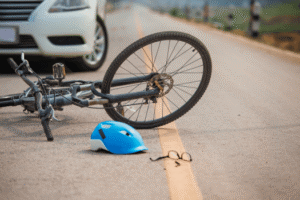


A driver turned across your path, and your head hit the hood, the pavement, or both. Maybe you blacked out for a second. Maybe you didn’t, and the ER told you it was “just a concussion.” Now the headaches won’t quit, your family says you seem different, and an adjuster is already asking for a statement.
Bicycle accident head injuries are some of the most serious and most underestimated injuries a Las Vegas cyclist can suffer. This guide covers what these injuries are, how long a brain takes to heal, what a TBI claim is worth in Nevada, and what to do before an insurance company decides for you.
Why Cyclists Take the Hardest Hits to the Head
Of all the motor vehicle accidents in Las Vegas, bike crashes are among the most dangerous for the head. A driver has a steel frame, airbags, and crumple zones. A cyclist has a helmet, if they’re wearing one, and nothing else.
Most car-vs-bike crashes involve two impacts. First the rider strikes the vehicle’s hood, windshield, or side mirror. Then they hit the pavement, curb, or another car. The second impact often does more damage than the first.
Speed makes it worse. Many of the most dangerous roads for cyclists in Las Vegas, including Tropicana, Flamingo, and Rainbow, carry 45-mph traffic past bike lanes that appear and disappear. A rider thrown at that speed absorbs forces the brain simply isn’t built for.
Helmets help. CDC research links helmet use to a 20% to 55% reduction in bicycle-related head injuries. But a helmet protects the skull far better than it protects the brain from the rotational, twisting forces that cause concussions and deeper damage. Plenty of helmeted riders still walk away with a brain injury.
The Most Common Bicycle Accident Head Injuries
Head injuries range from a bump that heals in days to trauma that changes a person’s life. The injuries cyclists see most often include:
Concussion (Mild Traumatic Brain Injury)
A concussion happens when the brain shifts or twists inside the skull. You don’t have to lose consciousness to have one. Common signs include headaches, dizziness, light sensitivity, trouble concentrating, and feeling “foggy.” Concussions are the most common cycling TBI, and the most commonly brushed off by insurers.
Skull Fractures
A hard strike against a curb, windshield frame, or pavement can crack the skull. Some fractures are simple. Others push bone toward the brain or tear the protective membranes around it and need surgery.
Brain Bleeds (Epidural and Subdural Hematomas)
A hematoma is bleeding between the skull and the brain. These are dangerous because a person can seem fine at the scene and then get worse over hours as pressure builds. Worsening headache, confusion, repeated vomiting, or one pupil larger than the other are emergency signs.
Brain Contusions and Diffuse Axonal Injury
A contusion is a bruise on the brain tissue itself. Diffuse axonal injury happens when rapid rotation stretches and tears nerve fibers across the brain. It may not show clearly on a standard CT scan, which is one reason these injuries get called “invisible.”
Facial and Jaw Trauma
Riders thrown forward often land face-first. Broken jaws, orbital fractures, and dental injuries frequently come with a concussion, even when the facial injury gets all the attention.
Head Injury Warning Signs That Show Up Hours or Days Later
Adrenaline masks symptoms. Many cyclists feel shaken but “okay” at the scene, decline an ambulance, and go home. That’s exactly when a slow brain bleed or a concussion can surface.
Go to the ER right away for any of these:
- A headache that gets worse or won’t go away
- Repeated vomiting
- Slurred speech, weakness, or numbness
- Confusion, unusual drowsiness, or trouble waking up
- Seizures
- Unequal pupils
Other signs are quieter and tend to build over days: memory gaps, irritability, trouble sleeping, sensitivity to noise, mood changes, and difficulty finding words. Family members often notice these before the injured person does.
If you’re unsure, get checked. Our guide on when to get medical care after a crash explains why same-day evaluation protects both your health and your claim.
Is a TBI Considered a Major Injury?
Yes. Any traumatic brain injury is a serious injury, including one labeled “mild.”
Doctors grade TBIs as mild, moderate, or severe based on factors like loss of consciousness, memory loss around the event, and brain imaging. That grade describes how the injury looked at the start. It does not predict how much it will disrupt your life. A “mild” TBI can still mean months of headaches, missed work, and trouble with tasks that used to be automatic.
Insurance adjusters know this, and they use the word “mild” anyway. Reading “mild TBI” as “minor injury” is one of the most common ways a cyclist’s claim gets undervalued.
Moderate and severe TBIs can bring permanent cognitive, physical, and personality changes, along with lifelong care needs. Those cases often move into the territory of catastrophic injury claims, where future care and lost earning ability drive the value.
How Long Does It Take the Brain to Heal After a Bike Accident TBI?
There’s no single timeline, and anyone who promises one isn’t being straight with you.
Many people with a concussion feel better within a few weeks. Some take months. A meaningful number deal with lingering symptoms, sometimes called post-concussion syndrome, for much longer. Moderate and severe TBIs often involve a long rehab process, and some effects may be permanent.
Recovery depends on the severity of the injury, your age, any prior head injuries, and how quickly you got proper treatment.
That uncertainty matters for your case. If you settle while you’re still healing, you give up the right to ask for more if symptoms linger. That’s why lawyers generally wait until you reach maximum medical improvement, the point where your doctors can say what your recovery will look like long-term.
How Much Is a Bicycle Accident TBI Settlement Worth in Nevada?
There is no honest “average” TBI settlement. Online averages mix mild concussions with lifelong disabilities and tell you almost nothing about your case. What moves the number is the facts.
Factors that shape a Nevada TBI claim:
- Severity and permanence. A concussion that resolves in two months is valued very differently than a brain injury with lasting cognitive effects.
- Medical costs, past and future. ER care, imaging, neurology, therapy, and any long-term care or rehab.
- Lost income and lost earning capacity. A TBI that limits your ability to do your job can be worth far more than the wages you’ve already missed.
- Pain, suffering, and loss of enjoyment of life. These losses count for a lot in brain injury cases, where the changes can reach into every relationship.
- Shared fault. Under Nevada’s modified comparative negligence rule, you can recover as long as you’re not more than 50% at fault, but your recovery drops by your percentage of fault.
- Available insurance. This is often the real ceiling.
That last point catches many Las Vegas cyclists off guard. Nevada’s minimum auto liability coverage is only $25,000 per injured person. A serious TBI can blow past that quickly. The good news: your own auto policy’s uninsured/underinsured motorist (UM/UIM) coverage may still protect you even though you were on a bike, not in your car. Tracking down every available policy is often the difference between a claim that covers your future and one that doesn’t, and it’s a core part of how we handle Las Vegas bicycle accident claims.
Every case is different. The only way to get a realistic range is to have an attorney review your medical records, the crash facts, and the insurance in play.
“I Wasn’t Wearing a Helmet.” Can I Still Bring a Claim?
Yes. Nevada has no statewide law requiring cyclists of any age to wear a helmet. Not wearing one doesn’t make you responsible for the crash. The driver who turned left in front of you or passed too close still caused it.
What insurers will try to argue is that a helmet would have made your head injury less severe, and that your recovery should shrink because of it. That argument, when it’s allowed, can only touch the head injury. It has nothing to do with a broken wrist, a shoulder injury, or road rash.
Whether the argument holds up depends on the medical evidence and how the crash happened. If you want to understand how fault is split in a car-vs-bicycle crash, that’s a good place to start. Just don’t assume you have no case because your helmet was at home.
How Insurers Try to Shrink a Cyclist’s Brain Injury Claim
Glen Howard spent years as an insurance defense attorney before he started representing injured people. He knows the playbook because he used to work on that side of it. With brain injuries, it usually looks like this:
- “Your CT scan was normal.” Many concussions and axonal injuries don’t show up on a standard CT. A clean scan doesn’t mean a healthy brain.
- “You waited to see a doctor.” Any gap in treatment gets framed as proof you weren’t really hurt.
- “You had a concussion before.” Prior head injuries get blamed for current symptoms.
- The recorded statement. An adjuster calls early, while you’re still foggy, hoping you’ll say “I’m fine.”
- The fast offer. A quick check arrives before anyone knows how your recovery will go.
Proving an “invisible” injury takes the right evidence: neuropsychological testing, treating-physician records, statements from family and coworkers about how you’ve changed, and your own record of symptoms over time. That work starts early, while memories and records are fresh.
What to Do Now If You or Someone You Love Hit Their Head
- Get evaluated, even if you feel okay. Tell the doctor exactly how you hit your head and every symptom, however small.
- Keep the helmet and the bike exactly as they are. A cracked or dented helmet shows where and how hard you were hit. Don’t repair or toss anything.
- Start a symptom journal. Write down headaches, memory lapses, sleep problems, and mood changes daily. Ask a family member to add what they notice.
- Follow every treatment recommendation. Keep appointments and follow-ups so there are no gaps for an insurer to exploit.
- Don’t give a recorded statement. Politely decline until you’ve spoken with a lawyer.
- Mind the deadline. Nevada generally gives you two years from the crash to file a personal injury lawsuit. Brain injury cases take time to build, so waiting until the end is risky.

Frequently Asked Questions
Can you get a concussion even if you were wearing a helmet?
Yes. Helmets are very good at preventing skull fractures and reducing the force of an impact, but they can’t fully stop the brain from shifting and twisting inside the skull. That movement is what causes a concussion. Many cyclists who were wearing a properly fitted helmet still suffer a TBI in a serious crash. If you were wearing a helmet and still have symptoms, take them seriously and get evaluated. Your helmet use can also strengthen your claim, since it shows you took reasonable precautions and still got hurt.
Can you have a brain injury without losing consciousness?
Yes. Most concussions happen without any loss of consciousness. Losing consciousness is one factor doctors look at, but plenty of people with a real traumatic brain injury never black out. They may feel dazed, confused, or “not right” for a moment and then seem fine. Symptoms like headaches, memory problems, dizziness, and irritability can appear hours or days later. Don’t let an adjuster argue you weren’t hurt because you stayed awake.
Should I keep my damaged bike helmet after an accident?
Yes. Stop using it, but don’t throw it away. A damaged helmet is physical evidence of where your head hit and how hard. Cracks, dents, compressed foam, and scrapes can help doctors and experts connect your symptoms to the crash. Store it somewhere safe, along with your bike and the clothes you were wearing, and photograph everything. Replace it with a new helmet before your next ride, since a helmet that has taken a hard impact may no longer protect you.
How long do I have to file a bicycle accident claim in Nevada?
Nevada generally allows two years from the date of the crash to file a personal injury lawsuit, under NRS 11.190(4)(e). Claims against a government entity, such as a city vehicle, come with their own notice requirements and damage caps, so confirm your deadline with an attorney early. With a head injury, the deadline can arrive sooner than you expect, because you may spend months in treatment before the full picture is clear. Starting early gives your lawyer time to gather medical evidence and find every insurance policy before the deadline gets close.

Talk to a Las Vegas Attorney Who Used to Work for the Other Side
You shouldn’t have to prove your brain injury while you’re still recovering from it. If you hit your head in a bike crash and something still doesn’t feel right, the question isn’t whether you’re being dramatic. It’s whether the people paying your claim understand what happened to you.
Glen Howard knows how insurance companies value, and undervalue, brain injury claims because he spent years on their side. Now he uses that knowledge for injured Nevada cyclists. There’s no fee unless we win, and a conversation costs you nothing.
Not sure if you have a case? That’s what the first call is for. Talk with a Las Vegas bike accident lawyer about what happened, or request your free case review. We’ll tell you where you stand before an adjuster decides for you.