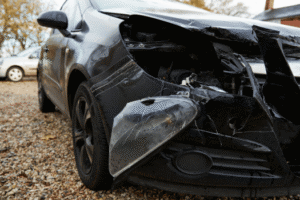


A wrong-way crash on a Las Vegas freeway is rarely a fender-bender you walk away from. These wrecks are relatively rare, but they kill at a rate few other crashes come close to — and if your family is reading this after losing someone, you already know why.
The reason is physics, not bad luck. When two vehicles hit head-on at freeway speed, the forces involved are far beyond what any car, seatbelt, or airbag was built to absorb. Below is a plain explanation of why wrong-way crashes turn fatal so often, where they happen in the valley, and what Nevada families can do when the worst has already occurred.
What Makes a Wrong-Way Crash Different From Any Other Collision
Most freeway crashes are same-direction events — a rear-end, a sideswipe, a merge gone wrong. Even at high speed, the two vehicles are usually moving the same way, so the difference in their speeds is what causes the damage.
A wrong-way crash breaks that rule. Two vehicles travel toward each other, so their speeds add together instead of canceling out. A driver going 65 who meets a wrong-way driver going 65 isn’t in a 65 mph crash. The impact behaves like a 130 mph event. That single difference is why a collision that might be survivable in any other configuration so often is not.
The Physics: Why Combined Speed Multiplies the Damage
Two forces stack in a head-on wrong-way crash, and both work against everyone in the vehicles.
The first is closing speed — the combined speed of both cars at the moment of impact. The second is kinetic energy, the energy a moving vehicle carries. Kinetic energy doesn’t rise in a straight line with speed; it rises with the square of speed. Double the speed and you roughly quadruple the energy that has to go somewhere in a crash. In a head-on impact, that energy is released almost instantly and slammed back into both cabins.
Crumple zones, airbags, and belts are engineered to manage the energy of a typical crash. A head-on freeway collision routinely overwhelms all of it at once. That’s the core reason wrong-way crashes produce catastrophic injuries and fatalities at a rate ordinary crashes don’t.
Why Wrong-Way Crashes Happen on Las Vegas Freeways
Wrong-way driving is not usually a simple mistake by an alert driver. National crash research points to the same small set of causes over and over, and all three show up on Las Vegas roads.
Impairment is the number one factor. Roughly six in ten wrong-way crashes involve an alcohol-impaired driver. An impaired driver is far more likely to enter a freeway ramp going the wrong direction and far less likely to correct in time. In a 24-hour city built around late-night bars, clubs, and casinos, that risk runs higher than in most places.
Older drivers are over-represented. Drivers over 70 make up a disproportionate share of wrong-way drivers, often tied to poor nighttime vision or momentary confusion at an unfamiliar interchange.
Most wrong-way drivers are alone. Close to nine in ten wrong-way crashes involve a driver with no passenger — nobody in the car to shout that something is wrong before it’s too late.
Las Vegas adds its own layer. Millions of visitors drive rental cars on freeways they’ve never navigated, at night, sometimes after drinking. An unfamiliar driver misreading a Strip-area off-ramp as an on-ramp is exactly the scenario these crashes come from. If you want the broader picture of why crash rates run high here, our overview of why motor vehicle accidents are so common in Las Vegas breaks it down.
Where These Crashes Cluster in the Valley
Wrong-way crashes concentrate on the valley’s controlled-access freeways, because that’s where a wrong-direction entry meets high speed. The corridors that come up most are I-15, US-95 / I-11, and stretches of the 215 Beltway — the same high-volume routes that carry the valley’s worst crash patterns generally. Our breakdown of crash hotspots across Las Vegas maps where the risk is highest.
The danger isn’t spread evenly. It spikes at freeway on- and off-ramps — the point where a confused or impaired driver enters against traffic — and it spikes at night, when visibility is low and impairment is more common.
What Nevada Is Doing to Stop Wrong-Way Drivers
Nevada has treated wrong-way driving as a distinct safety problem, and the Nevada Department of Transportation (NDOT) has rolled out ramp-based detection systems across the valley. These use radar and cameras to sense a vehicle entering a ramp the wrong way, then trigger bright flashing signs to warn the driver to turn around — with the lower signs deliberately mounted at the eye level of an impaired or distracted driver.
Early systems went live on ramps including I-15 at Starr Avenue and US-95 at Durango, Kyle Canyon, and Skye Canyon. NDOT has reported that a large majority of wrong-way drivers turn around once the flashing alerts activate, and the agency has announced a significant expansion — additional systems along the I-11/US-95 corridor and the 215 Beltway, with more sites phasing in through 2026.
The technology helps. It does not solve the problem. As NDOT has put it plainly, you can’t engineer your way out of a driver getting behind the wheel impaired. That limit is exactly why so many of these crashes still end in a fatality — and why the aftermath so often lands on a family instead of a policy fix.
When a Wrong-Way Crash Turns Fatal: What Families Should Know
If a wrong-way crash took someone you love, the legal side is the last thing you want to think about — and the one with a clock running on it. A few things are worth knowing early, in general terms.
Nevada law lets a family pursue a wrongful death claim when a death is caused by another driver’s wrongful act or neglect. Nevada is unusual in creating two connected tracks: the decedent’s heirs can recover for their own losses — grief and sorrow, lost companionship, lost support — and the estate, through a personal representative, can recover the financial costs the death created, such as medical bills and funeral expenses. Which claims apply, and who can bring them, depends on the specific family and facts. Our guide on what a family can recover after a fatal car crash in Nevada walks through both tracks.
A wrongful death claim is also separate from any criminal case against the driver. A DUI charge, a conviction, or even no charges at all does not decide your civil claim — those are different systems, and one can succeed without the other. Because wrong-way crashes so often involve an impaired driver, that overlap comes up constantly; here’s how a driver’s criminal case affects a fatal crash claim.
The urgent piece is timing. Nevada sets deadlines for filing, and they are shorter than most families expect while grieving. Missing one can end a valid claim before it starts, so it’s worth confirming when a wrongful death auto claim must be filed in Nevada sooner rather than later. Every case is different — this is general information, not advice about your situation, and a short conversation with a lawyer is the only way to know how the deadlines apply to you.
This is where who you hire matters. Attorney Glen Howard spent years on the insurance defense side — the side that puts a value on a fatal claim and looks for reasons to pay less. Our Las Vegas fatal crash attorneys use that inside knowledge to push back on those tactics from day one. If your loss came from a driver going the wrong way and you’re weighing representation, our team also handles wrong-way driver crash claims in Las Vegas directly.
Frequently Asked Questions
How common are wrong-way crashes?
They’re rare compared to other crashes but far deadlier. Wrong-way collisions make up only a small slice of freeway crashes nationwide, yet they cause hundreds of deaths every year in the U.S. because they’re typically head-on. In Nevada, wrong-way crashes kill roughly five to six people in an average year. The takeaway isn’t the raw count — it’s the severity. A crash type that’s a fraction of total wrecks produces a wildly disproportionate share of the fatalities, which is why safety agencies treat it as its own problem rather than folding it into general crash statistics.
What is the deadliest highway in Nevada?
Nevada’s high-volume freeway corridors — I-15, US-95/I-11, and the 215 Beltway — carry the most serious crashes simply because they carry the most traffic at the highest speeds, and they’re where wrong-way entries turn fatal. Surface routes like Boulder Highway also have a long-standing reputation for severe crashes. Ranking a single “deadliest” road is less useful than knowing that risk concentrates on fast, high-traffic corridors, especially at night. Our Las Vegas crash hotspot breakdown covers where valley crashes cluster in more detail.
Is the wrong-way driver always at fault?
In most wrong-way crashes, the driver traveling against traffic bears the fault — driving the wrong direction on a freeway is a clear violation, and it usually leaves little dispute about who caused the collision. Nevada uses a comparative negligence system, meaning fault can be divided when more than one party contributed. But when your loved one did nothing wrong, their share of fault is generally zero, and that shouldn’t reduce your family’s recovery. Fault in a fatal case can still get complicated when other factors are involved, so it’s worth having the specific facts reviewed rather than assuming.
Why do so many wrong-way crashes happen in Las Vegas?
The same national risk factors — impairment, older drivers, and driving alone — are amplified by what Las Vegas is. It’s a 24-hour city where drinking and late-night driving are woven into the economy, and it draws millions of visitors who navigate unfamiliar freeways and ramps, often after dark. That mix produces more of the exact conditions wrong-way crashes come from. For the fuller picture of why crash volume runs high across the valley, see our overview of why motor vehicle accidents are so common in Las Vegas.

If Your Family Lost Someone to a Wrong-Way Driver
Right now you’re grieving, and there’s a legal clock running that no one warned you about. You don’t have to have it all figured out to make one call. A free, no-pressure consultation with a Las Vegas fatal car accident lawyer will tell you whether you have a claim, what your family may be entitled to, and which deadlines apply — before any of them pass.
Howard Injury Law works on a contingency basis: no fee unless we win your case. And because Glen Howard built his career defending insurance companies, he knows exactly how the other side will try to minimize a fatal claim — and how to stop them. Reach out for a free case review whenever you’re ready.