


Not every accident becomes a personal injury case. Not every injury automatically means someone owes you compensation. What determines whether you have a viable claim under Nevada law comes down to four specific legal elements — and whether your situation satisfies all of them.
Understanding what qualifies as a personal injury case in Nevada removes the guesswork from a question most people spend too long wondering about. Some situations are clearly viable. Others aren’t. Many fall into a middle zone that requires a legal eye to assess accurately.
Here’s how Nevada law defines a personal injury claim, what types of incidents qualify, what the state’s rules mean for your timeline, and what to do if you think your situation might fit.

The Four Legal Elements Every Nevada Personal Injury Claim Requires
Duty of Care
Every personal injury claim starts with a legal relationship between you and the party who caused your injury. That relationship is called a duty of care — an obligation to act with reasonable caution to avoid harming others.
Duty of care exists in many everyday situations. Drivers on Nevada roads owe a duty of care to other motorists, cyclists, and pedestrians. Property owners — including casino operators, hotel management, and retail businesses — owe a duty of care to people on their premises. Doctors and medical professionals owe a duty of care to their patients. Employers owe a duty of care to workers and sometimes to members of the public.
Establishing that a duty existed is usually the straightforward part of a claim. The more contested elements come next.
Breach of Duty
A breach occurs when someone fails to meet the standard of reasonable care their duty required. A driver who runs a red light breaches their duty to other road users. A casino that ignores a known wet floor breaches its duty to guests. A surgeon who operates on the wrong site breaches their duty to a patient.
“Reasonable care” is evaluated against what a prudent person in the same situation would have done. It’s not a standard of perfection — it’s a standard of ordinary caution. When someone’s conduct falls below that standard and causes harm, the breach element is satisfied.
Causation
Establishing that a breach occurred isn’t enough on its own. The breach must have directly caused your injury. This is the causation element — and it’s frequently where insurance companies apply the most pressure.
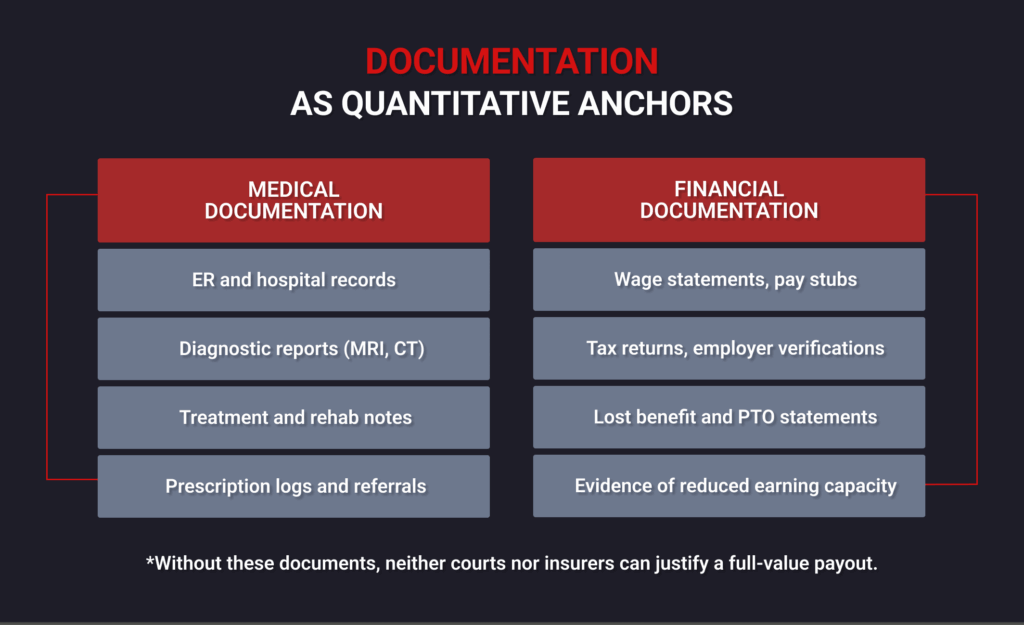
Causation arguments get complicated when prior injuries exist, when symptoms developed gradually rather than immediately, or when multiple incidents could potentially explain your condition. Insurance companies routinely argue that injuries were pre-existing, unrelated to the incident, or exaggerated. Strong medical documentation — starting close to the incident date and continuing consistently — is what supports the connection between what happened and what you’re experiencing now.
Damages
The final element is damages — measurable harm you actually suffered as a result of the breach. Medical expenses, lost wages, reduced earning capacity, property damage, and pain and suffering all qualify. Without documented damages, there’s no basis for compensation even when liability is clear.
Damages fall into two categories under Nevada law. Economic damages are the concrete numbers: bills, lost income, projected future costs. Non-economic damages cover the human impact: pain and suffering, emotional distress, loss of enjoyment of life, and the ways injury has changed your daily existence. Both are legitimate and recoverable. Both require documentation to substantiate effectively.
What Types of Incidents Qualify as Personal Injury Cases in Nevada
Motor Vehicle Accidents
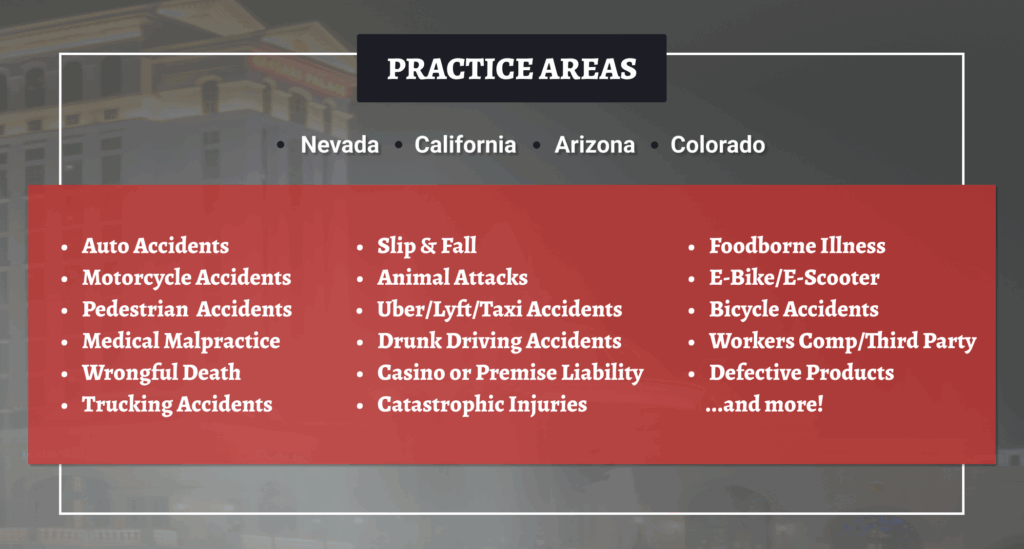
Car accidents are the most common source of personal injury claims in Las Vegas and across Nevada. The state’s high traffic volume, busy tourism corridors, and major interstate routes — particularly I-15, US-95, and the Strip — create frequent collision scenarios involving cars, trucks, motorcycles, rideshare vehicles, and commercial carriers.
Nevada requires all drivers to carry minimum auto insurance. Many carry only the minimums. Some carry nothing at all. When the at-fault driver’s coverage is inadequate, your own uninsured and underinsured motorist coverage becomes a critical part of the recovery equation — which is why understanding the full insurance picture early matters.
Fault in vehicle accidents is established through the police report, physical evidence, witness accounts, traffic data, and in complex cases, accident reconstruction. Nevada’s comparative negligence rule means shared fault reduces but doesn’t necessarily eliminate recovery — as long as your share of fault stays below 51%.
Premises Liability — Including Casino and Resort Injuries
Las Vegas has a uniquely high concentration of premises liability exposure. Millions of visitors move through casino floors, hotel lobbies, resort pools, parking structures, and entertainment venues every year. Property owners have a legal obligation to maintain reasonably safe conditions for guests.
When they fail — a wet floor with no warning sign, a broken staircase railing, inadequate lighting in a parking garage, a known security risk that went unaddressed — and someone is injured as a result, the property owner may be liable. Premises liability claims in Las Vegas often involve large corporate defendants with sophisticated legal teams and significant resources. That reality makes experienced local representation particularly important.
Slip and fall injuries are the most common form of premises liability claim. They’re also among the most frequently disputed — insurers argue the condition wasn’t hazardous, that it was open and obvious, or that the injured party was inattentive. Building a strong premises liability case requires prompt evidence documentation before conditions are repaired or altered.
Negligent Security
Las Vegas venues have a duty to provide reasonable security measures to protect guests from foreseeable harm. When a casino, hotel, nightclub, or resort fails to maintain adequate security — and a guest is assaulted, robbed, or otherwise harmed as a result — the property owner may bear liability alongside or instead of the individual who caused the harm.
Negligent security claims require establishing that the harm was foreseeable — typically through evidence of prior similar incidents at the property — and that the operator failed to take reasonable steps to prevent it. These cases involve both personal injury law and premises liability principles working together.
Medical Malpractice
Medical malpractice is a specialized category of personal injury law. It applies when a healthcare provider’s conduct falls below the accepted standard of care in their field and causes harm to a patient. Surgical errors, misdiagnosis, medication mistakes, and failure to diagnose serious conditions can all form the basis of a malpractice claim.
Nevada medical malpractice claims have specific procedural requirements beyond the standard personal injury framework — including expert affidavits and modified damage caps in certain circumstances. These cases are complex, time-sensitive, and require attorneys with specific experience in medical negligence litigation.
Vehicle Defect
When a defective product causes injury — a malfunctioning vehicle component, a dangerous pharmaceutical, a poorly designed consumer product — the manufacturer, distributor, or retailer may be liable under product liability law. These claims don’t require proving that someone acted negligently. They require establishing that the product was defective and that the defect caused harm.
Vehicle defect claims sometimes arise alongside car accident claims. If a mechanical failure contributed to a crash, the product liability exposure runs parallel to any negligence claim against another driver.
Wrongful Death
When another party’s negligence causes a fatal injury, surviving family members may pursue a wrongful death claim under Nevada law. Compensation can include funeral and burial expenses, lost financial support, loss of companionship, and the pain and suffering experienced by the deceased prior to death.
Wrongful death claims in Nevada have the same two-year statute of limitations as standard personal injury claims, running from the date of death. Surviving spouses, children, and in some circumstances parents or siblings may have standing to bring a claim.
Nevada’s Comparative Negligence Rule — Partial Fault Doesn’t End Your Case
You Can Be Partly Responsible and Still Recover
Nevada follows a modified comparative negligence standard. Your compensation is reduced proportionally by your assigned percentage of fault. Being 20% responsible for an accident on a $100,000 claim produces an $80,000 recovery. Being 30% responsible produces $70,000.
The cutoff is 51%. If you’re found to be 51% or more at fault, recovery is barred entirely. Below that threshold, a claim remains viable — just adjusted.
Insurance companies understand comparative negligence intimately and use it strategically. Shifting fault onto an injured claimant is a standard tactic for reducing what they have to pay. Statements made at the scene, recorded statements given to adjusters, and inconsistencies in early accounts all feed into how fault gets allocated. Starting your claim with legal representation means someone is managing that narrative from the beginning.
Nevada’s Statute of Limitations — Time Is a Legal Constraint, Not Just a Suggestion
Two Years for Most Personal Injury Claims
Nevada law gives most personal injury claimants two years from the date of the incident to file a lawsuit. Missing that deadline ends your right to pursue compensation through the courts — regardless of how strong your case is, how serious your injuries are, or how far along insurance negotiations may be.
The two-year clock runs whether you’re aware of it or not. Ongoing insurance negotiations don’t pause the statute. Financial hardship doesn’t extend it. Uncertainty about case strength doesn’t toll it.
Shorter deadlines apply in specific situations. Claims against government entities — a city vehicle, a county agency, a public transit bus — often require formal notice within six months of the incident. Missing the government notice deadline can bar your claim even before the two-year window closes.
Discovery of injury — where harm wasn’t immediately apparent — can affect when the clock starts in limited circumstances. Those situations require legal analysis specific to your facts.
What Doesn’t Automatically Qualify
Accidents Without Negligence
If you were injured in a purely accidental situation where no one failed to meet a standard of reasonable care, the legal elements of a personal injury claim may not be present. Injuries caused entirely by your own actions, by unforeseeable circumstances, or by genuinely unavoidable conditions don’t satisfy the breach element.
This doesn’t mean you shouldn’t have the situation evaluated. What looks like a straightforward accident sometimes involves a party whose negligence contributed in ways that aren’t immediately obvious. A pothole that caused a motorcycle crash may involve government liability for road maintenance. A fall in your own home that was caused by a defective product may involve product liability. The facts matter more than the initial appearance.
Workers’ Compensation vs. Personal Injury
Injuries that occur in the course of employment are typically governed by Nevada’s workers’ compensation system rather than standard personal injury law. Workers’ comp provides benefits regardless of fault but limits the types of compensation available. In some circumstances — particularly when a third party’s negligence contributed to a workplace injury — a personal injury claim can run alongside a workers’ comp claim. These situations require careful legal analysis to navigate correctly.

Frequently Asked Questions
Does a minor injury qualify for a personal injury claim in Nevada?
There’s no minimum injury threshold under Nevada law. What matters is whether another party’s negligence caused measurable harm — medical expenses, lost wages, pain and suffering, or other documented impact. An injury that initially seems minor sometimes develops into a more significant condition requiring extended treatment. Getting a legal evaluation before settling or dismissing a claim is always worth doing.
Can I file a personal injury claim if I was partially at fault?
Yes, as long as your share of fault is below 51%. Nevada’s comparative negligence rule reduces your recovery proportionally but doesn’t eliminate it below that threshold. How fault gets allocated is often disputed — which is why having an attorney managing that narrative from the beginning matters.
How long do I have to file a personal injury claim in Nevada?
Most personal injury claims have a two-year statute of limitations from the date of the incident. Government entity claims may have notice requirements as short as six months. If you’re unsure where your deadline stands, getting a legal evaluation as soon as possible protects your options.
What if my injury symptoms appeared days after the accident?
Delayed symptom onset is common and doesn’t automatically disqualify your claim. What matters is establishing a documented connection between the incident and your injury. Seeking medical attention as soon as symptoms appear — and being clear with your provider about the incident history — preserves that connection in your medical record.
If the Elements Are There, the Case Is Worth Pursuing
Four elements. Duty, breach, causation, damages. When all four are present, Nevada law gives you the right to pursue compensation for what another party’s negligence cost you. When some are present and others are uncertain, an attorney’s evaluation clarifies where the gaps are and whether they can be addressed.
The only way to know whether your situation qualifies is to have someone with legal expertise apply Nevada law to your specific facts. That evaluation costs nothing at Howard Injury Law and comes with no obligation to move forward.
A client came to us after a slip and fall at a resort property on the Strip. She was uncertain whether her injuries were serious enough, whether the property had actually done anything wrong, and whether too much time had passed. All three concerns turned out to be unfounded. The property had prior knowledge of the hazardous condition. Her injuries required months of treatment. The statute hadn’t run. Her case was viable — she just hadn’t known it until she called.
Start with a free case review at Howard Injury Law. Glen Howard evaluates your situation personally — 24/7, no upfront cost, no obligation.
If you’re also wondering how much a qualifying case might be worth, our post on how much is my personal injury case worth walks through how Nevada attorneys calculate damages. And if uncertainty about case strength is what’s holding you back from calling, our post on what if I’m not sure I have a strong enough case to call addresses that directly.