

Fatal crashes in Las Vegas are not spread evenly across the valley. Year after year, deadly wrecks cluster on the same handful of roads, highways, and intersections — and that pattern is not just a traffic statistic. It often points to who is responsible when a family loses someone.
If you’re reading this after losing a loved one, you may already know the road where it happened. Understanding why that corridor is so dangerous is the first step toward understanding whether the crash was preventable, and whether someone can be held accountable under Nevada law.
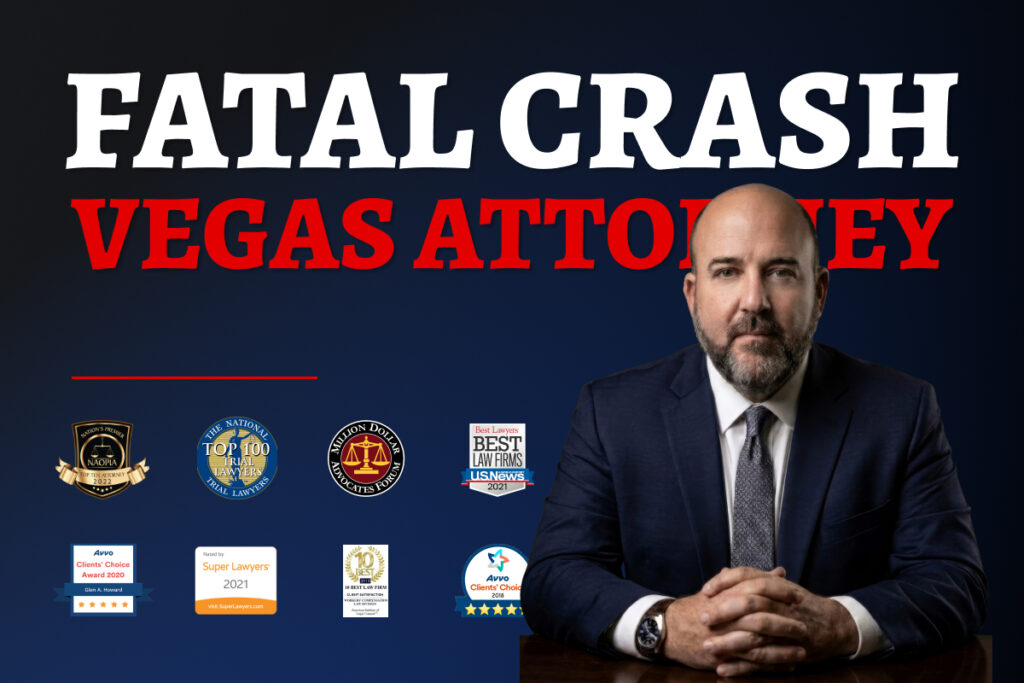
Where Fatal Crashes Happen Most in Las Vegas
Clark County records more than 150 traffic deaths in a typical recent year, and those numbers have been climbing. The Nevada Department of Transportation reports that roughly nine out of ten fatal crashes in the state happen in urban areas — with the Las Vegas Valley at the center of that risk. Heavy tourist traffic, 24-hour activity, unfamiliar drivers, and wide high-speed arterials combine to make certain corridors far deadlier than others.
If you drive the valley regularly, you can probably already name a few of them.
Boulder Highway (SR-582): the valley’s deadliest corridor
Boulder Highway — State Route 582 — is repeatedly identified as the deadliest stretch of road in the Las Vegas area, especially the segment running from East Sahara Avenue down through the east valley toward Henderson. It is notorious for fatal pedestrian crashes.
The reasons are structural. Boulder Highway pairs higher travel speeds with older commercial frontage, long distances between crosswalks, and dense bus and foot traffic. That mix produces exactly the kind of high-speed, high-vulnerability collisions that turn deadly. Metro’s own fatal crash reports return to this corridor again and again.
The freeways — I-15, US-95, and the 215 Beltway
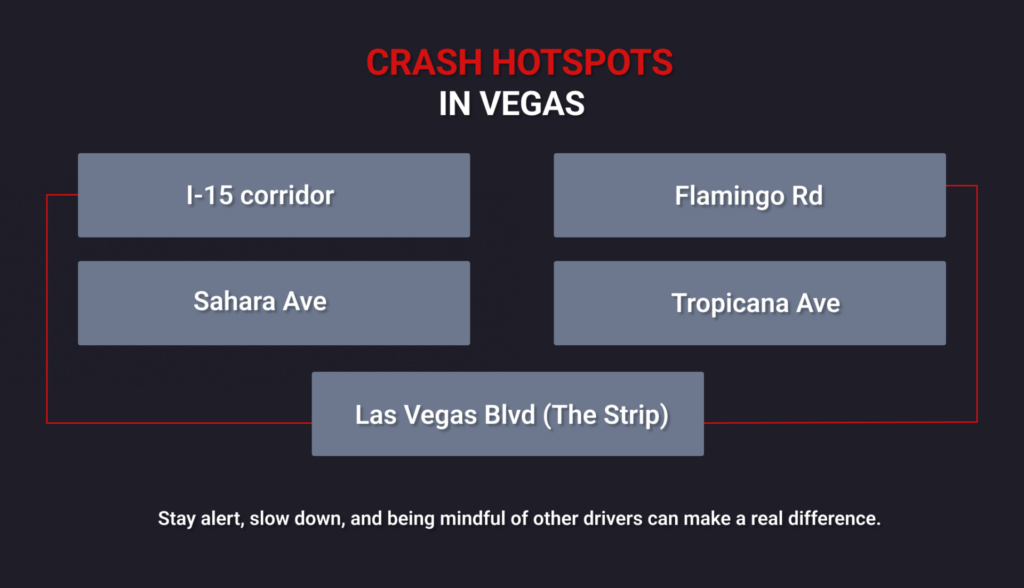
The valley’s freeways carry the heaviest volume of serious and fatal crashes. I-15 through the Sahara, Tropicana, and airport interchanges sees relentless stop-and-go traffic and lane-changing. US-95 from the Spaghetti Bowl out toward Rainbow and the Summerlin spur is a merge-zone problem area. The 215 Beltway around Rainbow and Durango produces frequent high-speed sideswipe and lane-change wrecks.
Freeway deaths are often driven by speed and wrong-way driving — two factors that leave little margin for survival. We cover one of the most horrifying versions of this in our look at why wrong-way crashes on Las Vegas freeways are so deadly.
The Strip and major arterials
Las Vegas Boulevard sees a high volume of crashes near the Wynn, Flamingo, and Tropicana intersections, particularly during peak hours. And the big east-west and north-south arterials — Sahara Avenue, Flamingo Road, Tropicana Avenue, Charleston Boulevard, and Decatur Boulevard — concentrate serious injury and fatal wrecks at their busiest signalized crossings.
These roads share a common problem: high speed, heavy volume, and dozens of conflict points where a single failure to yield or run a red light kills someone.
The Most Dangerous Intersections in Las Vegas
Some Las Vegas intersections show up on “most dangerous” lists so consistently that local crash investigators and attorneys recognize them by name. The recurring offenders include:
- Decatur Boulevard at Flamingo Road, Sahara Avenue, and Tropicana Avenue
- Rainbow Boulevard at Flamingo Road, Tropicana Avenue, and Charleston Boulevard
- Flamingo Road & Pecos-McLeod
- Boulder Highway & Nellis Boulevard
- Sahara Avenue & Valley View Boulevard
Intersections turn deadly for predictable reasons: left-turn and failure-to-yield collisions, red-light running, and pedestrians caught in long crossings. In fact, failure-to-yield fatalities in Las Vegas surged in recent reporting — more than doubling in a single year — and pedestrian mistakes and pedestrian exposure account for a large share of the valley’s deaths.
For a broader look at where all crash types concentrate across the valley, our Las Vegas crash hotspots guide maps the intersections and corridors that generate the most collisions of every kind — not just fatal ones.
What Actually Causes These Fatal Crashes
The location tells you where. The cause tells you why — and it usually comes down to a driver’s choice.
Across Las Vegas fatal crashes, three contributing factors show up over and over: impairment (alcohol and drugs), excessive speed, and failure to yield. Roughly one in three Nevada traffic deaths is tied to alcohol, and most fatal DUI crashes happen in urban zones during late-night and weekend hours — the exact rhythm of a 24-hour city built around the Strip.
Speed is its own killer. It shortens reaction time, multiplies impact force, and routinely converts a survivable crash into a fatal one. We break that down in how speeding turns a Las Vegas crash fatal.
None of these causes are accidents in the true sense. They are choices — and under Nevada law, a choice that kills someone is negligence.
Why the Location of a Fatal Crash Matters to Your Case
Here’s what most families don’t realize: the road itself can become part of the case.
When a corridor is known to be dangerous, several questions open up. Did poor road design, missing crosswalks, bad lighting, or an obscured signal contribute to the crash? If so, a government entity responsible for that road could share liability — though claims against public entities in Nevada carry their own strict notice deadlines, which is one reason not to wait. Was a commercial vehicle, a rideshare driver, or an impaired driver leaving a bar involved? Each opens a separate source of insurance and responsibility beyond the at-fault driver.
This is also where the other side goes to work. Insurance companies know these corridors too, and they use that knowledge against you. Their playbook on a Boulder Highway or Strip fatality is to blame the road, blame the pedestrian, or blame the victim — anything to shift fault away from their driver and shrink what they owe.
Attorney Glen Howard spent the early part of his career on the insurance defense side, learning exactly how carriers build those arguments before he switched to representing injured people and grieving families. That background is the difference between accepting the insurer’s version of what happened on that road and proving what actually happened. Evidence on a busy Las Vegas corridor — skid marks, debris fields, traffic-camera footage, business surveillance — disappears within days. The sooner it’s preserved, the harder the truth is to bury.
What Families Can Do After a Fatal Crash on a Las Vegas Road
If you lost someone in a crash on one of these roads, a few things are worth knowing now, while decisions still feel impossible to make.
First, request the official Metro or Nevada Highway Patrol crash report and hold onto everything — photos, the responding agency, any witness names. Second, be careful with the insurance company. Adjusters may call within days sounding sympathetic; anything you say can be used to reduce the claim. Third, understand that Nevada wrongful death claims generally must be filed within two years of the date of death, and negotiating with an insurer does not pause that clock. Our guide on when you have to file a wrongful death auto claim in Nevada walks through the deadline in detail.
Even if your loved one was thought to be partly at fault, your family may still be able to recover, as long as their share of the blame was not greater than everyone else’s combined. Every crash is different, and only a review of the specific facts can tell you where a case stands — which is exactly what a consultation is for.
For a step-by-step of the earliest decisions, see what to do in the first days after a fatal car accident in Vegas.
Frequently Asked Questions
Which street in Las Vegas is the most dangerous?
Boulder Highway — State Route 582 — is consistently identified as the deadliest road in the Las Vegas Valley, particularly the stretch from East Sahara Avenue through the east valley. It has a long, well-documented history of fatal crashes and is especially dangerous for pedestrians, largely because it combines higher speeds with older commercial frontage, wide gaps between crosswalks, and heavy foot and transit traffic. Other high-risk corridors include the Strip, US-95, I-15, and major arterials like Sahara, Flamingo, Tropicana, and Decatur. A single “most dangerous” label can be misleading, though — the deadliest road for your situation is the one your crash happened on, and its specific hazards are what matter to a claim.
What are the most crash-prone intersections in Las Vegas?
Several Las Vegas intersections appear on “most dangerous” lists year after year. The recurring names include Decatur Boulevard at Flamingo, Sahara, and Tropicana; Rainbow Boulevard at Flamingo, Tropicana, and Charleston; Flamingo Road and Pecos-McLeod; Boulder Highway and Nellis Boulevard; and Sahara Avenue and Valley View Boulevard. These crossings turn fatal mainly through left-turn and failure-to-yield collisions, red-light running, and pedestrians caught in long crossings. Heavy traffic volume and high approach speeds mean a single driver’s mistake at one of these intersections can kill. If your crash happened at a known-dangerous intersection, that history can become useful evidence in establishing how and why it occurred.
What is the leading cause of traffic deaths in Las Vegas?
In terms of traffic fatalities specifically, the leading contributing factors in Las Vegas are impaired driving, excessive speed, and failure to yield, along with heavy pedestrian exposure across the valley’s wide arterials. Roughly one in three Nevada traffic deaths involves alcohol, and impaired-driving crashes cluster in urban areas during late-night and weekend hours. It’s worth separating this from the leading cause of death overall — that’s a medical statistic, not a traffic one. When people ask what most often kills on Las Vegas roads, the honest answer is preventable driver behavior: someone drove impaired, drove too fast, or failed to yield.
What highway in Las Vegas has the highest death rate?
Among Las Vegas-area freeways, US-95 and I-15 carry the heaviest volume of serious and fatal crashes, driven largely by high speeds, congestion, and wrong-way driving. Among surface highways, Boulder Highway (SR-582) is repeatedly cited as the deadliest corridor in the region. Statewide, remote stretches of highways like US-93 also see high fatal rates because isolation and speed leave little room for error. The key point for a family is that a “high death rate” road is often a road with known, documented hazards — and documented danger can strengthen a claim when a crash was foreseeable and preventable.

You Deserve to Know What Really Happened on That Road
Losing someone on a Las Vegas road you now can’t drive past leaves you with more questions than answers — and an insurance company already working to make the road, or your loved one, the villain of the story. You don’t have to accept their version.
The team at Howard Injury Law’s fatal crash and wrongful death practice will review what happened at no cost to you, tell you honestly whether you have a case, and preserve the corridor evidence before it’s gone. Because Glen Howard spent years on the insurance defense side, he knows precisely how carriers try to shift blame after a fatal crash — and how to counter it. Our fatal crash cases are handled on contingency: there is no fee unless we win.
If your family lost someone in a fatal crash anywhere in the Las Vegas Valley, contact us for a free, confidential consultation or call (702) 331-5722. One conversation can tell you whether the road that took your loved one also created a case worth pursuing. Every situation is different — talk to a Las Vegas attorney about yours before the evidence and the deadline slip away.