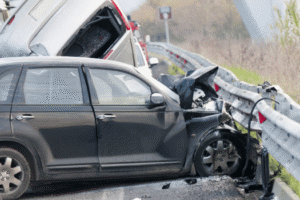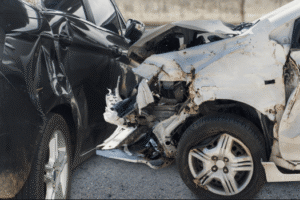


A T-bone crash lands the hit exactly where your car protects you least: the door. Side-impact injuries happen because only a thin panel of metal and glass stands between you and the vehicle that struck you — no engine, no trunk, no crumple zone to soak up the force. That’s why a broadside collision at a Las Vegas intersection can leave you seriously hurt even when the car looks, to an adjuster, “not that bad.”
If you were T-boned in Las Vegas and the door caved in near your hip, shoulder, or head, this guide explains what that damage does to the human body, why it matters to your claim, and what your next move should be.
Why a side impact is the most dangerous place to get hit
The front and back of your car are engineered to fail on purpose. Bumpers, the engine bay, and the trunk are built as crumple zones that crush and absorb energy before it reaches you. The side has almost none of that. A door, the window, and a reinforcing beam are the whole defense.
In a T-bone, the striking vehicle drives that force straight into the passenger space, and you’re often sitting just inches from the point of impact. Side impacts account for roughly a quarter of all vehicle-occupant deaths in the U.S., according to federal crash data — a share far out of proportion to how often these crashes happen. When the vehicle that hits you is a taller, heavier truck or SUV, the door can fold inward and the intrusion reaches the occupant directly.
Near-side vs. far-side: where you were sitting changes your injuries
One of the most important — and least understood — facts about a T-bone is that where you were sitting relative to the impact changes how you get hurt.
The near-side occupant is the person on the struck side of the car. They take the intrusion directly. As the door and pillar push in, that force loads into the pelvis, hip, ribs, and shoulder, and the head can strike the window frame or the intruding vehicle. Near-side injuries tend to be crush-pattern injuries: fractures, internal organ damage, and lacerations from glass and bent metal entering the cabin.
The far-side occupant — the person seated away from the impact — is often assumed to be safe. They’re not. In a hard side impact, the body is thrown sideways across the cabin. Even belted, a far-side occupant can slide out from under the shoulder belt, strike the center console, dashboard, or another passenger, and suffer serious head, neck, chest, and spine injuries. “The door by me wasn’t even hit” is not the same as “I wasn’t badly hurt.”
This distinction matters for your claim, too. Insurers know near-side and far-side injury patterns and will scrutinize whether your diagnosis “fits” where you were sitting. Getting the mechanism right from the start protects the value of the claim.
What door intrusion does to the body
When people talk about door damage in a T-bone, they usually mean the repair bill. But the intrusion of the door into the space where a person is sitting is also a direct cause of injury. Here’s what that force commonly produces:
- Pelvic and hip fractures — the pelvis sits right at door-and-console height, so a caved-in door drives force straight into it.
- Rib fractures and chest trauma — the door panel and armrest can act like a punch into the chest wall, risking broken ribs, lung bruising, and damage to organs like the spleen or aorta.
- Lower-limb crush injuries — when the door and the striking vehicle intrude, the legs and feet nearest the panel absorb it.
- Head injuries — the head can strike the window, door frame, or intruding structure, or be whipped violently sideways, causing concussions and more serious traumatic brain injuries.
- Neck and spine injuries — lateral force can herniate discs and, in severe crashes, cause spinal cord injuries with lasting nerve damage.
- Lacerations — shattered side glass and torn metal cause deep cuts, even when side airbags deploy.
If your crash left you with lasting back or spine injury symptoms, the intrusion pattern is part of the story that connects your diagnosis to the collision.
The side-impact injuries you don’t feel right away
Some of the most serious side-impact injuries don’t announce themselves at the scene. Internal bleeding, organ damage, and brain injuries can take hours or a couple of days to show their full severity. Adrenaline masks pain, so it’s common to tell the officer you feel “okay,” drive home, and wake up unable to turn your neck or shake a headache.
That delay is dangerous two ways. Medically, an untreated internal injury is a real emergency. Legally, a gap between the crash and your first medical visit is the first thing an insurer uses to argue you weren’t really hurt — or that something else caused it.
The safe move is simple: get evaluated within a day or two even if you feel mostly fine, and tell the doctor exactly how the crash happened — that you were struck in the side. Every case is different, so treat this as general information, not medical or legal advice for your specific situation; a doctor and an attorney can tell you what your facts actually call for.
Why your door damage is evidence, not just a repair bill
Here’s what most people don’t realize until an adjuster says it: the insurer will look at photos of your car and argue “it doesn’t look that bad.” In a side-impact case, that argument falls apart when you understand that intrusion is evidence.
A caved-in door, a bent center pillar, a pushed-in seat frame, shattered side glass — that damage isn’t just a cost to fix. It’s a physical record of how much force reached the occupant and where. The parts of the car that came into your space usually line up with the parts of your body that got hurt. A door pushed in at hip height and a fractured pelvis tell one consistent story, and that story is hard for an adjuster to wave away.
This is exactly the kind of argument Howard Injury Law is built to make. Attorney Glen Howard spent years on the insurance defense side before he started representing injured people — so he knows how carriers use “minor-looking” vehicle damage to discount real injuries, because he used to make those arguments himself. Preserving the vehicle, the intrusion photos, and the intersection footage early is how you keep the insurer from writing the story for you.
Who’s at fault in a Las Vegas side-impact crash
Most T-bones come down to right-of-way. A broadside almost always happens because one driver entered an intersection they weren’t clear to enter — running a red light, rolling a stop sign, or turning left across oncoming traffic. In most cases the driver who failed to yield is at fault. These crashes cluster at busy Las Vegas surface intersections — corridors like Sahara & Decatur or Tropicana & the I-15 ramps — where cross-traffic and left-turners meet at speed. Our broader guide to intersection crashes in Las Vegas covers how fault is sorted out.
Two more things worth knowing. Nevada generally gives you two years from the date of the injury to file a personal injury lawsuit, and negotiating with an insurer does not pause that clock. And the evidence that proves a side-impact case — intersection camera footage, the damaged vehicle, witness memory — fades fast, often within days. Acting early protects both.
Frequently Asked Questions
Is the driver’s side worse than the passenger side in a T-bone?
Not necessarily — it depends on which side took the hit. The near-side occupant, whoever is on the struck side, absorbs the door intrusion directly and tends to suffer crush-type injuries to the pelvis, ribs, and chest, plus possible head strikes. But the far-side occupant can be badly hurt too, thrown sideways across the cabin into the console or another passenger. So “driver’s side vs. passenger side” matters less than “struck side vs. far side.” Either seat can produce serious injuries, and the injury pattern should match where you were sitting relative to the impact — something a Las Vegas attorney will look at closely when building your claim.
Can a far-side passenger be seriously injured in a side-impact crash?
Yes. It’s a common and dangerous misconception that only the person next to the struck door gets hurt. In a hard side impact, the far-side occupant’s body is thrown toward the point of impact. Even wearing a seat belt, they can slip out from under the shoulder belt and strike the center console, dashboard, door frame, or another passenger, causing head, neck, chest, and spine injuries. Because the door beside them looks undamaged, insurers sometimes question these claims — which is exactly why documenting the crash mechanism and getting prompt medical care matters for a far-side occupant.
Does the damage to my car prove how badly I was hurt?
It’s strong supporting evidence. In a side-impact crash, the intrusion — a caved-in door, bent pillar, pushed-in seat, broken side glass — shows how much force reached the occupant and where. The body parts closest to the intrusion usually match the injuries, and that alignment is powerful when an insurer argues the car “doesn’t look that bad.” Vehicle damage doesn’t replace medical records — your diagnosis and treatment history still carry the claim — but together, the intrusion pattern and your injuries build a consistent, hard-to-dispute picture. Preserving those photos and the vehicle early is important, because repairs and salvage can erase the proof.
What internal injuries should I watch for after a side impact?
Side impacts drive force straight into the torso, so internal injuries are a real risk — bruising or bleeding of organs like the spleen, liver, or kidneys, lung injuries from rib fractures, and, in severe crashes, damage to major blood vessels. These often don’t produce obvious symptoms right away. Warning signs to take seriously include worsening abdominal or chest pain, shortness of breath, dizziness, or feeling faint in the hours and days after the crash. If you notice any of these, seek emergency care immediately. Even without symptoms, a prompt medical evaluation after a side-impact crash is the safest choice for your health and your claim.

Talk to a Las Vegas T-bone accident lawyer
If you were T-boned and you’re staring at a wrecked door, hurting, and worried the insurance company will lowball you because the car is “still drivable” — that instinct is right to be worried, and it’s exactly the fight we handle. A T-bone accident claim in Las Vegas turns on connecting the intrusion to your injuries and pinning fault on the driver who blew the right-of-way — before the evidence disappears.
Not sure you even have a case? That’s what a free consultation is for. Our T-bone accident lawyers will look at the police report, your vehicle damage, and your injuries and tell you honestly where you stand — no obligation, and no fee unless we win. See how we handle car accident cases across Las Vegas, then request your free case review or call (702) 331-5722. Do it before the two-year deadline quietly narrows your options.