


Your medical records are the strongest evidence you have in a personal injury claim. In a fault-based state like Nevada, they turn “my word against the insurance company’s” into a documented case — which is why medical documentation in personal injury cases decides so many outcomes long before anyone sees a courtroom.
If an adjuster has started hinting that your injuries are minor, pre-existing, or “not that serious,” you’re already in that fight. Here’s what your records actually prove, how insurers attack them, and how the Las Vegas personal injury lawyers at Howard Injury Law keep those tactics from quietly shrinking your claim.

Why Medical Documentation Is the Backbone of Your Injury Claim
Nevada is a fault-based state. To recover compensation, you have to show that another party’s negligence caused your injuries — and the burden of proving that falls on you, not on the person who hurt you. Your medical records are how you carry that burden.
Good documentation answers three questions an insurance company will try to muddy:
- Do the injuries exist? X-rays, MRIs, and physician notes give objective proof of harm an adjuster can’t wave away as exaggeration.
- How serious are they? Treatment plans, specialist evaluations, and prognoses show whether you’re looking at a few weeks of recovery or a permanent limitation.
- Did the accident cause them? A clear treatment timeline ties your injuries to the crash or fall — not to something that happened before or after.
Without that paper trail, a claim comes down to your account against theirs, and insurers are very comfortable in that gray area. With it, the conversation shifts to documented facts.
The Types of Medical Records That Prove Your Injuries
Not every record carries the same weight, and a strong claim usually pulls from several sources that reinforce each other.
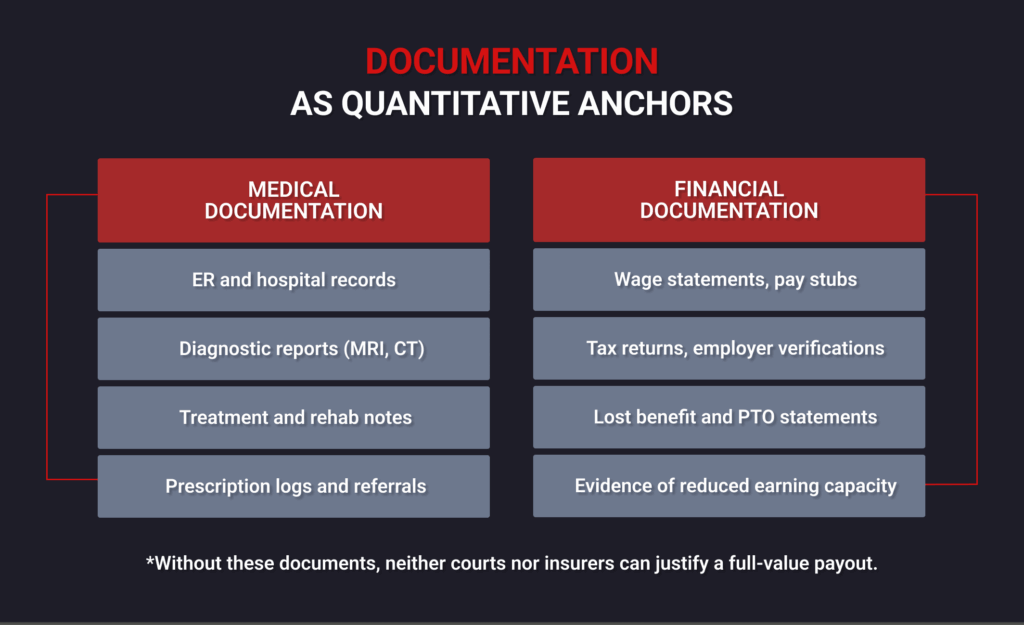
- Emergency and first-response records. Ambulance run sheets and ER notes capture your condition right after the accident. Because they’re created immediately and independently, they’re some of the hardest evidence for an insurer to dispute.
- Treatment and specialist notes. Notes from your primary doctor, orthopedist, neurologist, or pain-management specialist track your diagnosis, your care, and your physical restrictions over time.
- Diagnostic imaging. X-rays, CT scans, and MRIs provide objective proof of structural damage — a herniated disc or a fracture doesn’t show up on a report because someone “felt sore.”
- Billing and expense records. Itemized hospital bills, pharmacy receipts, and physical therapy ledgers put a concrete dollar figure on what the injury has cost you.
- Rehabilitation and prognosis reports. For serious injuries, records documenting ongoing therapy and a doctor’s opinion on long-term recovery support compensation for future care and lasting limitations.
How Your Records Connect the Accident to Your Injury
Causation is where many Nevada claims are won or lost. It isn’t enough to prove you’re injured — you have to prove the accident is what injured you, and the timeline in your records is what makes that link.
That’s why prompt care matters so much. When you’re treated within a day or two of a crash on I-15 or a fall at a Strip property, the record draws a straight line from the incident to your injuries. Wait weeks, and you hand the insurer an opening to argue something else caused the harm.
Hidden injuries make this trickier. Whiplash, soft-tissue damage, concussions, and internal injuries often don’t announce themselves right away — adrenaline masks them, and symptoms can surface days later. Feeling “fine” at the scene is not the same as being uninjured, and getting checked out early protects both your health and your claim. One small step protects the connection: tell every provider your injury happened in the accident, so it lands in the record from the start.
How Insurance Adjusters Use Gaps in Your Records Against You
Glen Howard spent years working on the insurance-defense side before building Howard Injury Law, so this next part isn’t a guess about how the other side operates — it’s how the playbook actually reads.
Adjusters look for three openings in your medical file:
- The pre-existing condition angle. If you ever treated the same body part before, expect them to argue the accident changed nothing. Detailed records showing a clear before-and-after are how you answer that.
- The “minor injury” angle. Thin documentation gets read as a minor injury. Consistent treatment notes show the real severity.
- The treatment-gap angle. Every stretch where you stopped treating becomes evidence, in their telling, that you’d recovered. Following your treatment plan closes that door.
This is also why the insurer’s other requests deserve caution. Think carefully before you give a recorded statement, and remember that what you post on social media can be pulled straight into your file to contradict your injuries. Every case is different, so treat this as general guidance and talk to an attorney about your specific situation.
What Your Medical Records Mean for the Value of Your Claim
Beyond proving your case, your records set the ceiling on what it’s worth. Compensation is built from documented losses, and your medical file is where most of those numbers come from.
Records support several categories of damages: current medical bills, the cost of future surgeries or ongoing therapy, lost wages and reduced earning capacity, and pain and suffering. The stronger the documentation, the harder it is for an insurer to lowball any one of them. If you’re worried about how your bills get paid while your case is pending, that’s a separate but common concern — how a medical lien works explains one route many injured people use to keep treating.
How to Protect Your Medical Records After an Accident
You have more control over the strength of your file than you might think. A few habits make a real difference:
- Get care promptly and don’t tough it out. Early treatment protects the causation link. If you’re avoiding the doctor because you’re worried about the cost of treatment, there are options — skipping care to save money almost always costs more in the end.
- Follow your treatment plan. Keep your appointments and finish the course of care your doctors recommend. Gaps are the easiest thing for an adjuster to exploit.
- Tell every provider it was an accident. That detail belongs in the record from your first visit forward.
- Keep your own file. Save discharge papers, prescriptions, imaging summaries, and bills. You don’t have to chase down every record yourself — a lawyer can gather and organize the complete set — but your own copies are a useful backstop.
Nevada gives most injury victims two years from the date of the injury to file a claim, and building a complete medical record takes time. The sooner your documentation is handled properly, the stronger your position.
Frequently Asked Questions
Can medical records be used in a lawsuit?
Yes. Medical records are among the most important pieces of evidence in a personal injury case, used to prove your injuries exist, show how serious they are, and connect them to the accident. In a lawsuit, both sides review them, and treating doctors or medical experts often rely on them to explain your injuries to an insurer, a judge, or a jury. Your records are protected health information, so they generally enter a case through your authorization or the formal discovery process rather than being handed over automatically. A personal injury attorney handles that exchange for you and makes sure the file that gets used is complete and accurate.
What are the 5 C’s of medical record documentation?
The 5 C’s are a shorthand clinicians use for quality documentation: Clear, Concise, Complete, Correct, and Chronological. (Some versions swap in “consistent” or “confidential” for the fifth.) In plain terms, a good record is easy to read, sticks to the relevant facts, leaves nothing important out, is accurate, and lays events out in the order they happened. Those same qualities are what make a record persuasive as evidence. A clear, complete, chronological file is hard for an insurance company to poke holes in — while a sloppy or inconsistent one gives an adjuster room to argue.
What are the CMS guidelines for medical record documentation?
CMS — the federal agency overseeing Medicare and Medicaid — sets standards for what a proper medical record should contain. At their core, the guidelines require every entry to be legible, complete, dated, and signed by the provider who delivered or evaluated the care, and to document the reason for the visit, relevant history, exam findings, test results, and the treatment plan. Late entries have to be labeled as such. You don’t need to master these rules yourself, but they’re worth knowing for one reason: records that meet these standards carry more weight as evidence, and gaps or missing signatures give an insurer something to challenge.
How much is a good settlement for pain and suffering?
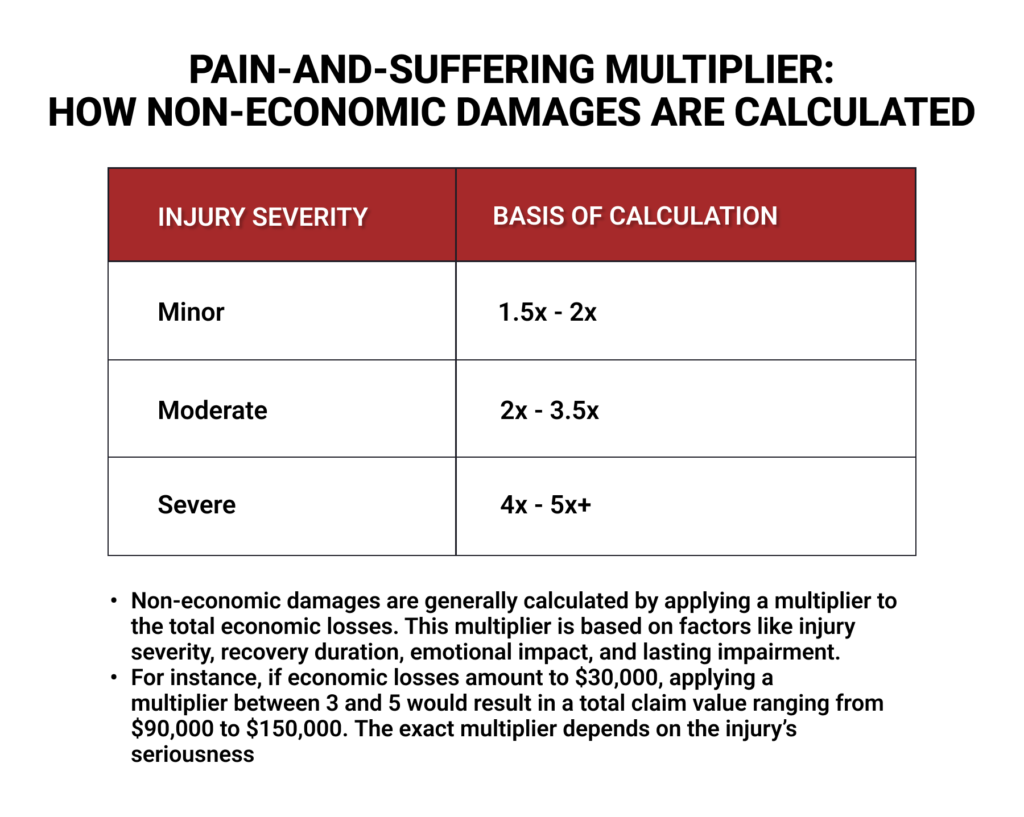
There’s no fixed number, and anyone quoting an “average” is guessing. Pain and suffering is compensation for the physical pain and emotional toll of your injury, and its value depends on how severe the injury is, how long recovery takes, and how it’s affected your daily life — all of which your medical records document. Insurers often estimate it using a multiplier applied to your medical costs or a per-day figure, and how injury settlements are valued breaks down those methods. Because every case is different, the honest answer comes from reviewing your specific records with an attorney, not from a chart.
Talk to a Las Vegas Lawyer Who Knows How the Other Side Reads Your Records
If you’re worried your injuries won’t be taken seriously, that worry is worth acting on — because the insurance company is already reading your file with that goal in mind. The advantage of having a Las Vegas personal injury attorney who came from the insurance-defense side is simple: Glen Howard knows exactly where they look for weaknesses, and he builds your case to close those gaps before they’re used against you.
There’s no cost to find out where you stand. Howard Injury Law works on a contingency fee, so you pay no attorney fee unless we win, and your first consultation is free. Call (702) 331-5722 or request a free case review, tell us what happened, and we’ll walk you through what your records show and what your claim may be worth — no pressure, just a straight answer.