

One second you’re driving straight; the next, a car slides into your door because the other driver never checked the lane was clear. Sorting out lane change accident fault in Nevada gets messy fast, because both cars were moving and each driver swears the other one drifted. If a merging driver clipped you on US-95 or a surface street in Spring Valley, you’re probably angry, sore, and worried the insurance company will pin it on you.
Here’s the short version: Nevada law puts the responsibility on the driver who leaves their lane. But “usually at fault” isn’t “automatically at fault,” and how the blame gets split decides what your claim is worth. Below is how fault actually works, what proves it, and what a ticket does to your record and your case.
What Counts as an Unsafe or Improper Lane Change in Nevada?
Nevada spells out the rule in NRS 484B.223. A driver has to stay within a single marked lane and can’t move out of it until they’ve given the proper turn signal and made sure the move can be made safely. Both parts matter. Signaling alone isn’t enough if the lane wasn’t clear, and checking isn’t enough if you never warned the drivers around you.
An improper or unsafe lane change usually comes down to one of these:
- No signal — changing lanes without the blinker, so no one around you knows what’s coming.
- Failure to check — merging without truly looking at mirrors and blind spots. What looks clear over your shoulder can hide a whole car.
- Drifting — sliding out of the lane while distracted, drowsy, or reaching for the phone.
- Crossing solid lines — moving over where the markings prohibit it.
- Cutting it too close — squeezing into a gap that wasn’t actually big enough.
Any one of these can turn a routine merge into a side-impact crash. The driver who broke the rule is the one who created the danger — and that’s where fault starts.
Who Is at Fault When You Change Lanes?
The driver changing lanes carries the legal duty to do it safely, so in most lane change crashes, that driver bears the bulk of the fault. If someone merged into your lane and hit you while you were driving straight and predictably, the facts usually favor you.
But it isn’t automatic. Fault can shift or split when:
- You were also moving over — both drivers changed into the same middle lane at once.
- The other driver was speeding — a car closing far faster than traffic changes what “safe to merge” even means.
- You sped up or drifted — closing the gap the merging driver was aiming for.
- A third car forced the merge — someone else’s bad move pushed the chain of events.
This post focuses on the merge maneuver itself. If your crash was a broader side-to-side collision without a clear lane change — two cars simply scraping down the freeway — the fuller breakdown lives in our guide on who is at fault in a sideswipe accident in Nevada. And if the other driver’s excuse is “I never saw you,” that’s a blind spot merge — not a defense. Failing to check a blind spot is exactly the safety duty the law requires.
Every crash has its own facts, so treat this as general information, not a verdict on your case. A quick conversation with a Las Vegas attorney will tell you where the fault likely lands.
How Nevada’s Comparative Negligence Rule Splits the Blame
Fault in Nevada isn’t all-or-nothing. Under the state’s modified comparative negligence rule (NRS 41.141), you can still recover money even if you were partly to blame — as long as your share of fault is 50% or less. Cross into 51% or more and you recover nothing. If you’re partly at fault but under that line, your compensation drops by your percentage. Found 20% at fault on a $100,000 claim, and you’d collect $80,000.
That single number is exactly what the insurance company fights over. Adjusters know that every percentage point of blame they push onto you is money out of your settlement. So after a lane change crash, expect the other driver’s insurer to argue you were speeding, that you moved over too, or that you could have avoided it. That’s a negotiating tactic dressed up as a fault finding — and it’s why the evidence matters so much.
Proving Who Changed Lanes Unsafely
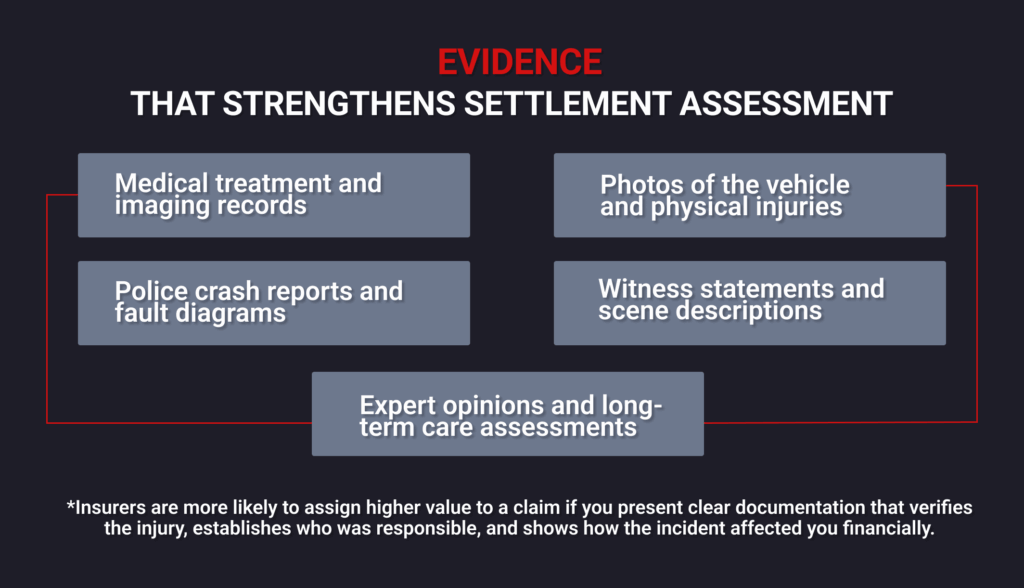
Two drivers, two stories, and often no independent witness — that’s the typical lane change crash. Fault gets decided by what the physical evidence shows, not who talks loudest. The pieces that carry the most weight:
- Point of impact and damage location. Where the vehicles struck each other often reveals who was moving into whom. Paint transfer and the angle of the dents can tell the story a driver won’t.
- Dashcam footage. If you or a nearby car recorded the merge, that’s frequently the whole case.
- The police report. An officer’s narrative and any citation issued at the scene carry real weight with adjusters.
- Witnesses. A neutral third driver who saw the merge can break a he-said-she-said tie.
- Photos. Skid marks, debris, final resting positions, and lane markings all help reconstruct the moment.
Collecting and preserving the right proof early is what turns “your word against theirs” into a documented claim. Our overview of what evidence you need for a car accident injury claim walks through it in detail.
Does a Lane-Change Ticket Affect Your Record — and Your Claim?
If an officer cited the other driver for an unsafe lane change, that helps you — but a citation isn’t the final word on liability, and the reverse is true if you got ticketed.
An improper lane change is a moving violation in Nevada, so a conviction adds demerit points to your driving record. Those points fall off your license after 12 months, but the conviction itself stays part of your permanent driving record, and insurers typically factor moving violations into your rates for around three years. Rack up 12 or more points in a 12-month window and the DMV suspends your license for six months.
For your injury claim, though, the ticket is evidence — strong evidence, but not automatic proof. A citation can be contested, and fault in a civil injury case is decided separately from the traffic court outcome. If you were wrongly blamed at the scene, that finding can still be challenged with the physical evidence. Don’t assume a ticket sinks your case, and don’t assume it wins it either.
What to Do After a Lane Change Crash in Las Vegas
The moves right after the crash protect both your health and your claim:
- Call 911 and get a report. A police report anchors the official account, especially on high-merge stretches like the I-15 corridor or the 215 Beltway.
- Photograph everything — both vehicles, the point of impact, lane markings, and the scene before cars are moved.
- Get names and numbers from any witnesses before they leave.
- See a doctor, even if you feel okay. Side-impact injuries and whiplash often surface a day or two later, and a gap in treatment gives the insurer an argument.
- Don’t admit fault or guess at the scene. “I’m sorry” gets quoted back to you.
- Save your dashcam file immediately so it isn’t overwritten.
Merge-heavy areas — the Spaghetti Bowl where I-15 meets US-95, on-ramps across the valley — see these crashes constantly. The steps are the same wherever it happened.
Frequently Asked Questions
Who is at fault when changing lanes in Nevada?
The driver changing lanes almost always carries the primary duty, because Nevada law requires them to signal and confirm the lane is clear before moving over. If a merging driver hit you while you drove straight and predictably, the facts usually point to them. That said, fault isn’t automatic. It can split if you were also changing lanes, speeding, or closed the gap the other driver was merging into. Nevada uses comparative negligence, so more than one driver can share blame. The physical evidence — point of impact, dashcam, witnesses — is what ultimately decides how fault gets assigned.
What is considered an improper lane change?
An improper or unsafe lane change is any move out of your lane that breaks the safety duty in NRS 484B.223. The most common forms are changing lanes without signaling, merging without checking mirrors and blind spots, drifting out of your lane while distracted, crossing solid lines where the markings prohibit it, and cutting into a gap that wasn’t big enough. In short, if a driver leaves their lane without warning others and without making sure the lane is clear, it’s improper. When that maneuver causes a crash, the merging driver is typically the one who created the hazard and bears the fault.
How do insurance companies decide who is at fault in a sideswipe?
Adjusters weigh the police report, any citations, the point of impact and vehicle damage, statements from both drivers, and any dashcam or witness accounts. But they’re not neutral referees. The other driver’s insurer has a financial reason to shift as much blame onto you as possible, because under Nevada’s 51% rule, every percentage point of fault they assign you cuts what they owe. That’s why an insurer may claim you were speeding or also drifting, even when the damage suggests otherwise. Documented evidence — and someone who knows how adjusters build these arguments — is how you push back on an inflated fault finding.
How long does an at-fault accident stay on your record in Nevada?
Two different clocks are running. Demerit points from a moving violation like an unsafe lane change drop off your driving license about 12 months after the conviction. But the conviction itself remains a permanent part of your driving record, and insurance companies typically look back roughly three years when setting your premiums, so your rates can feel the effect longer than the points last. Accumulating 12 or more points within a 12-month period triggers a six-month license suspension. Completing a DMV-approved traffic safety course can remove three points once per year if you qualify.

Talk to a Las Vegas Lane Change Accident Lawyer
If a merging driver hit you and the insurance company is already hinting the crash was partly your fault, that’s not a coincidence — it’s the playbook. Before Glen Howard founded Howard Injury Law, he worked as an insurance defense attorney. He knows exactly how the other side builds a case to shift blame and shrink your payout, and he uses that knowledge to protect what your claim is actually worth.
You don’t have to argue point of impact and comparative fault with an adjuster on your own. Talk it through with a Las Vegas sideswipe accident attorney who can look at your evidence and tell you where fault likely lands. The consultation is free, and because we work on contingency, there’s no fee unless we win your case.
Wondering whether you even have a claim — especially if you got blamed at the scene? That’s the exact question a quick call answers. Reach our team through the car accident lawyers in Las Vegas at Howard Injury Law, or contact us here to get started. If your crash happened on a busy multi-lane stretch, our guide to a multi-lane sideswipe crash on the Las Vegas Strip covers that scenario too.