

You changed lanes on Sahara, felt the jolt, and now the other driver is jabbing a finger at you: “You were in my blind spot — this is your fault.” Their insurance adjuster may be saying the same thing before you’ve even seen a doctor. Before you accept any of it, know this: in Nevada, sitting in another driver’s blind spot does not make the crash your fault. A Las Vegas blind spot accident lawyer hears this exact blame-shift every week, and Nevada’s own traffic law puts the duty to check that blind spot on the driver who moved over — not on the driver who was already there.
That distinction is the whole ballgame. It decides who pays, whose rates go up, and whether you walk away covering your own medical bills for someone else’s mistake. Here’s how Nevada actually treats these crashes.
What Counts as a Blind Spot Accident in Las Vegas?
A blind spot accident happens when a driver moves into a lane that’s already occupied by a vehicle they couldn’t see — or didn’t bother to look for. Most of them land as sideswipes: two cars traveling the same direction, one drifting into the other during a merge or lane change. The damage runs down the side panels, and in a split second a routine lane change becomes a spin, a curb strike, or a chain of cars trading paint.
Every vehicle has blind spots — the zones just behind and to the side of the driver that mirrors don’t fully cover. The problem isn’t that blind spots exist. It’s that a driver is legally required to account for them before changing lanes, and plenty don’t.
These crashes cluster wherever lanes converge and drivers make fast decisions. Think of the merge from the 215 Beltway onto I-15, the lane-drop chaos near the Spaghetti Bowl, or a four-lane stretch of Tropicana where someone dives for an exit at the last second. Add heavy tourist traffic near the Strip — drivers who don’t know the roads and change lanes on instinct — and you get one of the most common crash types in the valley. If you were hit this way, your case sits squarely in the same family as any other sideswipe accident, and the fault analysis starts with one question: who had the duty to look?
Who Is at Fault in a Blind Spot Accident in Nevada?
Fault in these crashes turns on Nevada’s lane-change law, NRS 484B.223. It says a driver must stay in a single lane and cannot move out of it until two things happen: they’ve given the proper turn signal, and they’ve made sure the move can be done safely. That second part — confirming the lane is actually clear — is the legal home of the blind spot check. A driver doesn’t get to skip it just because a car happened to be in a spot they couldn’t see. Checking is their job.
So being in someone’s blind spot is not, by itself, fault. The law doesn’t ask whether you were hard to see. It asks whether the other driver confirmed the lane was clear before crossing into it. When they didn’t, the fault points at them.
When the driver who changed lanes is at fault
In most blind spot sideswipes, the merging driver is responsible. They had the duty to signal and verify, they failed to do it, and the crash followed. That’s true whether they never checked their mirror, glanced too fast, or simply assumed the lane was open. Nevada doesn’t grade on effort — the duty is to actually confirm the lane is safe, and a collision usually shows it wasn’t confirmed.
When fault gets shared — the “you lingered in my blind spot” argument
Here’s the argument insurers love: their driver was making a normal lane change, and you were doing something unreasonable — camping in the blind spot on purpose, speeding up to stay alongside, or drifting toward their lane yourself. If any of that is true, Nevada’s comparative negligence rule (NRS 41.141) can assign you a share of the fault and reduce your compensation by that percentage.
But two things matter here. First, you can still recover as long as you were 50% or less at fault — you’re only barred if you were more than half responsible. Second, an adjuster asserting you “lingered” is not the same as proving it. That claim has to be backed by evidence, and most of the time it isn’t. A disputed-liability car accident is often just an insurer testing whether you’ll fold. Every case is different, so treat this as general information rather than a verdict on yours — but don’t hand over fault you don’t owe.
Blind Spots on Big Rigs: Truck No-Zones in Las Vegas
Commercial trucks turn the blind spot problem into something far more dangerous. Big rigs have blind zones — “no-zones” — on all four sides: directly in front, directly behind, and wide stretches along both flanks, worst on the right. A trucker who merges on I-15 without confirming the lane is clear can flatten a passenger car that never had room to escape.
Truckers are held to that same duty to check before moving over, plus federal safety training standards on top of it. When a professional driver sideswipes you out of a no-zone, the claim often reaches past the driver to the trucking company that employed them. These cases carry bigger insurance policies and harder-fighting adjusters, which is exactly why a Las Vegas truck accident claim is worth treating differently from a two-car fender-bender.
What to Do After a Blind Spot Sideswipe in Las Vegas
What you do in the days after the crash shapes whether that “you were in my blind spot” story sticks or falls apart.
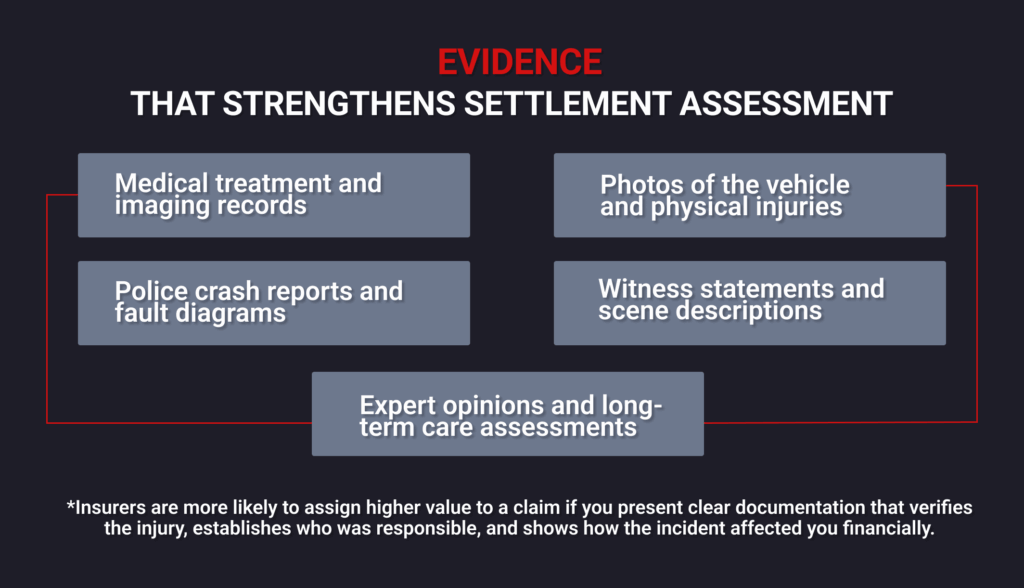
Call the police and get a report. Photograph both vehicles — the paint transfer and damage pattern on a sideswipe often show who crossed into whom. Get names and numbers from any witnesses before they drive off. See a doctor even if you feel okay; adrenaline hides injuries, and a gap in treatment is the first thing an adjuster uses to shrink your claim. And be careful what you say at the scene — a reflexive “I didn’t see them” can be twisted into an admission.
Evidence that shows the other driver never checked
The strongest blind spot cases are built on proof, not argument. Damage location and angle, skid marks, dashcam footage, nearby business or traffic cameras, and the other driver’s own statements all help reconstruct who moved into whose lane. Knowing exactly what evidence a car accident claim needs — and moving fast before footage is overwritten — is often what separates a paid claim from a denied one.
How long you have to file in Nevada
Nevada gives you two years from the date of the crash to file a personal injury lawsuit (NRS 11.190(4)(e)). That deadline sounds far off while you’re still treating and negotiating, but it closes faster than people expect, and once it passes a court will almost certainly refuse to hear your case. The full picture of how long you have to sue after a car accident in Nevada is worth reading early — evidence disappears long before the two years run out.
Why “You Were in My Blind Spot” Doesn’t End Your Claim
That line does a lot of work for insurance companies. It sounds like common sense, it makes you feel responsible, and if it makes you settle cheap or walk away, the insurer wins. But it’s a framing, not a legal finding — and Nevada law doesn’t back it up when the other driver failed the duty to check.
This is where knowing how the other side operates pays off. Attorney Glen Howard spent years as an insurance defense lawyer, building the very arguments that adjusters now use against people like you. He knows how a blind spot blame-shift gets assembled, which pieces of “evidence” are bluff, and how to take the whole thing apart. When the insurer says the crash is on you, that background is the difference between accepting their number and getting what the claim is actually worth.
Frequently Asked Questions
What not to say after a blind spot accident?
Be completely honest with your own attorney — those conversations are privileged and confidential, and the more your lawyer knows, the better they can protect you. The caution is aimed at the other driver’s insurance adjuster. Avoid guessing about fault, speculating about how fast you were going, or tossing out phrases like “I didn’t see them” or “I’m sorry.” Adjusters record calls and mine them for admissions. Stick to facts if you must speak — where and when it happened — and decline to give a recorded statement until you’ve talked to a lawyer. You are never required to give the at-fault driver’s insurer a statement, and it rarely helps you.
Where do most car accidents happen?
There’s no clean “90% happen at one spot” statistic, despite how often people search for one. What research consistently shows is that the vast majority of crashes — roughly nine in ten — trace back to a driver’s choice or error, not the road or the weather. Blind spot sideswipes fit that pattern exactly: they’re preventable failures to look. In Las Vegas, they tend to happen where lanes merge and drivers rush — freeway on-ramps to I-15 and US-95, lane drops near the Spaghetti Bowl, and busy multi-lane arterials like Flamingo and Charleston during heavy or tourist traffic.
How long does an at-fault accident stay on your record in Nevada?
On your Nevada DMV driving record, most accidents stay for about three years; serious crashes tied to a conviction can stay ten. Insurers look back three to five years when setting your premium, and industry claim databases can hold the data up to seven. Here’s the part that eases a lot of worry: if you were not at fault and you pursue a claim against the other driver’s insurance — a third-party claim — that generally does not land on your own driving record or raise your rates. It’s the other driver’s policy on the hook, not yours. Proving you weren’t at fault is what keeps it that way.
Is being in someone’s blind spot automatically my fault?
No. Nevada law (NRS 484B.223) requires the driver changing lanes to signal and confirm the lane is clear before moving over. A blind spot is a known feature of every vehicle, and the duty to account for it sits with the driver making the move — not with the car already traveling lawfully in its lane. You can be entirely out of sight and still not be at fault. Insurers argue otherwise because it’s cheaper for them, but the position doesn’t hold up when the other driver failed to verify the lane was safe.
Talk to a Las Vegas Blind Spot Accident Lawyer
If an insurer has already decided the blind spot crash is your fault, that’s the reason to make one call before you say anything else. You don’t have to argue with an adjuster or prove Nevada’s lane-change law on your own — that’s the job of your Las Vegas sideswipe accident attorney.
Howard Injury Law offers a free consultation to walk through what happened, tell you honestly whether you have a case, and lay out what it may be worth. Because we work on contingency, there’s no fee unless we win — and with Glen Howard’s insurance-defense experience on your side, you have someone who knows exactly how the other side builds the “it’s your fault” story. Reach out for your free case review or call (702) 331-5722. Bring the photos, the police report, and the adjuster’s name if you have them — and let us handle the rest.