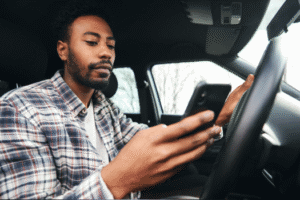


You saw it happen. The other driver’s head was down, the car drifted, and by the time they looked up it was too late. Now you’re hurt, your car is wrecked, and you keep replaying the same thing: they were on their phone. That detail matters more than you might think — and this is what it means for your claim.
Being hit by a texting driver in Las Vegas puts you in a stronger legal position than a lot of crash victims, because the driver who hit you likely broke a specific Nevada safety law the moment they picked up that phone. The challenge is that the insurance company knows this too, which is why they work hard to blur whether the phone was ever really in the driver’s hand. Here’s how the law works in your favor, how distraction gets proven, and what to do next.
What Nevada’s Handheld Ban Means When a Texting Driver Hits You
Nevada has a total ban on handheld phone use behind the wheel. Under state law (NRS 484B.165), a driver cannot manually type, send, or read a text, browse the internet, or hold a phone to their ear while driving. Voice-operated and hands-free setups are allowed, but the moment a driver physically handles the device, they’re breaking the law. It’s also a primary offense — an officer can pull a driver over for nothing more than seeing a phone in their hand.
That legal line is the backbone of your case. When someone violates a safety statute written to protect other people on the road and that violation causes a crash, Nevada law treats the broken rule as strong evidence of negligence. In plain terms: if the driver who hit you was texting, they weren’t just careless in a vague sense — they were doing something Nevada specifically outlawed to prevent crashes exactly like yours. That makes proving fault more direct than it is in a lot of accidents.
You don’t need to memorize the fine schedule to build your claim — the penalties a texting driver faces are a separate track from your injury case. If you want the full breakdown of tickets and fines, our overview of Nevada’s texting and driving laws walks through it. For your purposes, the takeaway is simpler: the law was on your side before the crash even happened.
Distracted Driving Is One of Nevada’s Top Crash Causes
Texting gets the headlines, but distraction covers more than a phone. Talking on the phone, eating and drinking, adjusting the dashboard or navigation, reaching for something in the back seat — all of it pulls a driver’s eyes, hands, or attention off the road, and all of it is among the top causes of crashes in Nevada. A driver reading a text at highway speed can travel the length of a football field essentially blind.
The scale of it is hard to overstate. National safety surveys consistently find that a large share of drivers — often around a quarter to a third — admit to reading or sending texts behind the wheel, even while calling it dangerous. On busy Las Vegas corridors like the I-15, US-95, and the crush of traffic around the Strip, that kind of split-second inattention is exactly how rear-end hits, sideswipes, and intersection crashes happen. If a distracted driver caused your wreck, you’re not an outlier — you’re part of a pattern the data has tracked for years. For a fuller picture of how these crashes stack up, see the most common types of car accidents in Las Vegas.
How It’s Shown the Other Driver Was Distracted
The obvious question is: how do you actually prove someone was on their phone? More ways than most people expect. Investigators and attorneys build the picture from several angles:
- Phone records. With the right legal steps, a driver’s cell phone and carrier records can be requested to show call and text activity at the time of the crash.
- The driver’s own words. People admit it at the scene — to you, to witnesses, or to the responding officer — before they think through the consequences.
- Witnesses. Other drivers and passengers often saw the phone in the driver’s hand or the car drifting.
- Cameras. Dashcams, nearby business security cameras, and traffic cameras at Las Vegas intersections can capture what happened.
- The police report. Officers frequently note suspected distraction, and citations become part of the record.
You don’t have to gather all of this yourself — much of it takes legal authority and moves fast before records are lost. That’s one of the biggest reasons to involve a lawyer early. Building the evidence that shows distraction and injury is its own process, and our guide on the evidence you need for a car accident injury claim covers it in more depth.
What to Do After a Distracted-Driving Crash in Las Vegas
What you do in the first days shapes what your claim looks like later. A few priorities:
- Get medical care right away, even if you feel “okay.” Adrenaline hides injuries, and gaps in treatment are the first thing an adjuster points to.
- Document everything you can — photos of both vehicles, the scene, and anything that suggests distraction, plus witness names and numbers.
- Don’t give a recorded statement to the other driver’s insurer before talking to a lawyer. Those calls are designed to get you to say something that shrinks your claim.
- Preserve evidence and act quickly. Camera footage gets overwritten and memories fade.
Time also matters legally. In Nevada, you generally have two years from the date of the injury to file a personal injury lawsuit. That sounds like a long runway, but the evidence that proves distraction disappears far sooner — which is why moving early protects you. Our breakdown of how long you have to sue after a car accident in Nevada explains the deadline and the exceptions. Every case is different, so treat this as general information and confirm the specifics of your situation with an attorney.
Why the Insurance Company Fights “Was He Really Texting?”
Here’s what catches victims off guard: even when it seems obvious the other driver was on their phone, the insurer will fight it. They’ll argue the phone was mounted, that the driver was using hands-free, that no one can actually prove the text was being read at the moment of impact. Distraction is powerful evidence against their driver — so their playbook is to muddy it before it ever reaches a jury.
This is where Howard Injury Law’s background changes the equation. Founder Glen Howard spent years as an insurance defense attorney — the lawyer on the other side, arguing exactly these points. He knows which records they’ll try to bury, how they minimize distraction, and how to counter it. Because HIL works on a contingency basis, there’s no fee unless we win, so pursuing the evidence to prove the other driver’s distraction costs you nothing up front. If you’re carrying the emotional weight of the crash on top of everything else, our HILhelps community resources are there for support beyond the legal case.
If you were hurt by a driver who wasn’t watching the road, a Las Vegas distracted driving accident lawyer can tell you quickly whether the evidence supports a claim.

Frequently Asked Questions
How do you prove the other driver was texting when they hit me?
Distraction is usually proven by combining sources rather than relying on one. A driver’s cell phone and carrier records can be requested through the proper legal channels to show text or call activity around the time of the crash. On top of that, investigators look at what the driver admitted at the scene, statements from witnesses who saw the phone, and footage from dashcams, traffic cameras, or nearby businesses. The police report often notes suspected distraction as well. Most of these sources require legal authority to obtain and can be lost quickly, which is why getting an attorney involved early gives your case the best chance.
Is a driver who was texting automatically at fault in Nevada?
Not automatically, but it’s strong evidence. Texting behind the wheel violates Nevada’s handheld ban (NRS 484B.165), and when a driver breaks a safety law and causes a crash, that violation weighs heavily toward showing they were negligent. Fault still depends on the full picture — how the crash happened, the injuries, and any dispute over the details. Nevada also compares fault between parties, so the other side may try to shift some blame onto you to reduce what they pay. That’s exactly why having the distraction clearly documented and countered matters. An attorney can tell you how the specific facts of your crash are likely to be viewed.
Can I get the other driver’s phone records after a crash?
Not on your own, but they can often be obtained through your claim. Cell phone and carrier records generally require a subpoena or formal legal request, which is part of why victims who try to handle these cases alone struggle to prove distraction. Once an attorney is involved, requesting and preserving those records is a standard step — and one that needs to happen quickly, because carriers don’t keep detailed data forever. The sooner the request goes out, the more likely the activity around the moment of the crash is still available to support your case.
What percentage of drivers admit to texting behind the wheel?
National traffic safety surveys have consistently found that a large share of drivers — frequently around a quarter to a third — admit to reading or sending texts while driving, even though most of those same drivers describe the behavior as dangerous. The gap between what people know and what they do is a big reason distracted driving remains one of the leading causes of crashes in Nevada and nationwide. For you as a victim, the point isn’t the exact figure — it’s that this is an extremely common, well-documented behavior, which makes a distracted driver’s “I wasn’t on my phone” defense a lot less convincing than they’d like.
How long do I have to file a distracted-driving claim in Nevada?
For most personal injury cases, Nevada gives you two years from the date of the injury to file a lawsuit under NRS 11.190. Certain situations can change that window, so it’s worth confirming your exact deadline early rather than assuming. The bigger practical concern is evidence: the phone records, camera footage, and witness memories that prove the other driver was distracted can disappear long before two years pass. Acting soon after the crash protects both your legal deadline and the proof your case depends on. Because every case has its own facts, check your specific timeline with a Nevada attorney.

Talk to a Las Vegas Lawyer Who Knows How the Other Side Thinks
You already know what you saw. The question now is whether the evidence backs it up — and that’s something you can find out for free. Howard Injury Law will review what happened, tell you honestly whether you have a case, and explain what proving the other driver’s distraction would take, with no fee unless we win.
Call (702) 331-5722 or request your free consultation to find out where your claim stands before the evidence slips away.