

A driver turned left across your path, rolled a stop sign, or pulled out of a parking lot without looking — and now you’re hurting and trying to figure out who pays for it. A failure to yield accident in Las Vegas usually leaves one driver clearly in the wrong, but “clearly” and “provable” are two different things, and the insurance company knows it. This guide walks through what failing to yield actually means under Nevada law, whether it’s a ticket or a crime, how that citation shapes fault, and what your injury claim may be worth.
Glen Howard spent years as an insurance defense attorney before founding Howard Injury Law. He knows exactly how adjusters use — or quietly pick apart — a failure to yield citation, which is the whole reason this matters for your case and not just your driving record.
What counts as “failure to yield” in Nevada?
Failing to yield the right of way means a driver was legally required to let someone else go first and didn’t. Nevada’s rules of the road spell out the most common situations:
- Turning left across traffic. A driver turning left must yield to oncoming vehicles (NRS 484B.253). This is the single most common failure to yield crash — and a frequent cause of side-impact and T-bone collisions.
- Stop and yield signs. A driver entering an intersection controlled by a stop or yield sign has to give way to cross traffic already there (NRS 484B.257).
- Pulling out of a driveway or parking lot. A driver entering the road from a private drive or lot must yield to traffic already on the street (NRS 484B.260) — think a car nosing out of a strip-mall exit on Sahara Avenue.
- Merging onto a highway. Drivers entering a controlled-access highway like I-15 or the 215 Beltway must yield to through traffic (NRS 484B.263).
When a driver skips one of these duties, the other car often has no time to react. That’s why so many of these end as broadside crashes — the impact hits the door rather than the bumper. If you were struck in the side, our T-bone accident lawyers in Las Vegas handle exactly this kind of collision. For the broader picture of how crashes happen at Vegas intersections, our guide to intersection car accidents in Las Vegas covers the full range.
Is failure to yield a traffic violation or a crime? Can you go to jail?
For most drivers, this is the scariest question — and the good news is that a routine failure to yield is not a crime in Nevada anymore.
Under Assembly Bill 116, effective January 1, 2023, Nevada reclassified most minor moving violations from criminal misdemeanors to civil infractions. A standard failure to yield citation now carries a civil penalty (generally capped at $500 plus court assessments), demerit points on your DMV record, and the risk of a license suspension if points pile up — but no jail time and no criminal record for the violation itself.
There are real exceptions where criminal exposure comes back into play:
- Failing to yield to an emergency vehicle (NRS 484B.267) is still treated as a criminal offense.
- Reckless driving (NRS 484B.653) — driving in willful or wanton disregard for safety — is criminal, and a bad enough yield violation can be charged that way.
- DUI or a crash that causes death can bring criminal charges on top of the traffic violation.
So “can I go to jail for failure to yield?” is, in the ordinary case, no. But the answer changes fast if the conduct escalates or someone is killed. If you’re facing a citation tied to a serious injury crash, that’s a conversation worth having with a Nevada attorney before you assume anything.
Is failing to yield the right of way “aggressive driving”?
Not on its own. People often hear “aggressive driving” and assume any right-of-way violation qualifies. Nevada defines it much more narrowly.
Under NRS 484B.650, aggressive driving is a separate offense that requires a driver, within a single continuous mile, to speed and commit two or more other specified violations and create an immediate hazard to someone. Failing to yield is one of the acts that can be part of that stack — but by itself, a single yield violation is not aggressive driving. Aggressive driving is a misdemeanor and is prosecuted as its own charge, which is a meaningfully more serious situation than a standalone civil citation.
Why does the distinction matter for your injury claim? Because if the at-fault driver was cited for reckless or aggressive driving, that’s a stronger liability fact — and in some cases it opens the door to arguments for additional damages. The label on the ticket can shift the value of your case.
How a failure-to-yield ticket affects fault and your claim
Here’s what surprises a lot of injured clients: a ticket helps, but it doesn’t settle your case.
A citation issued to the other driver is strong evidence they broke a traffic law. It is not, by itself, a finding that they’re 100% liable for your injuries, and it does not put a dollar figure on your claim. Nevada follows modified comparative negligence under NRS 41.141 — as long as you’re 50% or less at fault, you can still recover, but your share of the blame reduces what you collect. If a jury were to find you 51% or more at fault, you’d recover nothing.
That rule is exactly where insurers go to work. Even with a clear failure to yield, an adjuster may argue you were speeding, distracted, or “could have avoided it” to shift a percentage of blame onto you — because every point they move is money off your payout. This is the machinery Glen worked inside for years, and knowing how the other side builds that argument is how you take it apart. Our overview of how fault is determined in a Nevada car accident breaks down the process, and if the other driver is flat-out denying they failed to yield, our guide to disputed liability car accident claims in Las Vegas walks through how those fights get won.
What a failure-to-yield crash claim is worth in Nevada
Because these crashes so often hit the side of the vehicle, the injuries tend to be serious — the door and window offer far less protection than the front crumple zone. We regularly see broken ribs, shoulder and hip injuries, concussions, and spinal damage from side-impact and T-bone collisions.
A fair claim accounts for far more than your first repair estimate. Depending on your case, compensation can include current and future medical care, lost wages and lost earning capacity, and pain and suffering. The at-fault driver’s citation doesn’t calculate any of that — an insurer will still open low and hope you accept before you know the full extent of your injuries. If you want to understand what actually drives value, our breakdown of how much your car accident case is worth in Las Vegas is a good place to start. Every case is different, so treat these as general guideposts and get your specific facts reviewed.
What to do after a failure-to-yield accident in Las Vegas
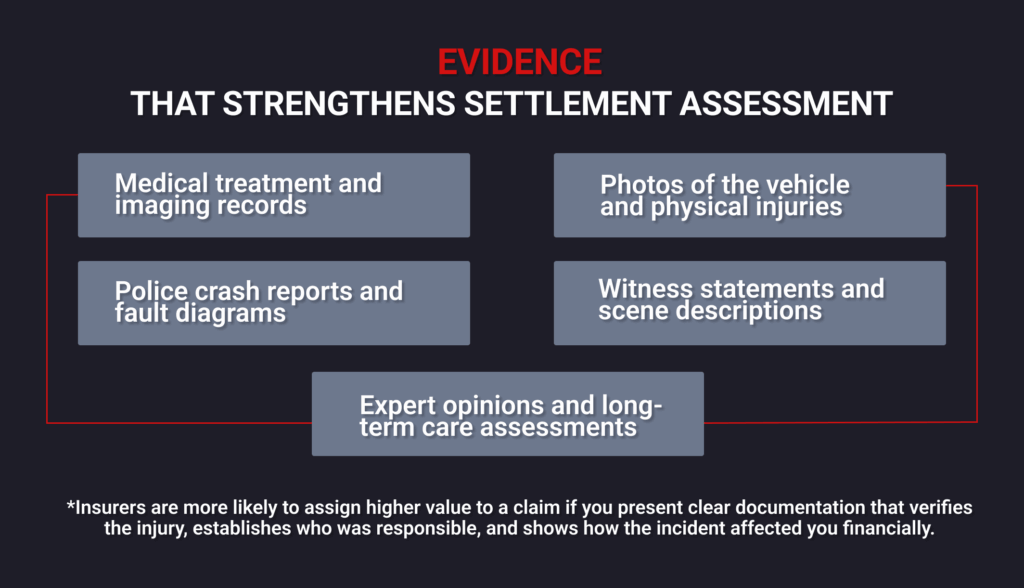
The evidence that proves who had the right of way disappears quickly, so a few steps matter more than the rest:
- Get the police report started. The responding officer’s account of who yielded — and any citation — becomes a key piece of your file.
- Photograph the scene, the signs, and the damage. The point of impact and the position of the stop or yield sign often tell the story better than words.
- Get checked out, even if you feel “okay.” Adrenaline masks side-impact injuries, and a gap in treatment is the first thing an adjuster attacks.
- Watch the clock. Nevada’s deadline to file a personal injury lawsuit is generally two years from the date of the crash under NRS 11.190. Settlement talks don’t pause it.
For the full step-by-step and the rest of the Vegas crash silo, our Las Vegas car accident resources cover it in depth.
Frequently Asked Questions
Can I go to jail for a failure to yield accident in Nevada?
In almost all cases, no. Since January 1, 2023, Nevada treats a standard failure to yield as a civil infraction, not a criminal misdemeanor. That means a civil penalty (generally up to $500 plus assessments) and DMV demerit points, but no jail and no criminal record for the violation itself. Jail only becomes a real possibility when the conduct rises to something more serious — reckless driving, DUI, failing to yield to an emergency vehicle, or a crash that causes a death. If your citation is tied to a serious injury collision, it’s worth speaking with a Nevada attorney rather than guessing.
Does the other driver’s failure-to-yield ticket mean they’re automatically at fault for my injuries?
No, though it helps a great deal. A citation is strong evidence the other driver broke a traffic law, but it isn’t a final ruling on liability, and it doesn’t set the value of your claim. Under Nevada’s comparative negligence rule, the insurer can still try to pin part of the blame on you to shrink your payout. A ticket gets you started; proving the other driver’s full responsibility — and defeating attempts to shift fault onto you — is the actual work of the claim.
Is failure to yield a moving violation in Nevada?
Yes. Failing to yield the right of way is a moving violation. Since 2023 it’s handled as a civil infraction rather than a criminal misdemeanor for most drivers, but it still carries demerit points that report to the DMV and can count toward a license suspension if enough accumulate. “Civil” does not mean consequence-free — it stays on your driving record and can affect your insurance.
Is failing to yield the right of way the same as aggressive driving?
No. Aggressive driving is a separate and more serious offense under Nevada law. It requires a driver to speed and commit two or more other violations while creating an immediate hazard, all within a single mile. A single failure to yield can be one ingredient of that charge, but on its own it’s just a right-of-way violation, not aggressive driving. The distinction matters, because an aggressive or reckless driving charge against the at-fault driver can strengthen your injury claim.

Talk to a Las Vegas attorney who knows how the other side thinks
If a driver failed to yield and you’re the one left injured, the citation on their record is only the beginning — the insurance company still has to be made to pay what your injuries are actually worth. That’s where an experienced Las Vegas car accident lawyer changes the outcome.
Glen Howard built his career defending insurance companies before he started fighting them. At Howard Injury Law, that means we can see the fault-shifting arguments coming and shut them down before they cost you. Not sure you even have a case? That’s exactly what a free consultation is for — we’ll look at the police report, the citation, and your injuries and tell you honestly where you stand. You pay nothing unless we win.
Call (702) 331-5722 or request your free consultation today — and do it before the two-year deadline quietly narrows your options.